
|
Home DH-Debate 14.The Xianbei Peoples 16. A brief History of Denmark |
Jaets can be found everywhere in the Old Norse myths and the later folk tradition. Their origin is extensively described in Gylfaginning, which is part of Snorre's Younger Edda. The Jaets were the first and the original, and they were created independently of the Æsirs' lineage. On the other hand, the Æsirs descended partially from the Jaets. They were the age-old enemies of the Æsirs, but that did not rule out marriage connections. Several Jaets lived among the Æsirs, including Ægir and Loke.
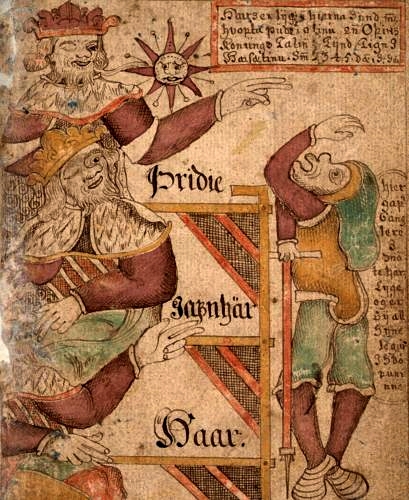
Gangleri talking with the kings Harr, Janharr and Thridi. The kings lack everyone an eye, telling that they are all Odin. From an 18. century Icelandic manuscript that is stored in the Arni Magnusson Institute of Iceland. Wikimedia Commons.
The Swedish King Gylfe was wondering why "The people of Æsirs were so knowledgeable that everything worked out as they wanted. He considered whether it was due to their own nature or whether they were because of the gods to whom they sacrificed." Therefore he disguised himself as an old man and made a journey to Asgård. He called himself Gangleri.
He came to a "hall so high that one could hardly look over it, it's roof was covered with golden shields". He was invited inside and was presented to three chiefs seated in three high seats, one higher than the other. They were called Harr, Janharr and Thridi. They agreed to answer his questions.
Gangleri asked: "Who is foremost, or oldest, of all the gods?" - "Harr answered: He is called Allfather in our speech" - "He lives throughout all ages and governs all his realm, and directs all things, great and small". Janharr added: "He fashioned heaven and earth and air, and all things which are in them." Thridi added: "The greatest of all is this: that he made the man, and gave him the soul, which shall live and never perish, though the flesh rot to mould, or burn to ashes. All men, who have the right faith will live and be with him in the place called Gimle, but evil men will come to the Misty Hel and from there down to Niflhel, and that is down in the ninth world." Later in the story, it becomes clear that Allfather is Odin.
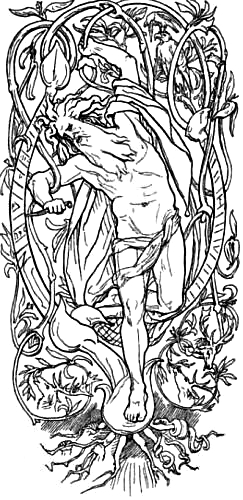
Odin hangs in the world tree Ygdrasil, marked by spear, sacrificed to himself. It is the part of the Nordic mythology, which reminds most of Christianity, namely, where Jesus hangs on the symbolic tree, marked by spear. Drawing by Lorenz Frohlich.
However, the three chiefs' description of the Allfather and his deeds clearly reminds of the Christian God. One can believe it originates in either remains of Aryan Christianity, brought to Scandinavia by returning migration people, or it is a section inserted by Snorri to appease the priests, who were not happy that he wrote about the pagan gods, or that the Christian faith is not as original as we would like to believe.
The chiefs Janharr and Thridi explained Gangleri that at the beginning of times there was nothing, no earth and no heaven, no cooling waves and no grass. There was only a great void called Ginnungagab. The northern part of Ginnungagab was filled with ice and radiated cold while the southern part was burning hot. But where the cold and the heat met each other "was as mild as the still air", and there a human-like creature, called Ymir, was formed, and from him, all Jaets descent, also called the races of the Rime-Turses as it is said in Völuspa:
All Völves
spring from Witolf.
But from Vilmeid
all magicians;
Wizards all
from Svarthøfde.
All Jaets
are Ymir's offspring.
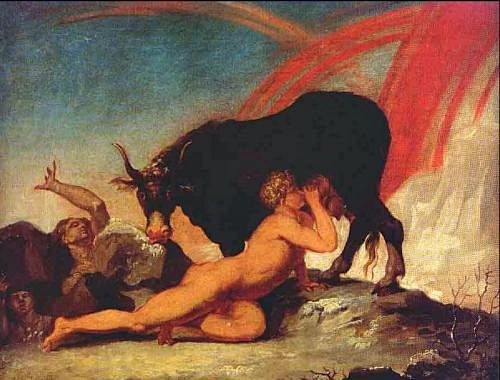
The first Jaet, Ymir, sucks the cow Audhumbla that licks the man Bure out of a salt-stone. Painting by Nicolai Abraham Abildgård 1743-1809. Photo Wikitrans.
They told that Ymir came to sweat while sleeping "and there grew under his left arm a man and a woman, and one of his legs begat a son with the other; and thus the races came that are called the Rime-Turses."
The king Harr told further that Ymir lived on milk from the cow Audhumbla "- from its udder ran four rivers of milk and they nourished Ymir."
Gangleri asked further: "But what did the cow live on?" The chief Harr explained that the cow licked salty stones, thus producing the ancestor of the Æsirs, the man Bure: "She licked the rime-stone, which were salty; and the first day that she licked the stones, there came forth from the stones in the evening a man's hair; the second day, a man's head; the third day the whole man was there. He is named Bure: he was fair of feature, big and strong. He begat a son called Borr."
The three chiefs do not tell how the man Bure got his son Borr, but as the Jaets - called the Rime-Turses - were the only ones that existed besides himself, Bure must have had his son with a Jaet-woman. Borr was the father of the god Odin and his brothers: "he wedded the woman named Bestla, daughter of Bölthorn the Jaet; and they had three sons: one was Odin, the second Vile, the third Ve."
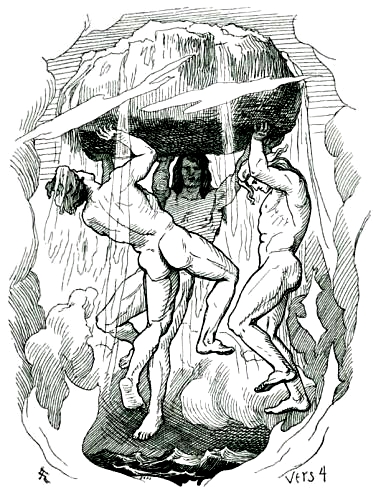
Odin, Vile and Ve create the World of the original giant Ymir's body. Drawing by Lorenz Frohlich.
Bors three sons killed the original giant Ymir, and in the flow of his blood all Rime-Turses drowned except one: "But when he was killed there gushed forth so much blood out of his wounds that therein all the race of the Rime-Turses drowned, except one, who escaped with his household. The Jaets call him Bergelmir; He entered his "ludr" and his wife with him, and they were saved there; From them, the lineages of Rime-Turses descend."
Of Ymir's body Odin, Vile and Ve created the World. His blood became the ocean, his flesh became solid land, the bones became rocks, his skull became the sky, his hair became trees and the brain became clouds. "It is told in ancient poems that from that time we distinguished between day and night and counted years."
It is said in Völuspa:
Of Ymir's flesh
the earth was fashioned,
of his blood the sea;
rocks of his bones,
trees of his hair,
And of his skull the sky.
Both in Younger Edda and even more directly in Ynglinge Saga, Snorre tells that the Æsirs came from Asia. In addition, we must put some meaning in the resemblance of the words Æsirs-Asia. It is further supported by the fact that the Chinese have a very similar myth that the world was created from the body of an original giant.
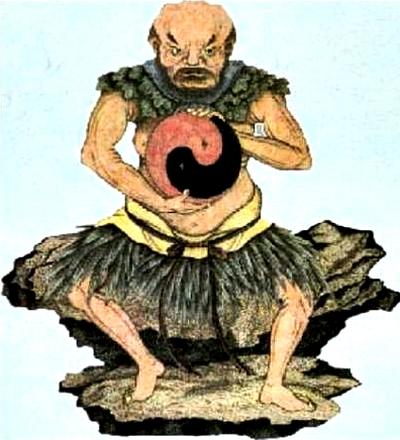
The Chinese original giant Pan Ku.
They can tell that in the beginning, everything was chaos. But when the two opposing forces, ying and yang, met each other, the original giant, Pan Ku, was created. From his own body, he created the earth. The head became a mountain, his breathing became the clouds, and his voice became the thunder. The skin became the plains, the hair became trees, the bones became metals, and the blood vessels became rivers. Of the insects that crawled on his body, humans were created.
Therefore, we must believe that the creation myth of the Æsirs came into being in their original home in Asia.
Many have difficulties to accept such a cultural and ethnic link between Scandinavia and Asia because today we connect Central Asia with Turkish and Mongolian peoples. But it was not always so. A few thousand years ago a very large part of central Eurasia was inhabited by Indo-European tribes. There may have been hundreds of mutually rivaling small kingdoms. In central Asia, we know of the Tocharians from Tarim Basin, and Sogdian, Massagetes and Kushans in present Uzbekistan, Afghanistan and Pakistan. The Persians lived in present Iran. On the central steppe, Alans, Saka, Sarmatians and Scythians lived and most likely countless others.
The ancient Roman geographic Strabo (who lived around the year 0) wrote: "Now the greater part of the Scythians, beginning at the Caspian Sea, are called Däae, but those who are situated more to the east than these are named Massagetae and Sacae, whereas all the rest given the general name of Scythians, though each people is given a separate name of its own. They all for the most part nomads. But the best known of the nomads are those who took away Bactriana from the Greeks, I mean the Asii, Pasiani, Tochari, and Sacarauli, who originally came from the country on the other side of the Iaxartes River." (Strabo, Geography, 11.8.1)
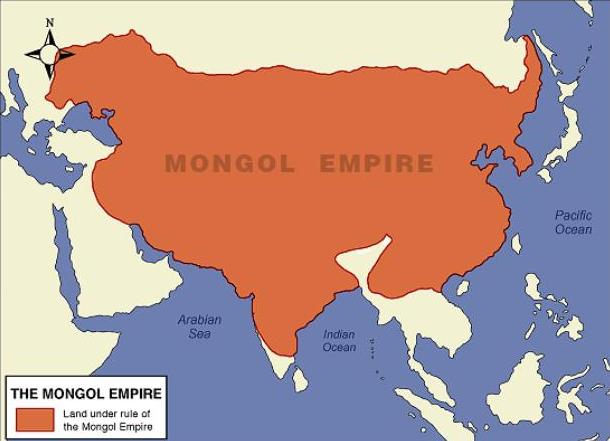
The Mongol conquests in the 1200's. The Muslim expansion in the 600's destroyed Persia, the Sogdian cities in present Uzbekistan and Afghanistan, and many Indian nations. The Mongolian armies in the 1200's completed the destruction of the Indo-European nations in central Eurasia. They killed and destroyed everything on their way on an unprecedented scale. The net result of the Mongolian conquests was a Muslim Central Asia. Map Minneapolis Institute of Art.
We remind ourselves prologue to Pompey Trogus' book XLII, where it says: "Reges Tocharorum Asiani interitusque Saraucarum", "Asiani became kings of Tochari and then wiped out the king of Saka". It may mean that the people "Tochari" chose as their kings a group of experienced and hardened warriors, "Asiani", and then they won victory over their enemies. As Snorre wrote about the Æsirs: "Odin was a great army-man."
But from the 600's came first the Muslim-Arab conquests, which swept across Asia and Africa all the way to Spain, and in the 1200's came the extensive Mongol conquests. The conquerors followed ancient practice killing the defeated men and making their own children on the women, and it is their descendants, who today populate these areas. In this way, Europe and Eastern Asia became completely isolated from each other.
India saw many invasions from central Asia. Shortly after Birth of Christ, a branch of Yuezhi created the famous Kushan empire, which also included northern India. Hephthalites, the White Huns, arrived in northern India around the year 500. Hephthalites originally lived on the steppe as Yuezhi's northern neighbours north of the Tien Shan Mountains of today's Chinese Xin-Jiang province. According to the Indians' own myths, the invaders were Massa-Geates, who also is said to descend from Yuezhi.
|
|
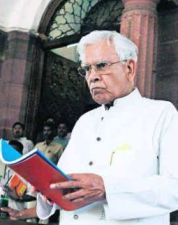
From left to right:
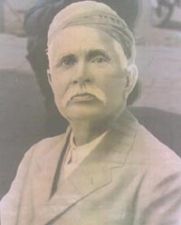
Chaju Ram - a Jat.
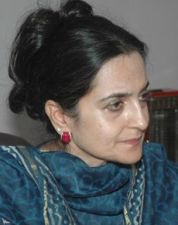
Kiran Choudhury - a Jat.
Malika Sherawat comes from a conservative Jat family.
Jat Sijh.
In India are around 30 million. people, who call themselves "Jat". They live mainly in the northwestern Punjab province. Being a Jat has nothing to do with religion or politics. It is a question of race and ancestry.
A Jat can be Hindu or Muslim, he can have one or another political belief. Most Jats are working with agriculture, but they can be found in all professions, for example as lawyers or businessmen.

Garhwal Rifles is marching on La Basse Road, France, August 1915.
A typical Jat has, after Indian standards, rather light skin, he is tall and strong with caucasian features. In India, they are considered as industrious and rather fast-witted. The Englishmen used many Indian soldiers during the first and second World War, they were very mainly recruited from the Jats in the Punjab province, as they were considered to be the best soldiers.
In general, the "Jats" consider themselves as descendants of the "Yuti" or Massa-Geates people, who came from north to India from the area around the Jaxartes river and in the fifth century crossed Indus, as it is narrated by the French historian, De Guignes (1721 to 1800).
We recall that in "Han Shu" as translated by Daniel C. Waugh in the "Han Histories" the "Yuezhi" is called for "Yue-te", pronounced something like ju-te. In the Xiongnu king Modun's message to the Chinese emperor he states: " - you pursued the Right Sage prince, untill he was driven westward into the territories of the Yue-te. There, however, heaven favoured our cause: our officers and troops were loyal and true; our horses were strong and spirited; and by slaughter, decapitation, subjugation and pacification, our army effected the complete reduction of the Yue-te - "
The letters Y and J can in different languages represent the same sound and the same applies to Y and U, so it is not unreasonable to think that Jat or Jaet is derived from Jye-te, who by the Chinese were called Yuezhi.
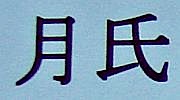
These are the Chinese characters for Yuezhi. The first sign means "moon". The second sign says "zhi", something in the direction of "member of" or "supporter of". In the old days, the daughters of a Chinese family often did not have a name, they were only girls, they were content with a number. When such a girl got married to another family, such as "Wang", this sign was used and the girl was called "Wang Zhi". Apparently, Yuezhi worshipped the moon.
But one can also imagine that the Chinese heard the word for Yuezhi's name and then described the sound with some characters that reepresented words that sounded like or almost sounded like the name, even though their true meaning was something else. Which means we can not feel completely sure that Yuezhi worshipped the moon, even though the sign means moon.
Therefore, the Indian Jats believe that they are named so because Jats were the first and the original who came from Central Asia - just as the Æsirs thought the Jaets were the first. Which brings one's thought to that the Æsirs, like so many other Indo-European people in Central Asia, may have descended wholly or partially from Yuezhi, whose real name may have been something like Jat, Jut, Juti, Jæt or Jæti.
Kushans, Sogdians and Massageates all claimed that they descended from Yuezhi, who were thus also to them the first and original. The Æsirs came from Asia to Scandinavia and they claimed that they descended from the Jaets. Therefore, one might think that Yuezhi, also called Yüeh-Chih, Yue-te or Jue-te, were Snorre's Jaets - the first and original.
The Edda says:
I remember Jaets
born in ancient days
those who in the past
raised me;
nine worlds I remember,
nine Jaet-women,
and the widely famous tree of destiny,
hidden underground.
(Vøluspa in Older Edda)
|
History and Study of the Jats Prof. B.S. Dhillon. Jat people & Noun Etymology of Jat Jatland.com Forum Her begynder Gylfis Øjenforblindelse Heimskringla Vølvens Spådom Heimskringla. The etnic of Sakas (Scythians) by I. Piankov - Iran Chamber Society. The Peoples of the West - Draft English translation by John E. Hill Washington.edu. The Western Regions according to the Hou Hanshu - Translatet by John E. Hill Washington.edu. Selections from the Han Narrative Histories - translated by Daniel C. Waugh. Washington.edu. Strabo Geography Book XI, Chapter 8 penelope.uchicago.edu. Gylfaginning Sacred Texts |
| To top |
