
|
Home DH-Debate 35. Canute the Sixth 37. Erik Ploughpenning |
Valdemar the Victorious ruled Denmark for 39 years. He is one of Denmark's famous kings. The byname Victorious he first earned in the 1500's because that time historians noticed that he expanded his kingdom's territory to an unprecedented extent at the expense of the Empire and the North German princes.
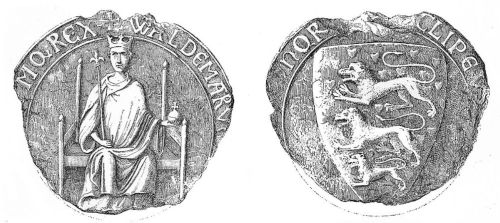
Valdemar the Victorious' seal. He holds the lily scepter in his right hand, which symbolizes the Trinity and the right Catholic faith. In his left hand he holds the royal apple. He continued the three lions among hearts as the Danish coat of arms. Photo Wikipedia fra Nordens Historie af Niels Bache fra 1885.
As Duke of Slesvig, he conquered Holsten and Lauenborg. As king he consolidated the territories in northern Germany that his brother Canute the Sixth had won. Exceptionally, the new German-Roman emperor Frederick 2., in writing approved Danish supremacy along the Baltic coast, including Holsten, Lübeck, Mecklenburg and Pomerania. But the Danes only got 9 years in Paradise, then Valdemar and his son were taken captive during a hunt on the island of Lyø, and Frederick revoked his approval and demanded the prisoners to be extradited. He wrote to the Bishop of Hildesheim: "As you yourself know, this king has without cause taken much of the Empire's land without, as he should, to recognize Us and the Empire. We therefore ask and remind you that you use every effort in that the king himself and his son must come into your hand."
During Valdemar's and his son's captivity by the Count of Schwerin, the Danish dominion in Northern Germany completely collapsed, so to speak without any fighting, and the border of Denmark again was along the river Ejder, where it always had been. After he was released from his captivity, Valdemar sought to regain the lost land, but suffered defeat in the Battle of Bornhøved in Holsten.
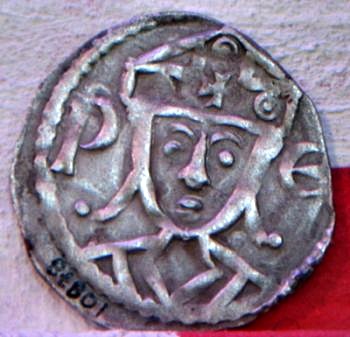
Coin from Valdemar the Victorious' time exhibited in Lunds Universitets Historiska Museum. Photo Hedning Wikipedia.
However, thanks to the Pope's support, he managed to maintain the dominion of Estonia.
The king was not spared personal hardship during his long reign. His young Queen, Dagmar, died after a few years of living together, probably in childbirth. His son with Dagmar, Valdemar the Young, died from an accidental shot during a hunt shortly after his wife Leonora had died in childbirth along with the baby.
Valdemar was a great legislator. He gave Valdemar's Sjælland Law. His greatest achievement, however, was Jutland Law, which he gave in his last year of life.
During Valdemar's reign, large parts of the kingdom were allotted to fiefs to royal princes, who were not expected to inherit the crown, thereby reducing the kingdom's revenue accordingly. The widespread custom of giving land to the churchs and monasteries for the sake of the givers' soul peace had the same effect.
|
|
Royal dynasties in Denmark's history. However, all kings - except Magnus the Good - descent from "Hardegon, son of a certain Sven", who conquered a big part of Jutland in 917, astold by Adam in his section of bishop Hoger. But it gives a good overview to divide the line of kings - and thus the history of Denmark - into manageable sections. The line of kings and tales of war and peace is the backbone of history - not so that accounts of culture and ordinary people's living conditions are not important, but without the line of kings they can easily become unstructured tales that are not easily placed in time.
The Knytling genus got its name from Hardecnudth, most likely son of Hardegon. He is also called Canute 1. and was Gorm the Old's father as told by Adam in the section of Unni. Magnus the Good, who was king in 1047, was the son of the Norwegian saint king Olav; his reign forms a transition period to Svend Estridsen and his sons' and grandsons' time.
The warring kings, Svend, Knud and Valdemar, around 1157, were all descendants of Sweyn Estridsson; their time was an interregnum to the Valdemars' era.
Many historians, possibly most, include only Valdemar the Great, his son Canute the Sixth and Valdemar the Victorious to the Valdemars. But one cannot claim such a definition, and it seems appropriate for the author to also include their less successful descendants - including Erik Plovpenning, Abel and Christoffer 1. - until Christoffer 2. who was the last king before Denmark's time without kings around 1340.
Valdemar Atterdag was not king of the Kalmar Union, but his grandson, Olaf, was, and his daughter Margrete 1. became the reigning queen of the Scandinavian Union. One can say - with some good will - that Valdemar Atterdag reestablished Denmark and thus the possibility of the Kalmar Union with Norway and Sweden.
The early Oldenburg kings were also Union kings but only for short periods.
The Civil War, the Count's Feud, in 1536 was a crucial turning point in the history of Denmark. As a consequence of the Lutheran Reformation, which took place at the same time, the kings confiscated the third part of Denmark's agricultural land that belonged to the church. This amazing wealth made it possible to cue Denmark's old nobility and create the absolute monarchy, which was a decisive reason for Denmark's historical decline. In 1848, a democratic constitution was introduced without civil war or other acts of violence.
The Oldenborg dynasty became extinct in 1863 with the childless Frederick 7. The throne was then taken over by Christian 9 of Glücksborg.
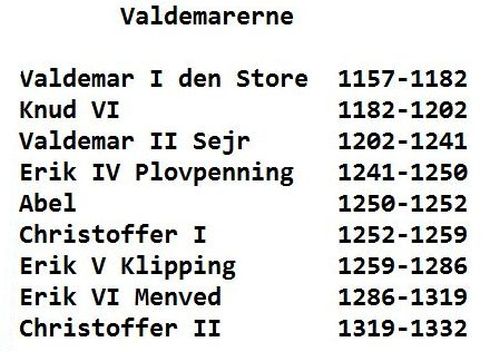
The Valdemars. It is customary simply to regard Valdemar the Great, Canute the Sixth. and Valdemar the Victorious to the Valdemars. But in doing so, their less successful descendants become educationally homeless, despite being direct descendants of the first Valdemars, and they are not separated from these by any natural transformation period. Therefore, I would suggest that until the kingless time the whole group to be called the Valdemars.
Erik Plovpenning, Abel and Christoffer were sons of Valdemar the Victorious and succeeded each other as kings. Abel probably killed his brother Erik and immersed his body in Slien. However, 24 knights swore that Abel was innocent and therefore he could still be elected king. However, shortly after he was killed in battle during a campaign in Frisia, his little brother Christoffer was chosen as his successor as king, and the eldest son of the deceased Abel was bypassed. This led to a long-standing rivalry between the descendants of Abel and the descendants of Christoffer in the following decades.
Christopher's son, Erik, who later was bynamed Klipping, became king only 10 years old with his mother Margrete Sambiria as guardian. The chieftains limited his power with a charter of rights at the Danehof meeting at Nyborg Castle, which, among other things, stated that the meeting of the king and the great men, who was later called the Danehof, should be the country's highest court. Furthermore, it was held that the royal court should not deal with cases which had not previously been presented to another court and that it should only impose standard penalties. Erik was killed in Finnerup Lade near Viborg with 56 stab wounds - one of the great mysteries of Danish history. His son Erik Menved tried to create goodwill and increased influence in Northern Germany by holding some magnificent knightly tours. He was followed by his brother, Christoffer 2. who had to take over the brother's large debts, while he was blocked the possibility of increasing the crown's income by a charter. When he died in 1332, no new Danish king was elected, and the country was for a period kingless.
When he was alive Valdemar did not have the byname the Victorious, that he got first in the 1500's because that time people believed that he had expanded the territory of Denmark more than other kings, they did not take into account that he lost even bigger territories.
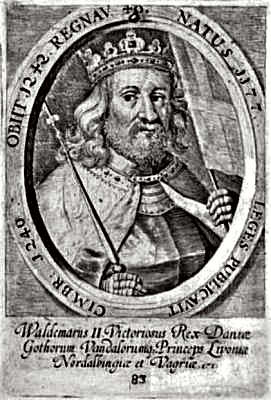
Valdemar the Victorious on copper engraving from 1685. He holds the Danish flag, Dannebrog in his left hand. There is, in all probability, no portrait likeness. Photo Det Kongelige Bibliotek.
Valdemar the Victorious was a far more colorful and outgoing type than his big brother Canute the Sixth, in fact his direct opposite. Svend Aggesen was greatly impressed by the charming young duke, he writes: "The King's brother Valdemar, a young man with the most wonderful aptitudes."
The new king seems to have been very popular since he was elected in complete agreement. Arnold says: "With great agreement he was then elected king, received at Christmas time the crown in Lund by Archbishop Andreas and was exalted with splendor to the royal throne."
He was personally brave and participated in the fighting in person. Thus he lost one eye in the battle of Bornhøved.
Valdemar was restless and impatient. In connection with his siege of the fortress Sygeberg in Holsten, Arnold of Lübeck writes: "Therefore, the Duke (Valdemar), who, for his part, could never find himself lying idle, let built ramparts around the fortress, thereby making any sortie impossible and pressing the defenders hard." By all accounts, he had the castle completely in his grip, the crew had no chance of rescue, and he could just wait for the surrender, but impatient as he was, he let the defenders get away so that each of them could "keep their inheritanced estate and lands unreduced, further they should be allowed freely and in all respects unimpeded to include all their household effects as well as everything else in the castle belonging to them."
Valdemar repeatedly released prisoners whom he himself had fought and humiliated, and who had reasons to hate him deeply.
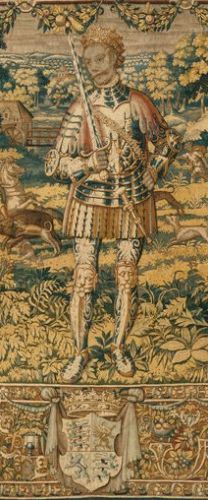
Valdemar the Victorious on the Kronborg tapestries. The Kronborg tapestries were 43 tapestries, commissioned by Frederik 2. and woven 1581-86 to the Dancinghall in Kronborg. The tapestries were designed by the Dutch painter Hans Knieper and show the entire Danish line of kings until Frederik 2. Only 15 of the tapestries are preserved, the seven hang at Kronborg and the rest are at the National Museum. Photo Det Kongelige Bibliotek.
He released Adolf 4. of Holsten from his captivity in Søborg castle against obtaining the castle of Lauenburg, though he himself had humiliated the same Adolf at his original capture, as Arnold tells: He "chained him hand and foot, led him not without dishonor through all the places he had previously ruled, and came to Danien as a poor prisoner, and when the Danes heard that their enemy was captured, they celebrated it like the Philistines of Saul's time in all cities and towns all to the delight and joy of the heart." In the deep of his heart Adolf must have hated Valdemar, and it was also this Adolf, who came to be in charge of the army that in the battle of Bornhøved finally ended the Danish domination in northern Germany.
Arnold says that Valdemar - around 1207 - attacked Count Henry of Schwerin and his brother Count Guncelin and ravaged their country because of a trivial matter: "The king also had a feud with Count Guncelin of Zverin and his brother Henrik, who had offended him by expelling Johannes with the byname of Gans of the land and violently taking possession of his castle Grabove. For he sent out an army under Albert, which he had appointed to count of the Nordalbingien (The land north of the river Elb), first destroying their castle Boyceneburg, and then irretrievably ravaged the whole country of Zverin." The Valdemar yearbook tells that again in 1214 Valdemar was on the war path in Schwerin as he captured and destroyed the fortress of Wotmund, and Count Gunzelin and Count Henrik of Schwerin had to take their land as a fief of the Danish king.
The same Henry of Schwerin used his knowledge that Valdemar and his son, Valdemar the Young, were hunting on the island of Lyø to capture both Valdemar and his son - while sleeping in their beds - to irreparable harm to Denmark.
Valdemar the Victorious was a tall man who towered a head above many of his contemporaries. At the opening of the royal tombs in Ringsted Church in 1858 his bones were measured and one could conclude that he had been 184 cm tall.
In the summer of 1203, immediately after his royal coronation, Valdemar returned to Holsten with an army to complete the work, by conquering the castle of Lauenborg. Arnold says: "After these precautions were taken, King Waldemar came in August with great splendor and a countless retinue to Lubeka, where he was greeted with much joy as the King of Danes and Slaws and the lord of Nordalbingien. From there, he, accompanied by Lund's Archbishop and his brother Peter of Roskilde, as well as the other bishops, provosts and noble men from Nordalbingien, Thietmarcien, Slavonia and the land of the Rugians, to Louenburk, around which he most vigorously let built ramparts; a camp was built, assault machines in abundance, siege machines and the like were erected, cross-bow shooters and archers kept continuously the castle's crew busy, and both parties had in these skirmishes both wounded and fallen." After some time, the castle's crew asked for negotiations, and it was agreed that the defenders would surrender the fortress if Count Adolf was released from his captivity in Søborg "and the Count gave hostages to get free. As hostages, the Count placed his two sons, his uncle Ludolf of Dasle's son, Count Henry of Dannenberghe's son, and eight sons of his sheriffs."
The political situation in Germany was such that the dispute between the Emperor Frederick Barbarossa and Duke Henry the Lion was continued by their sons. Most princes in southern Germany had chosen the emperor's son, Philip of Swabia, as king, while the northern princes in particular supported the son of Henry the Lion, Otto 4. who was declared German Roman emperor in 1209.
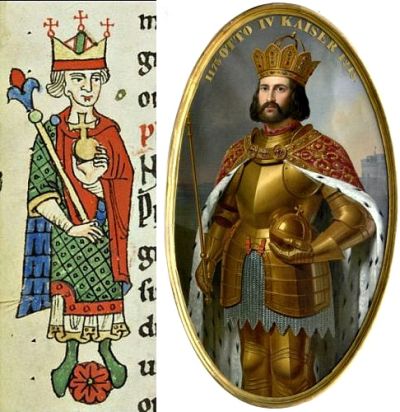
To the left King Philip of Swabia. Which had the title king from 1198 to his violent death in 1208. He was the son of Frederick Barbarossa. He was never elected emperor.
To his right his rival Otto 4. who was the son of Henry the Lion. He had the title of king from 1198 to 1209, which year he was named German Roman Emperor, which he was until his death in 1218.
There is probably no portrait likeness.
Valdemar the Great in his time cooperated with Henry the Lion, but had a few meetings with the Emperor, Frederick Barbarossa, after Henry's fall and exile. Canute the Sixth consistently supported the opposition against the Emperor and "Teutons", thereby winning the Slaws devotion. To begin with, Valdemar the Victorious also supported Henry the Lion's son Otto 4. It is stated in the Valdemar yearbook that in 1209 Valdemar sent his armies to Braunschweig to help Otto 4. against Philip, and that he on his own expense transferred King Otto from Ribe to England. Valdemar allegedly built the fortress of Harburg south of the Elbe in modern Hamburg as a defense against a possible attack by Philips.
But the murder of Philip of Swabia in 1208 changed the situation. With one stroke Otto 4. became the only candidate as German emperor, and he was crowned emperor by the Pope in Rome in the 1209.
However, Pope Innocens soon became filled with resentment against the new emperor, who did not keep the promises he had made prior to the emperor coronation. Already in 1212 the Pope proclaimed Frederick 2. of Sicily as the new emperor. Now there again were two rival rulers in the German-Roman Empire.
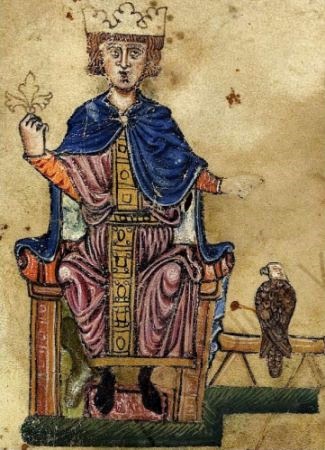
Illustration in the book "De arte venandi cum avibus", the art of hunting with birds, written by Frederick 2. of Sicily himself.
Originally, Frederick was King of Sicily that the Normans had made into a European model state, a centrally controlled kingdom with effective management. Frederick was of the genus Hohenstaufern, but also a grandson of the Norman King Roger 2. Frederick considered himself a successor to the Roman Emperors of Antiquity. He reportedly spoke six different languages, namely Latin, Sicilian, German, French, Greek and Arabic. From about 1220 until his death, the court in Palermo was home to the first literary use of a Romanesque language represented by Sicilian. Dante and his contemporaries admired the school's poetry. He was married three times and had countless mistresses. Frederick went on crusade twice. The philosopher Nietzsche called Frederick the first European.
Frederick's empire extended from his residence in Sicily through Italy to Germany and all the way to the border with Denmark, for a period it also included the Kingdom of Jerusalem. According to the historian Norman F. Cantor, he was not particularly interested in Germany.
Photo from a copy of the book in the Vatican Library - Wikipedia.
Denmark had a long tradition of maintaining a good relationship with the pope as a counterbalance to the emperor's power, a relationship in which both the pope and the Danish kings saw their advantage. Sweyn Estridsson and his sons and their descendants, for example, had been members of an international network of princes and kings, who called themselves Saint Peter's Vassals. Denmark and Valdemar now faced a dilemma. He now had to choose between the pope - in the form of Frederick 2. - and his traditional ally personified by Henry the Lion's son, Otto 4.
But in a short time, the problem resolved itself. As Otto, as an Emperor, saw with less sympathy on the Danish power in Holsten and Mecklenburg, and joined alliances with Denmark's former enemies, Count Adolf of Holsten and the Mark Count of Brandenburg. In 1214 the mark count crossed the Elbe and took the fortress Passewalk and the town of Stettin, which the Danes, however, quickly took back. It was also on this occasion that Valdemar captured and destroyed the castle of Wotmund in Schwerin.
Following his appointment as Emperor, Otto IV also complicated his relationship with Denmark by supporting Denmark's enemy, Valdemar Knudsson's return to the Hamburg-Bremen Diocese, where he for a long time maintained his power and played a not minor political role, also in relation to the Danish possession, Hamburg, very close to Bremen.
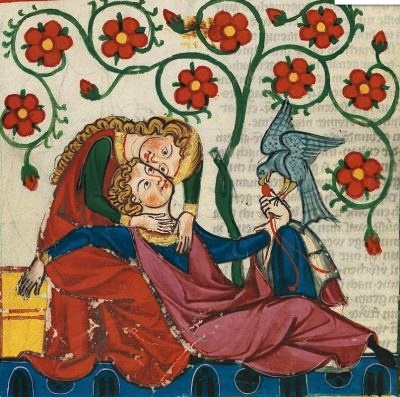
Frederick 2. and Bianca Lancia. A roughly contemporary depiction of Emperor Frederick 2. with his favorite mistress, Bianca Lancia. Photo Codex Manesse, fol. 249v: Konrad von Altstetten. Wikipedia.
These military fightings and political intrigues, which took place shortly after Otto 4's appointment as emperor, make it likely that Denmark fairly quickly changed sides from Otto 4. to Frederick 2.
For Valdemar, it should prove extremely fortunate that he had switched sides in time and joined the Pope's and Frederick 2's party. Already in March 1214 in Metz, Emperor Frederick 2. issued a document granting Valdemar the right to all areas that "belongs to the German-Roman Empire beyond Elde and Elbe". In the Emperor Frederick 2's diploma, it is said, among other things: "We have made everlasting and unmistakable friendship with Our dear Mr. Valdemar, the very Christian King of the Danes" - "conferred to him and his kingdom all the land beyond the Elde and Elbe which belong to the German Roman Empire, and which Canute 6, offended by the much wrongdoing that had befallen him, with his brother, the already mentioned Valdemar, acquired by force of arms and possessed. To this must be added all that King Canute has acquired and possessed by his father's and his own efforts in Venden. We affirm the above by this letter of privilege and its attached princely seal."
Valdemar may have known Frederick 2.'s inconstancy, at least he immediately secured himself a confirmation from the pope: "Our very dear son in Christ, Frederick, King of Sicily and German-Roman emperor", in order to maintain peace between the empire and Denmark, all lands on the other side of the rivers Elde and Elbe have transferred to the kingdom of King Valdemar. This transfer, made in the interest of peace by Frederick 2. following the advice of the German princes and with their approval, confirmed the pope with apostolic authority and "confirms with this letter" - "It must under no circumstances be allowed any man ignore this our confirmation letter or in foolhardy daring to act against it." When Innocens died in 1216, Valdemar immediately secured a new confirmation letter from his successor Honorius 3.
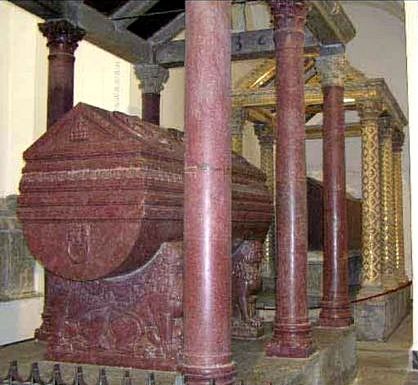
Frederick 2. sarcophagus in the Cathedral of Palermo - In the background Roger 2's sarcophagus. Photo Benutzer:burgkirsch Wikipedia.
However, the deposed emperor Otto 4. was not bound by the promises of Frederick 2. Ryd
Monestary Yearbook tells that he advanced into Holsten in 1215. But when Valdemar went against him with a Danish army he withdrew without a fight. It is believed that it was in particular a Pfalz-count, Henrik, from the area around Hamburg who had provided soldiers to Otto 4.'s army. We remember that it was precisely around Hamburg that Valdemar had built the fortress Harburg on the southern bank of the Elbe. The same yearbook tells about the year 1216: "When the frost made it possible to pass the Elbe, Valdemar went over with his army and plundered and burned the lands of the Pfalz-count Henry until the inhabitants entered into an agreement with the king; they paid money, gave hostages and promised that they would never stand up to him again."
The Mark Count of Brandenburg, who had crossed the Elbe and had attacked the Danish territories in 1214, changed side to Frederick 2. - probably forced by necessity - and therefore he had to reconcile with Valdemar. A marriage was agreed between the daughter of the Mark Count and a son of the King's nephew Count Otto of Luneburg.
In 1200, a canonicus from Bremen named Albert went ashore at the mouth of the river Dvina and founded the town of Riga a little up the river. Albert came from a distinguished German family and could have had a brilliant ecclesiastical career, but he chose to go to the Wild East. He was well prepared and had secured the support of the Pope and Philip of Swabia in advance. He had also been in Denmark and talked to Valdemar and the archbishop of Lund. Albert did not come alone to Dvina's mouth, he had assembled a small crusader army.
|
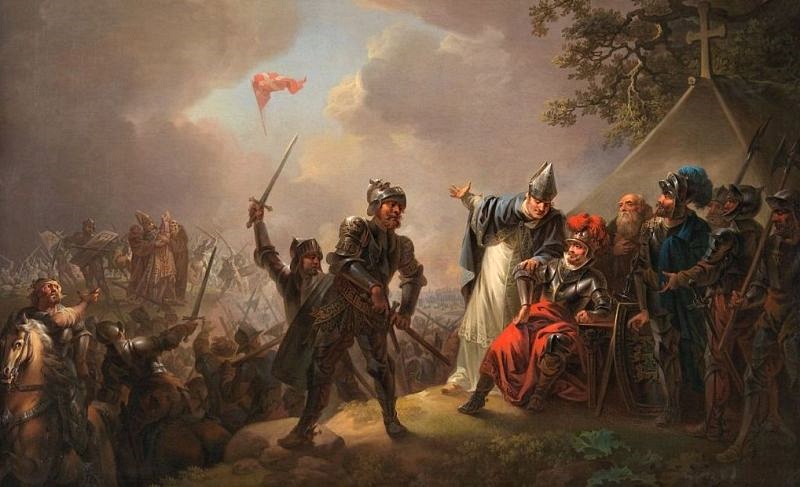
Dannebrog (Danish National flag) falls from the sky in the Battle of Lyndanisse 1219. The Roskilde Bishop Peder Jacobsen informs Valdemar the Victorious. Left in the background is seen Archbishop Anders Sunesen. Painting by Christian August Lorentzen 1809 - Wikipedia.
Very quickly many more crusaders flocked from Germany to Albert's small army, and Riga became a German city. In 1202, Albert founded the Order of the Swords, which quickly captured most of Livland and got most of the population baptized. In 1207, Albert was appointed German Reign prince and took his land as a fief from Philip of Swabia. Then the Swordsmen began to take an interest in the country north of Livland, namely Estonia.
The Order of the Sword later became part of the Teutonic Order also named Ordo Teutonicus.
Around 1206, Pope Innocens III wrote to Archbishop Anders Sunesen: "Since you in your righteousness and piety intend to attack the injustice against Christianity, and since you have sincerely decided to go against the heathens, we grant you by this letter authority to ordain a believing bishop in a city that you with Christ's help can win for the worship of the Christian faith after the dirt of the heathens has been removed." This meant that all cities and lands that the Danes conquered and Christianized in the future, with the Pope's blessing, could be placed under the archdiocese of Lund. This letter is believed to have been the signal for renewed Danish efforts to gain a foothold in the Baltic countries, especially Estonia, which the Brothers of the Sword had not yet conquered. Already that same year, Anders Sunesen himself led a raid to Estonia.
It is said that Bishop Albert of Riga was present at Valdemar the Young's coronation as Valdemar the Victorious' co-king in Slesvig midsommerday 1218. Here he asked the king to subdue Estonia.
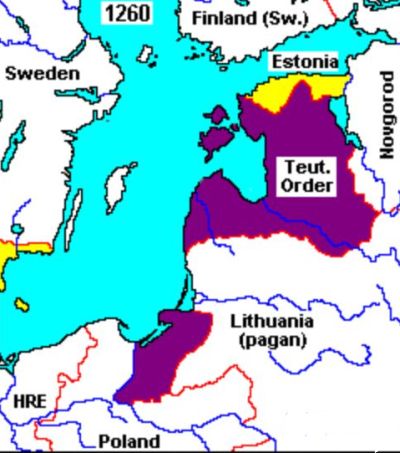
The Duchy of Estonia was part of the Danish kingdom from 1219 to 1346, when Valdemar Atterdag sold it to the Teotonic Knights, "Ordo Teutonicus", to get money to redeem other parts of the Kingdom. Photo WHKMLA Historical Atlas.
Next year, 1219, the king sailed to Estonia with a large fleet, which went ashore at later Tallin. The country's northern provinces, Reval and Harrien, submitted without a blow of swords, and everything seemed to be going well. However, the Estonians had secretly assembled a large army and on June 15, they fell upon the unsuspecting Danish army at Lyndanisse, thus launching the legendary Valdemar Battle. Prince Vitslav and the Rugen-warriors stopped the Estonians as the first ones. This gave the Danes time to get their ranks in order and, after a long and bloody fight, the Estonians pulled the shortest straw.
From this battle the legend origins that the old Archbishop Anders Sunesen prayed for Danish victory with his arms up, but when he grew tired and his arms sank, the Estonians advanced, but when he again raised his arms to heaven the Danish army again pushed forward.
It is also said that it was in the middle of this battle that a flag fell from the sky - a red cloth with a white cross - and a voice was heard saying that when this flag was raised the Danes would have victory.
Valdemar let built a castle and left a crew in it. New Estonia expeditions in the following years consolidated the Danish rule.
In the year 1223 both Valdemar the Victorious and his son Valdemar the Young were abducted. The kidnapper was Count Henry of Schwerin, who demanded a formidable ransom of 40,210 marks. The two kings were held captive for nearly three years until finally released by payment of the ransom.
|
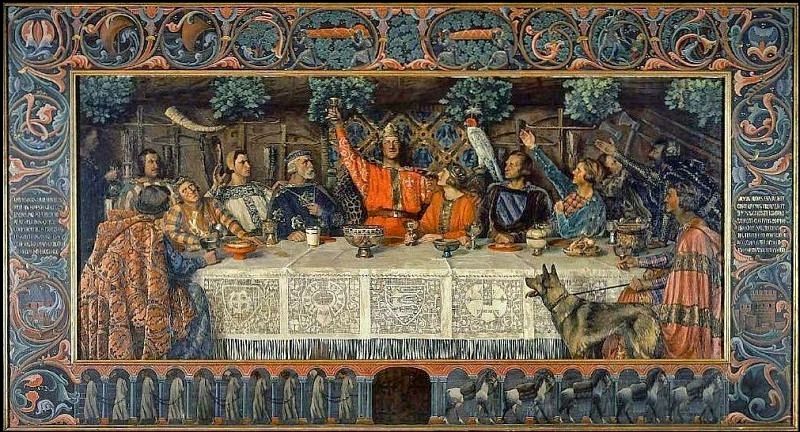
The hunting dinner by Agnes Slott-Møller 1862-1937. Photo Tutt art pitturas cultura poesia musica.
Ryd Monastery Chronicle writes for the year 1223: "King Valdemar and his son - Valdemar the third - was by Count Henrik apprehended in their bed on Lyø and their hofsinde betrayed them on Saint John by the Latinergates day. They were taken to Vendland and were in Schwerin for almost 3 years, but the Danes bought their freedom for 40,210 Lübeck mark." and onwards the following year: "The Danes and other courtly men donated the horses and clothing with which the Danes honored the most excellent men in Germany on the day they parted with the king. These things had the double value of what they bought him with. And you should know that the Germans have rarely or never won any honor or victory over the Danes, without it have been done with fraud and deception, as can be proved by these two kings and in many other respects."
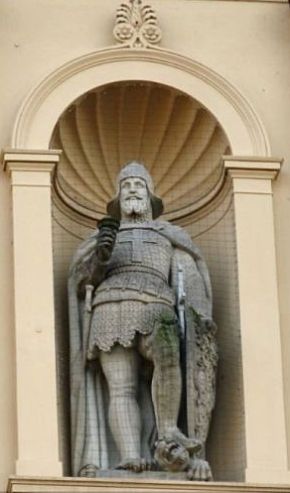
Statue of Count Heinrich of Schwerin in the facade of Schwerin Castle made by Gustav Willgohs in 1855. Photo Niteshift Wikipedia.
Historian Hal Koch writes that a German yearbook provides more detailed information. Count Henry of Schwerin was the king's man and had sworn loyality to him. He was the king's guest at a hunt on Lyø. In the evening they had eaten and drank together, but in the morning afterwards Henrik broke into the tent, where King Valdemar was sleeping on the same bed as his 14-year-old son, Valdemar the Young. The Count captured them both and carried them away on his ships after rendering the royal ships useless. Schwerin was still on Danish hands, which is why he initially brought them to the castle of Lenzen near Hamburg, later to Dannenberg still on the south side of the Elbe, and then eventually brought them to Schwerin.
Count Henry of Schwerin was not an unknown person. Valdemar had previously had many outstandings with him, all of which had fallen to Valdemar's favor.
Arnold tells that Valdemar - about 1207 - attacked Count Henry of Schwerin and his brother Guncelin and ravaged their land because of a negligible case: "The king also had a feud with Count Guncelin of Zverin and his brother Henrik, who had offended him by expelling John by the name of Gans of the land and violently taking possession of his castle Grabove. For he sent out an army under Albert, which he had ordained to the counties of North-Albingien, first destroying their castle Boyceneburg, and then irretrievably ravaged the whole country of Zverin."
The Valdemar yearbook tells that again in 1214 Valdemar was on the war path in Schwerin, taking and destroying the fortress of Wotmund, and Count Gunzelin and Count Henrik of Schwerin had to take their land as a fief of the king.
In the same year - 1214 - the Counts' sister, Oda, had married Count Niels 1. of Halland, Valdemar's son out of wedlock, and he had received half of the county of Schwerin as security for the dowry. In 1222, Count Henrik returned from his participation in the 7. Crusade and found that his brother, Gunzelin, and his brother-in-law, Niels of Halland, had both died the year before and Valdemar the Victorious had taken on the guardianship of his minor grandson, Niels of Halland-Schwerin, and appointed his nephew, Albert of Orlamünde, as governor and commissioned him to redeem the security.
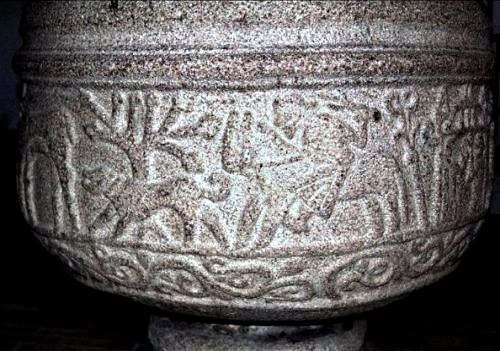
Romanesque baptismal font in Lime Church east of Randers with hunting scene. Photo Nordens Kirker.
Count Henrik as a guest in the kings' hunt on Lyø - as it is said in the "German source" - is an absolutely fantastic story: Both the king and his son and co-king had a real men's event - a hunt on the island of Lyø with subsequent dinner - without effective bodyguards - along with a man who had numerous good reasons to hate the king heartily, and afterwards they went to sleep, after the description with Count Henrik in the neighboring tent. Can that really be true?
Ry Monastery Yearbook writes: "and their own hofsinde betrayed them." Wikipedia and many other sources agree that a "hofsinde" was "a noble boy or young man doing paid service at the court" - A relatively minor position. Thus it is also described in Olav Tryggvasson's Saga in the account of Vagn, who is afraid that his beautiful hair will be soaked in blood when he is decapitated: "One of Håkon Jarl's hofsinds then grabbed his hair with both hands." Therefore, Count Henry can not be said hofsinde.
Ry Monastery Yearbook does not mention anything about that Count Henry was formally present on the island of Lyø - for example invited to the hunt. It only says that the kings "were by Count Henry apprehended in their bed on Lyø and their hofsinde betrayed them on Saint John on the day of the Latin gate." Which suggests that Count Henrik was merely aware that the king and his son were hunting together on Lyø on 6-7 of May, and this knowledge he had from a connection with one of the king's subordinates
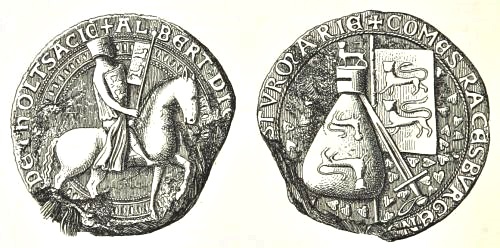
Albert of Orlamunde's seal. The text says: "Albertus Dei gratia comes Orlamunde et Holtsacie", comes Racesburgen et Sturmarie. Photo "Danmarks Riges Historie af J. Steenstrup, Kr. Erslev, A. Heise, V. Mollerup, J. A. Fridericia, E. Holm, A. D. Jørgensen.
The likely scenario is that Count Henrik, with a few flat-bottomed ships, ran up on the beach at Lyø in the early morning. The king, his son and most others slept safely - after the hunt and a good dinner the night before - in the awareness that they were staying on a deserted island far from friends and enemies. Possible guards were effectively overpowered. The count seized the two sleepy royals, destroyed the Danish ships and sailed away again.
The Emperor, Frederick 2. responded quickly and wrote to the Bishop of Hildesheim: "Our High Majesty has been informed that the King of Denmark has been taken captive and held in prison by our beloved and faithful man, Count Henry of Schwerin, as you yourself know, this King has without cause seized much of the land of the Empire without, as he should, recognizing Os and the Empire. We therefore ask and remind you that you will make every effort that the King himself and his son should come into your hand, and likewise that you, along with the venerable Bishop Otto of Wurzburg, promise Count Henrik as much for his prisoners as they have offered him a ransom."
The Count and the Emperor negotiated an agreement which required the prisoners to be handed over to the Emperor against the Count getting 52,000 pounds of silver and being granted a castle, as well as the Emperor building him another castle and obtaining his mother-in-law's goods back. In addition, the Count was guaranteed that he and all the other North-German princes would regain all their old rights when they succeeded in chasing the Danes away.
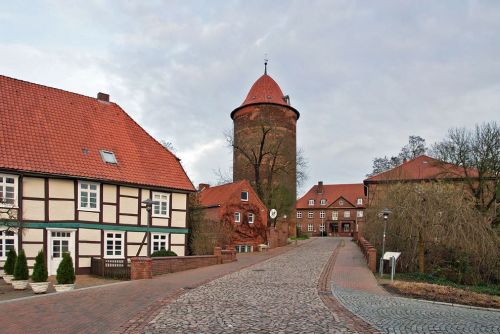
The Valdemar tower in the former castle Dannenberg on the southern bank of the Elbe about halfway between Hamburg and Berlin, where Valdemar the Victorious and his son were held captive. Foto Wikiwand.
This suggests that Valdemar had not only incurred the Count of Schwerin's enmity, but also many other North German princes'.
But the pope would not fail his Danish ally. He wrote to Count Henry and threatened to put him in interdict: "You have put a big and ugly stain on your honor". Within a month he was to release the king and his son. The Pope sent similar letters to the Archbishop of Cologne, the Emperor, the citizens of Lübeck and the Bishop of Verden in whose diocese the prisoners stayed.
However, the Pope had no armed forces at his disposal, as the Count and the Emperor had, and the royal prisoners were not released. But Count Henry no longer wanted to hand them over to the Emperor, he himself wanted to receive the ransom from the Danes.
It was Count Albert of Orlamunde who negotiated on behalf of Denmark. In 1224, the parties were finally close to a negotiated settlement. The agreement represented a complete destruction of Valdemar's rule in Northern Germany. The King was to pay 40,000 marks of silver to Count Henry, all of North-Albingien (the area north of the Elbe) to be handed over to the Emperor, all princes who had sworn loyality to him should be released for their oath - and the worst - "Still, the lord king must receive the Kingdom of Denmark as a fief by the Emperor.".
The German negotiators elaborated in great details Valdemar's weak point, namely a promise to the Pope that he would go on a crusade, not only to Estonia but to the Holy Land. They specified that Valdemar had promised to leave his kingdom for two years and lead 100 ships, viking ships and cogs together, on his journey. If the king died or was otherwise prevented, he would have to pay 25,000 marks of silver to help the Holy Land. This was a weak point because the Pope's support largely depended on this promise, but there is nothing to indicate that the King had the support of such a voyage among the Danish great men or he could simply order leding leading the Dansih fleet on such a long and dangerous journey from which many would not return.
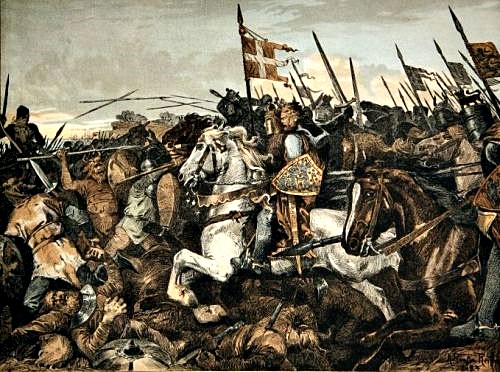
The Valdemar Battle in 1219 at the modern Tallin - painting by Hansen-Reitrup, K 1898.
But the negotiations broke down at the last minute, and so the weapons had to speak.
Count Albert of Orlamunde led the Danish army, which was mainly raised in Denmark. Count Otto of Luneburg joined from the south. He was the only German prince the Danes could trust. The armies met in January 1225 at Moln in Holsten. The fight lasted all day, but eventually the Germans prevailed. Count Albert was taken prisoner and now there was one more to be redeemed. Count Otto of Luneburg managed to escape.
After the battle, the negotiations were resumed and on 17 November 1225 an agreement was concluded, which was not as hard for Denmark as the former, but hard enough. It read: "For their release, Count Henry of Schwerin must be given 44,000 marks of pure silver, and each mark must weigh a unit less than Cologne's weight. In addition, all the gold that belonged to Queen Berengaria's garb, except the crown and what she before her death has given to monasteries and churches for her soul. In addition, suits must be provided for 100 army-men, namely, each of them 10 ells of Flemish scarlet and two and a half inches of brindled fur." As a security, the king was to place his two youngest sons and several great men as hostages.
Further the agreement said on the political conditions: "The king must leave to the German Empire all land between the rivers Eider and the Elbe and all the lands of the Slaws, except Rugen. The Regnoldsburg fortress must be handed over to Count Adolf of Holsten 10 days after the King's release." However, there was the bright spot that Denmark was not required to be an imperial fief.
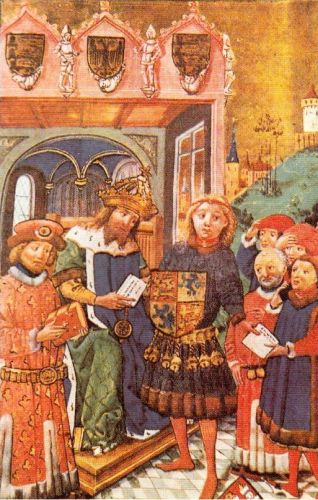
Count Otto - called Otto das Kind - receives the Duchy of Braunschweig-Lüneburg as a fief of Emperor Frederick 2. in 1235. Otto was the grandson of Henry the Lion and son of Valdemar the Great's daughter Helene. He participated in the war in Holsten on Valdemar's side. In 1235 he reconciled himself to Emperor Frederick 2. and received his lands from the Emperor as the Duchy of Braunschweig-Lüneburg. Book-illustration of Hans Bornemann in Lüneburger Sachsenspiegelhandschrift from 1442 - 1448. Photo Wikipedia.
However, now Valdemar the Victorious was again on the loose and he was determined to recover the lost. Immediately after his release, he wrote to Pope Honorius 3. that the obligations he had made to Count Henry of Schwerin prevented him from fulfilling his older promise to make a crusade to the Holy Land, and the promises he made to him, had been forced upon him. Moreover, Count Henry had broken the oath of allegiance which he had given to the king previously, and therefore the king could not, in his turn, owe the Count any keeping of promises. The Pope accepted this: "The Prophets command us to declare such obligations as invalid, which are forced upon us in an impious way."
Both sides began to prepare for a new showdown. From Denmark itself, Valdemar could not obtain larger forces. The Danes did not seem to have been very committed to his problems. He retrieved most of his army in Slesvig and Holsten, and from the south came Otto of Luneburg. Their enemies Count Henry of Schwerin and Count Adolf of Holsten hoped naturally enough to get help from the emperor, but Frederick 2. seemed to be busy elsewhere in his vast empire. However, Lübeck and the Archbishop of Bremen wanted to support them.
In the fall of 1226, the Danes opened the hostilities by invading Holsten and conquering the fortress of Rendsborg. They did a campaign to Ditmarsken and subjected it again to Denmark. Ryd Monastery Yearbook writes: "Many Frisians fell in Ditmarsken, which was subjected to Denmark."
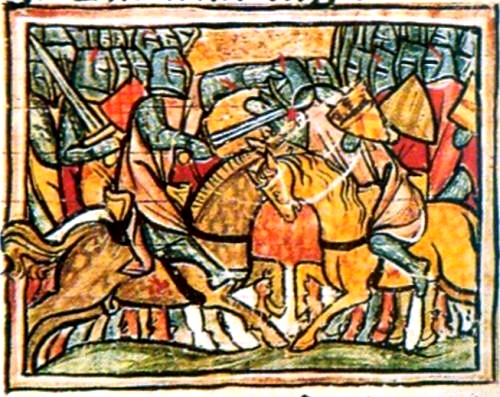
The Battle of Bornhøved July 22, 1227 in Holsten midway between Flensburg and Hamburg. The picture is from the Saxon World Chronicle from around 1250.
The Counts felt inferior and asked the Duke of Saxony for help. He would like to give it, but on conditions. In other words, he demanded recognition of his high power throughout Northern Germany, in fact the same position as Henry the Lion had. Reluctantly, the Counts accepted the Duke's terms, believing that without the his help, they would not be able to resist Valdemar.
The decisive battle took place at Bornhøved on July 22, 1227, approximately midway between Hamburg and Slesvig. The Archbishop of Bremen's troops opened the battle, which became hard and long lasting. The losses were very large because the cavalry on both sides attacked footmen. The Ditmarsken warriors fought on the king's side, but in the middle of the battle they changed side to the counts and it decided the outcome. Count Otto of Luneborg and three Danish bishops were taken prisoner. Valdemar escaped but lost his one eye.
This was the end of Valdemar's Baltic Sea reign. Then thirteen years had passed since the emperor had "declared eternal and unbreakable friendship with our dear Mr Valdemar" giving him that "belongs to the German-Roman Empire beyond Elde and Elbe".
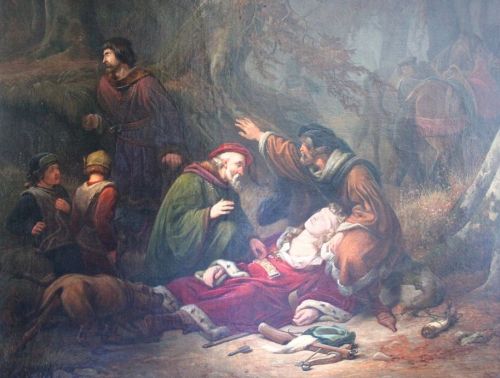
The death of Valdemar the Young. Valdemar the Young was killed by a accidental shot from a crossbow during a hunt on Røsnæs. Painted by Christian Emil Andersen in 1843. Bjoertved wikipedia.
Valdemar the Young was the son of Valdemar the Victorious and his first wife, Queen Dagmar, much loved by the people. He was born about 1209, but only three years later his mother died during childbirth.
Already in 1215 he was appointed as his father's co-king at a general meeting of noblemen on the island of Samsø. When he was 9 years old, he was solemnly crowned as his father's co-king at a grand ceremony in Slesvig.
During the fateful hunt on the island of Lyø in 1223, he was taken captive together with his father by Henry of Schwerin, and they spent nearly three years in captivity in various North German fortresses, much of the time in the Dannenberg Prison Tower at the Elbe. One would think that such circumstances would create a close relationship between father and son.
Valdemar the Victorious was released in return for a huge ransom in April 1226 and Valdemar the Young followed a few months later - at the age of about 17 years.
It is impossible to say what kind of person he was, besides being very interested in hunting.
In 1229 he married Eleonora of Portugal, the daughter of his stepmother Queen Berengaria's brother. But only two years later she died in a maternity bed and the baby probably died soon after.
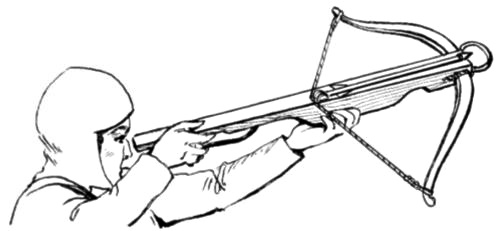
Medieval crossbow. The bow is fitted across a wooden frame. This crossbow is tightened by the shooter putting his foot in the footrest at the front of the weapon. He bends his knees and puts a hook he has fastened to his belt on the string and then straightens up. He attaches the string to the trigger mechanism. He places the arrow - which is called a bolt - in the furrow and is then ready to fire by releasing the trigger at the bottom.
The crossbow for military use has the great advantage that anyone can learn to use it in a very short time. Thus, a ruler could quickly raise an army of crossbow shooters based on peasants, who had no other military training. Archers, on the other hand, had to be trained from childhood. The disadvantage of the crossbow is that - compared to the longbow in particular - it takes a long time to prepare for shooting.
It is known that during the Qin dynasty in China - 2-300 BC - crossbows were widely used, they had even standardized the parts of the trigger mechanism.
In Europe, it became popular during the Middle Ages, especially for hunting. The later Valdemar Atterdag military success was due, among other things, to his effective crossbow shooters. Drawing Pearson Scott Foresman Wikipedia.
A few months later - during a hunt on Røsnæs in November 1231 - fate struck again, as Valdemar the Young was hit by an accidental shot from a crossbow in one leg, leading to his death.
A crossbow could inadvertently fire its bolt by an accidental touch on the trigger device or the like. Some medieval cities had banned carrying a drawn crossbow within the city walls.
Christian 4. donated 25 royal portraits to Sorø Academy, when he founded the city. Of these, 17 are preserved, and the text under the portrait of Valdemar the Young reads: "Waldemar - 3 - ruled 12 years / was shot by an arrow in his leg during a hunt in Refsnæs Skow at Kallingborg from which he died ANNO 1231 - buried in Ringsted at his parents."
"The king's brother Valdemar, a young man with the most wonderful aptitudes." Svend Aggesen wrote about the young Duke Valdemar. He must have been a lively and outgoing type, who made a great impression on others and found it easy to make connections and friendships.
Posterity has given him the byname the Victorious because he expanded the lands of the Danish King to an unprecedented extent in the northern parts of modern Germany and Poland. However, most were acquired already by Canute the Sixth, and Valdemar basically lost more land than he won.
The Norwegian civil war was still raging. The Birkebeins had brought King Sverre to power in Nidaros, but in the Viken the Birkebeins' opponents, the Baglers, had regained power. They had found a new royal subject, a man named Erling Steinveeg. His byname came from the fact that he had been a prisoner in a tower called Steinveeg on Visingø in Sweden, and had escaped from there by being lowered from a window. He was considered to be the son of king Magnus Erlingson, who was the son of Erling Skakke, who had been Valdemar the Great's govenor in Viken.
The Baglers went to Denmark and got promise of help from Valdemar the Victorious. In Aalborg they elected Erling as king in 1204 and immediately thereafter returned to Viken. Shortly thereafter, Valdemar came up to Viken with 360 ships. In Tunsberg, Erling - while the Danish king was watching - carried iron to prove his descent, Bishop Nikolas verified that his hand was unhurt. On the ting the common people hailed Erling as a king, and he again hailed Valdemar the Victorious as his overlord and gave hostages for his allegiance. However, Erling died a few years later, and new political constellations put an end to Valdemar's position in Viken.
|
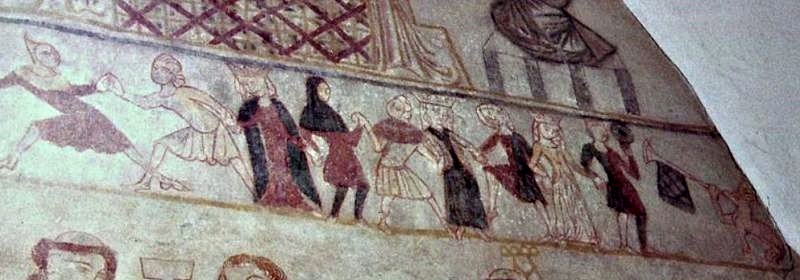
The dance picture from the 1300's in ørslev Church near Skelskør, which probably represents men and women in chain dance, which we know today as the Faroe chain dance. The robes on the first two from the left are short and show the main shape that is known from preserved robes found in Greenland. That must be what Arnold means by sailor clothes. Some of them are composed of right-left halves in contrasting colors. The women with crowns must be more distinguished than the others, and they all have loose clothes that reach to their feet, the figure to the right of the first crowned woman from the left wears a hood with a long tail. Photo kalkmalerier.dk
Arnold of Lübeck describes Denmark during the time of Canute the Sixth and Valdemar as a period characterized by prosperity and progress: While the Danes "Thus, in former times, they wore seamen's attire, as they as coastal dwellers all time tumbled with their ships, they are now dressed not only in scarlet, variegated and gray skins and furs, but even in purple and linen." - "For riches, of all kind they have in superfluous amounts as a result of the fishing they do annually in Skania," - "Because of their fertile pastures, the Danes also have a big number of excellent horses" - "Also in scientific knowledge they have made not little progress, as the nobility there in this country are sending their sons to Parisii, not only to raise the clergy, but also to have them educated in all kinds of worldly knowledge."
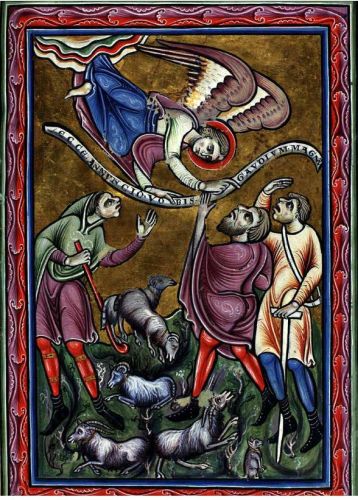
The shepherds in the field in the Folkunge Psalter from about 1200. The man on the left is wearing a robe and over it he has a kind of poncho with a hole to the head and hood. The man in the middle has only a poncho with a hole to his head, but no hood. The man on the right wears a usual "sailors'" robe, maybe a little long. They all wear some kind of tight trousers, perhaps very similar to the Iron Age trousers from Thorsmose, or they are trousers where each leg is attached to the pants with a strap - perhaps like women's nylon stockings. They all wear shoes. Photo Ukendt Wikipedia.
It was a time of progress for Denmark. Forests were cleared and new land was cultivated to a large extent. It was in the early Middle Ages that the last remnants of the original Danish primeval forest - where the Stone Age hunters had hunted - were felled. The hilly South Funen, which did not at first glance invite for agricultural use, was such an area.
Place names with the endings -rud, -rød, -tved, -skov and -løkke can all be dated to the late Viking and early Middle Ages, and at least the first four mean something with forest, which tells us that during this period large areas of forest were felled and converted into arable land, and a number of new villages were founded such as Morud, Birkerød, Langtved and Langeskov.
The ending -torp, rounded to -strup or -rup, was widely used in Denmark during the Viking Age and can also be found in England as Scunthorpe and Copmanthorpe. But still in the early Middle Ages, an immigrant village from an originally older village was called a -torp. Torp place names with Christian origins, for example Niels in Nielstrup near Svenborg, Peter in Pederstrup south of Odense and Abraham in Abrahamstrup at Jægerspris, represent with certainty villages founded in the early Middle Ages.
In some years there may have been setbacks. Archbishop Uffe wrote in 1231, the same year that Valdemar the Young and Eleonora died: "We suffer great poverty, partly because we have to pay for the ransom of our High King and some of our fellow bishops and almost all of the country's nobility, whom this traitor held captive for our sins, partly because of a plague disease that last year killed all the cattle of the kingdom and in this year has been followed by an even harsher torment, namely a severe famine."
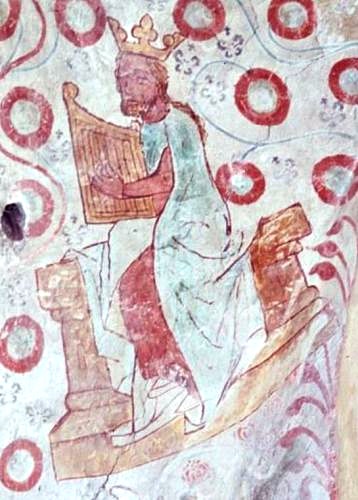
King David in fresco from 1375 in østofte Church northwest of Maribo. Like almost all kings during this period, he is depicted with a kind of dress that reaches almost to his feet, in addition he wears a loose folded robe. His attire isn't really that different from a woman's dress. Sweyn Forkbeard and Canute the Great did not wear such clothes, they wore nicely decorated "sailor clothes". The loose, long and folded fashion came from Constantinople via the Normans in southern Italy and Sicily, who had contact with the Eastern Roman Empire. From southern Italy, the fashion quickly spread to the north, also to the Norwegian Birkebeins, which were otherwise considered simple and hardy people. King Sverre said to the Birkebeins: "Before, you did not wear robes dragging over the ground, but had shorter and more manageable clothes, but better hearts". Photo kalkmalerier.dk.
The following year, in 1232, Valdemar's eldest son with his second wife, Berengaria, 16-year-old Erik - later to be bynamed Plowpenning - was solemnly crowned king.
The Danish chieftains played a strikingly small role in Valdemar the Victorious' reign. He relied primarily on Count Albert of Orlamunde and Count Otto of Luneburg. Archbishop Anders Sunesen played a prominent role in the conquest of Estonia, but otherwise one gets the feeling that the relationship between the king and the kingdom's noblemen was chilled. When Valdemar gathered troops after his release to recapture his North-German possessions, one does not get the impression that the Danes flocked around his banner. His army was mostly recruited in Holsten and Southern Jutland.
The Slaw princes, who had been so loyal to Canute, did not seem to care that their king had been kidnapped. They all fell - except the prince of Rugen - from Valdemar without even a protest.
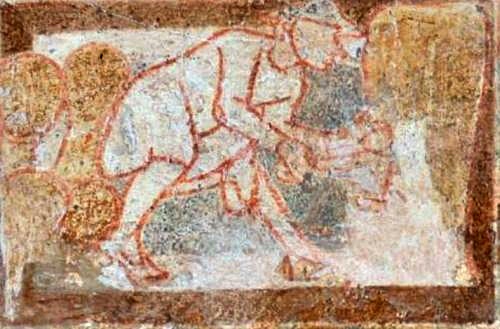
Mural from around 1200 with a peasant harvesting the field - from Sønder Nærå Church south of Odense. Photo kalkmalerier.dk
The Danish noblemen were strangely passive during Valdemar's captivity. It would certainly have been useful for the negotiations if an army had been assembled at the river Ejder, or a fleet had been gathered off the coast of Germany or the like, but no such thing happened. Hal Koch suggests that the Danish nobles were tired of leding raids year after year, without getting any benefit from them. We remember Saxo's repeated descriptions of the dissatisfaction of the leding army. The Warriors wanted reward for their "wounds and injuries". They wanted booty and revenge on the Slaws, who had previously looted and humiliated them. But the king let himself satisfy with money payments and promises of future tax payments - to himself.
The historian Ole Fenger quotes a poem from that time which confirms that the Danish nobility was quite passive in relation to the king's captivity:
"You Danish noblemen mourn and complain!
Once upon a time as bold fighters
your warriors guild won praise and reputation,
now you are lazy and afraid of weapons.
Your king has been robbed by sly thieves,
grimly the enemy promote himself without shame."
The posterity has tended to divide the kings of Denmark into strong and weak kings. For example, Harold Bluetooth, Valdemar the Great and Valdemar the Victorious are considered to be strong kings, while Oluf Hunger and Kristoffer 2. are considered weak kings. But the results of kings are very much an effect of the size of the royal revenue.
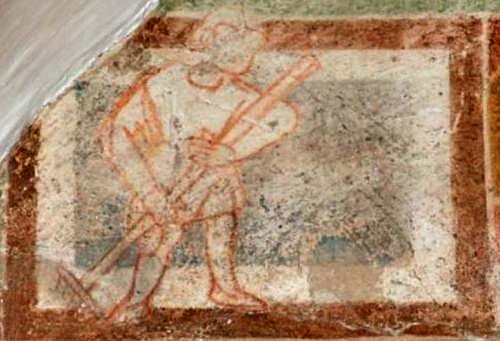
Mural from around 1200 with a peasant who rakes the field - from Sønder Nærå Church south of Odense. Photo kalkmalerier.dk
Harold Bluetooth seemed to have unlimited resources at his disposal, he could expand the defense dike Danevirke, build Viking ring-castles and an impressive bridge and pay a standing army in Jomsborg. This was probably because the Danes feared that the Emperor should attack Denmark and force the people to abandon their religion and traditional culture. The abundant incomes probably to some extent continued for his successors, Sweyn Forkbeard and Canute the Great. But Canute spent most of his time in England, and the peasants became unhappy to pay to a king, who was not there, when needed. Ulf Jarl complained about this: "I and many of this country's men and chieftains often appealed to King Knut that it seem them very difficult to sit here in the country without a king, while the previous Dane-kings thought they had more than enough to do with having kingdom over the reign of the Danes alone; but in the past many kings led this realm." This created a deeply rooted attitude among the Danish peasants that the kings should have only what was due to them by law and not a penning more, as it is said in "King Harald's Laws". Canute the Holy sought with violence and power to restore the abundant royal revenue and the strong kingdom, but he did not fare so well. One can imagine that the catastrophic civil war and the devastating Slaw attacks have motivated the Danish peasants to be more generous with their tax payments, especially when they saw that King Valdemar was really doing something for the benefit of the country. The increased prosperity and increased cultivated area have probably also helped to boost royal revenues.
But Valdemar the Victorious and his brother and father did not see that they themselves were contributing to undermining the royal incomes for their descendants and thus the prosperity and freedom of the country. There were in particular two factors that came into play.
One was that kings and great chieftains gave estates and villages to the monasteries and churches for the salvation of their souls, areas that soon became subject to the privileges of the church, including freedom of taxation to the crown. It was a development that only went one way, until the bubble bursted with the Protestant Reformation in 1536 and the kings' takeover of all church property, including that which the nobility had given to the monasteries over time.
Besides, future kings should find that the church leaders were also dangerous in another way, as they had two masters, namely both the king and the pope. It should turn out that when the royal power was weakened, the church leaders would push harder to gain additional power and privileges.
The second was that, following Central European custom, it became common to give parts of the country as a fief to the royal princes, who were not going to inherit the throne. In doing so, these princes were granted the right to most royal revenues in the territories which they were granted, and the king's revenue was cut accordingly.
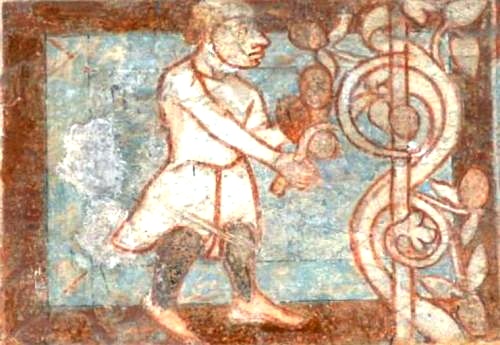
Mural from around 1200 with a farmer who harvest grapes - from Sønder Nærå Church south of Odense. It is interesting that grapes grew in Denmark around the year 1200. Photo kalkmalerier.dk
At the same time that Valdemar's eldest son, Erik, was crowned king, his father made the second oldest, Abel, the Duke of Slesvig. The youngest son, Kristoffer, got the islands Lolland and Falster as a fief. A fourth son, Knud, who was born out of wedlock, got Blekinge, and a grandson, Niels, got Halland. His sister's son, Albert of Orlamunde, got the island of Als as a fief.
All these lands were a kind of miniature kingdoms. Just like the king, the princes could "take men" and make them free of taxes. They had their own kancelli and their own armed forces, which were committed to the prince and not to the king. Their land was given to them for life, and like Buris Henriksson they wanted it to be hereditary as the royal power was in practice.
In the year 1223 - the same year as the catastrophic hunt on Lyø - a revolt broke out in the Duchy of Estonia and the Danish possession there was greatly reduced. In 1227, the Order of the Sword took advantage of the weakening and conquered the last Danish-controlled areas including the castle of Tallin, after which the Danish bishops had to travel home.
All supplies and reinforcements to the Order of the Sword were shipped via Lübeck. Valdemar managed to team up with Adolf of Holsten, who also had a horn in the side of Lübeck, to block the mouth of the river Trave so that no ships could depart for Riga and Tallin.
|
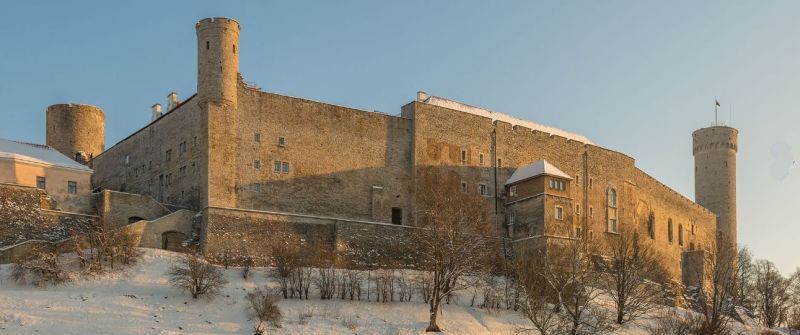
Toompea or Tallin Castle. Tallin literally means "The Danish Castle". In the impressive castle complex, which, in connection with a ring wall around the entire medieval city, makes up the fortification of the city, parts of the original Danish castle from the 1200's are preserved. This part is seen in the middle of the picture, encased in extensions that have come about over time. Photo Abrget47j Wikipedia.
But that became too much for the Pope. In February 1234, he wrote to the Bishop of Ratzeburg and to an abbot in Lübeck that they should take all the Crusaders - that is, all who would go out and join the Order of the Sword - under the protection of the church and give all, who obstructed them, strict ecclesiastical penalties. In the following letter it is plainly stated that it was the Danish king, who had blocked Lübeck harbor for the crusaders, and that he should be forced to give up his hostile acts.
However, in luck for Valdemar, the Order of the Sword in 1236 suffered a severe defeat to the Lithuanians, which led to the Order being dissolved and its surviving members admitted into another order, "Ordo Teutonicus" or "The German Knights".
Once again, Denmark came to reap the benefits of having a good relationship with the Vatican. The pope wrote to his envoy in Estonia, Wilhelm of Modena, declaring it his determined will for the knights to surrender to the pope, not only the castle of Tallin, but also the four Estonian landscapes that had previously been Danish.
The end was a international political gathering at the farm Stensby on Sjælland south of Vordingborg opposite the island of Bogø. Valdemar the Victorious, the German Knights' Grand Master Herman Balk and the Pope's envoy Wilhelm of Modena were present.
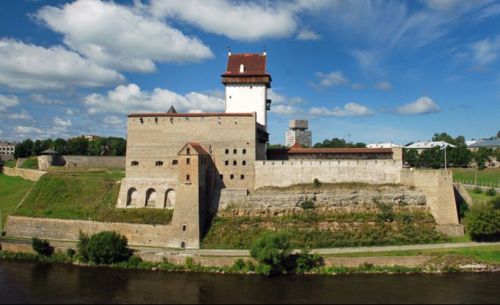
The castle in Narva also called the Herman Castle at the border with Russia. The fortress contains in its masonry significant parts of the castle, which was built in the time of the Danish reign in the 1200's, including the piece of the ring wall, which is seen to the left of the extension and the lower part of the tower. Photo Simm Wikipedia.
The result of the meeting was that the German Knights left to the king "the castle of Tallinn with the land belonging to this, which they hold, with all fortifications, undamaged as they are.". That is, that they left the Danes the landscapes Reval, Harrien and Wirland, they themselves retained the landscape of Jerwen, which, however, should be unfortified as a kind of neutral zone between the Parties. In addition, it was agreed that lands, such as the knights and the king should jointly take from the heathens, the king should "have the two-thirds and the knights and one-third of all worldly rights and glory."
Valdemar's Jordebog is a kind of Danish Doomsdaybook.
It is a gold mine for the place-name researchers because you can see what towns and villages were called in the Middle Ages. For example, Odense was named Othiniensi or Othænsø, Munkebo was named Munkæboth, Nyborg was named Nuburgh, Fåborg was named Foburgh , Assens was named Asnæs , Kalunborg was named Kalundæburgh, Aalborg was named Alburgh and Lyngby was named Lyungbu.
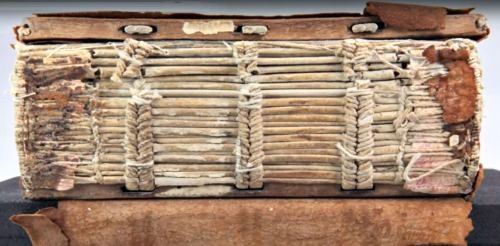
Valdemar's Jordebog. Photo Youtube.
Traditionally, "Valdemar's Jordebog" refers to a collection of manuscripts of very different kinds, which may have originated in Sorø Monastery, written around the year 1300. There is a mysterious "brother list" from Canute the Sixth's time, the chronicle Valdemar-årbogen, a list of kings, a list of Empires and a list of popes, religious texts, Latin verses, a sailing description to Estonia and more.
However, it is probably the so-called Main-piece - dated to 1231 - which has given rise to the term "Jordebog" (meaning book of land). This is a special document in that it is in some respects very detailed but incomplete, as not all cities and regions are included in the lists, and there is not much inter-relation between the lists. Here is information about royal land ownership for each shire, and what the shires owe the king - but not all shires are included. For some cities - but not all - income from customs and coin taxation is stated. Also attached to the chapter is the income list, which is a summary statement of the royal revenue for about 1240.
Kongelev is a term for the king's estate connected to the office of the king. The word is known only from King Valdemar's jordebog. Kongelev differs from patrimonium, which is the royal family's private property whether they hold the king's office or not, the king's ancestral heritage. The Kongelev list shows royal estates, important castles, towns and villages, but also the demand that what nobody owns belongs to the king, that is, deserted islands, peninsulas, original forrests and the like.
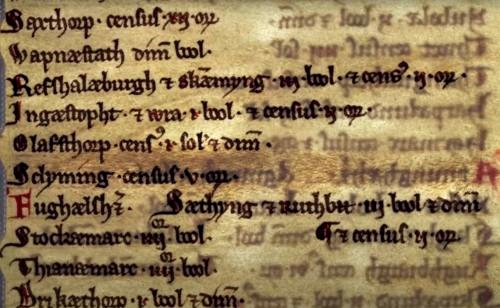
Excerpt of a page in Valdemar's Jordebog. Photo Youtube.
In the kongelev list one can see that kongelev is most prevalent on Sjælland and in Skåne, while patrimonium, the royal family's private properties, is most prevalent in Jutland and Fyn. From this some have concluded that Jutland and Fyn were the original area of the royal line, where they had their family property. Later, they also became kings in Eastern Denmark, where they took over the properties belonging to the king's office, kongelev.
The plow list from about 1241 probably formed the basis for collecting plow tax on Sjælland, Lolland, Falster and Møn, but apparently not in other regions - which shows that the plow tax probably was introduced already in Valdemar's time and his son, Erik Plovpenning, has his name wrongly.
An island list mentions almost all Danish small islands and the animals that could be hunted here, which shows that they were still largely uninhabited after the ravages of the Slaws.
There are detailed statements of income from Halland, Lolland, Falster, Fehmern and Estonia, but not similar documents for other regions. From this one can see that Fehmern belonged to Denmark.
There is a very comprehensive and detailed list of what a shire's peasants should deliver to the royal entourage's consumption for two nights: "The king's winter guesting is for two nights: 5 pounds of honey. Oats for fodder 6 mark. Of flour 1 mark rye-flour and 1 mark-wheat flour, and mark barley-flour. 3 mark malt. 1 mark porse after oat-meassure. 26 salted pigs, 14 live pigs, 16 salted oxen, 26 salted sheep, 14 aske butter, the ask is a twelve-mynnings ask, 360 cheeses, of each cheese enough for 5 plates. In addition, 360 chickens, 180 geese, 2 pounds of pepper and caraway seeds, 1 pound of salt, 8 barrels of herring, 360 dried fish. In addition, 2 marks of silver to buy fish, 2 øre for the carriers. In addition, the marsk 1 mark silver, the under-marsk 1/2 mark. The head-drost 1 mark silver. The little drost 1/2. The big and small cupbearer just like that. In addition, the chaplain 1 øre silver. The foodstorage-peoples 1 øre silver. In the basement 1 øre of silver. 1 kitchen 1 øre silver. Table-waiters and tablecloth-waiters 2 ørtug. 1 fodderhouse 1 øre silver. The one who distributes the candles 1 øre of silver. The Alms distributor 1 øre silver. In addition, 100 dishes and 400 plates. For firewood mark silver."
With estimated slaughter weights can be calculated how many kg. meat it is all about:
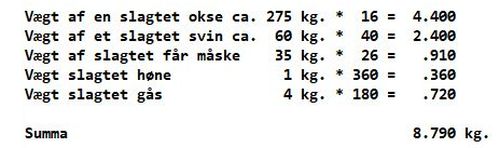
Estimate of how many kilos of meat the peasants were to deliver for Valdemar the Victorious' entourage for two nights. Slaughter-weights are found on the Internet. Assuming that the 400 plates represent 400 people, then each person should consume 8,790/(400*2) kilos per day. Which gives about 11 kilos of meat per person per day. It must be said to be impossible.
Therefore, either this statement is a playful writing exercise as some historians have suggested, or it represents a way to squeeze benefits out of the peasants.
Historian Ole Fenger cites another contemporary source. A bishop complains of a royal visit "with an immense amount of people, horses and dogs"
Valdemar's magnificence probably surpassed that of former kings. We remember what Saxo wrote about his predecessor a hundred years earlier, King Niels: "In order not to burden the country with a costly troop of household guards and great expenses, he satisfied in daily life with a guard of only six or seven men just to be safe for thieves and robbers, and the splendor he unfolded as a king did not exceed what was indicated by the size of his household guard."
Jutland law was given by Valdemar in Vordingborg in March 1241. Its famous preface reads:
"Thus begins the preface to Jutland Law, that King Valdemar gave, and the Danes adopted:
By law, land is to be built, but would anyone settle with his own and let others enjoy the same right, then no law was needed. But no law is as good to follow as the truth, but where there is doubt as to what is truth, the law must show the truth.
If there was no law in the country, those had the most who could acquire the most. Therefore, the law must be made in the best interests of all, that righteous and peaceable and innocents can enjoy their peace, and the unjust and evil can fear from what is written in the law, and therefore dare not execute the evil which they have in mind. It is also true, that if someone cannot be lured to the good for fear of God and love of justice, that the fear of government and the penal code of the country can prevent them from doing evil and punishing them if they do.
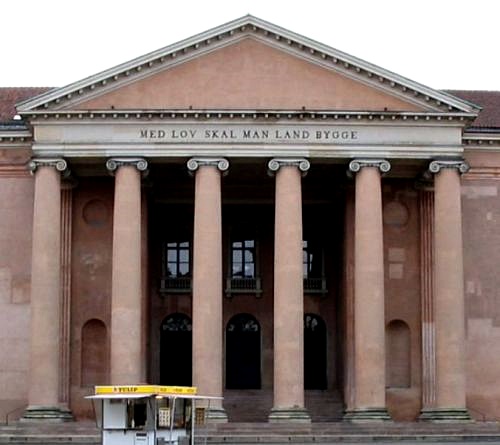
Jutland Law preface's opening words: "By law, land must be built" is found in many courthouses across the country - in different variants. Here at Copenhagen City Court. Photo Thomasz Sienicki Wikipedia.
The law must take into account the honor and justice, it must be tolerable, according to the custom of the country, appropriate and useful and clear, so that everyone can know and understand what the law says. The law is not to be made or written for the special benefit of any man, but to the best interests of the people living in the country. Neither shall any man judge against the law which the king gives, and the land adopt; but according to that law the land must be judged and governed. The law which the king gives and the land adopts, he can neither change or repeal without the will of the land, unless it is clearly contrary to the words of God.
It is the duty of the king and the country's chiefs to monitor judgments and to do justice and to save those who are being wronged, such as widows and defenseless children, pilgrims and foreigners and the poor - those are mostly wronged, and not to allow evil people, who do not want to improve themselves, to live in his land; for when he punishs and kills the wicked, he is the servant of God and the guardian of the land. For just as the Holy Church is ruled by the Pope and Bishop, so every land must be ruled and guarded by the King or his officials. Therefore, all who live in his country also have the duty of being obedient and submissive to him, and in return he is bound to give them peace. All worldly rulers must also know that with the power God gave them in this world, he also assigned them to guard his holy church against all demands. But if they become forgetful or biased, and do not guard what is right, then on Judgment Day, they must be held accountable if the freedom of the Church and the peace of the country is diminished by their guilt in their time.
Everyone who sees this book must know that King Valdemar, the second son of Valdemar, who was the son of Saint Knud, when he had been king for thirty-nine winters, and a thousand and two hundred and forty winters had passed after Our Lord was born, in the following month, had this book written and gave this law, which is written here in Danish, in Vordingborg with the consent of his sons present, King Erik, Duke Abel and Juncker Christoffer.
Jutland Law itself is divided into three "books".
First book provides detailed rules on inheritance, marriage and rules for the village community and much more.
Would you like to marry a woman, you have to ask for her hand from her father or another family. Paragraph 33 says: "Anyone who wants to take a wife should ask for her from her father or her son if he is full-grown, or her brother." - "but it should however be with her consent and will."
|
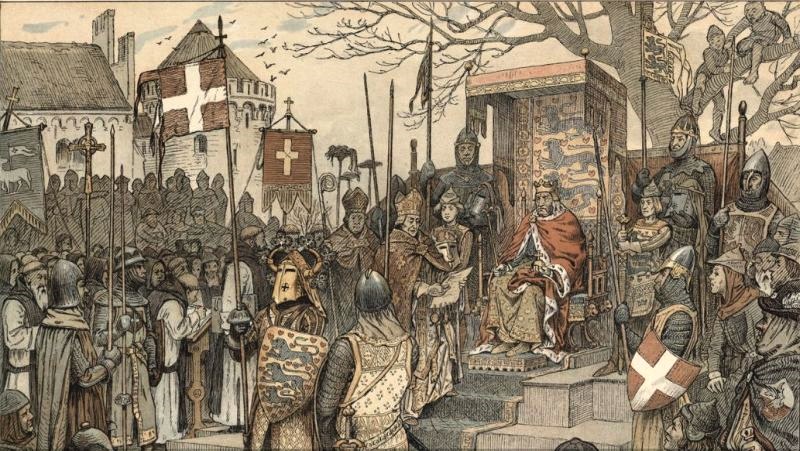
Jutland Law is being adopted in Vordingborg. Jutland Law was the second and last of the local Laws Valdemar the Victorious issued during his reign. It was given in his death year 1241 at his castle in Vordingborg. Canute the Sixth had already given Skåne Law and Valdemar had given Valdemar's Sjælland law. Painting by Rasmus Christiansen 1906. Wikipedia.
There were limitations to the community of property in marriage: Paragraph 35 says: "The husband may not sell his wife's land unless he has as good land to provide as security and has a child with her."
The peasants who live along the roads must maintain them. Paragraph 56 says: "To every town shall rightly lead four roads, those which from the time of Arild have led thither, and they must nobody block or destroy; but he who blocks or destroys them, shall pay three marks to the king, and yet make the road well. In each village field, the owners who live on the land must repair the public highway. But if it is very inaccessible, either because of bogs or large streams, then the whole parish should help building bridge if necessary."
Second book deals with legal proceedings including oaths, jurors, rape, outlaws, robbery and theft, bail and more.
According to Jutland Law, "sandemænd" (truth-men) can take part in a trial. They are a kind of jurors or law assessors. The term "truth-men" indicates probably that they were tasked with finding the truth. Paragraph 1 says: "There must be eight truth-men in each shire, two in every quarter. However, there must be no more than one in a community. Each of them must have property in the quarter of which he is a truth-man, and at least be a leaseholder and not a peasant. No one can dispose of them unless they offend their office by swearing falsely."
"Horse-hire" is a kind of salary for truth-men. The law also aims to prevent corruption: Paragraph 5 says: "If it is convinced that truth-men are taking more in horse-hire than they are entitled to, then they have first lost their estate and then their truth-man position. Their proper horse-hire is half a mark silver for all eight. Even if one of them receives half the mark silver, he must share it with all the others. Whoever demands the assistance of truth-men must give them horse-hire, whether they swear with him or against him or do not swear at all."
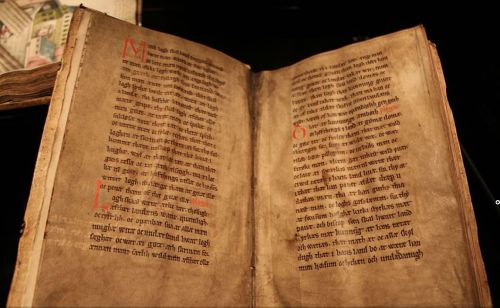
Jutland Law exhibited in Danmarks Borgcenter in Vordingborg. Photo Toxophilus Wikipedia
Truth-men were very important people on tings. They could judge that a murderer could get away by paying a fine. If it was emergency and self-defense for life or goods, a killer could escape punishment. Paragraph 12 states: "If truth-men want to swear a man to fines, they must ask God to help them, as true as he avenged either wounds or chops or had to guard his own life or goods and therefore shall keep his peace. But if they want to swear him outlaw, then they must swear that he killed a blameless man and therefore must lose his peace. But if a murder case gets announced on the county ting, then the truth-men must find out who is the murderer, or what caused the victim's killing and death"
Jutland law prescribes outlawing - which is a more severe punishment than fines - for the one who has taken a woman against her will and thus made her a mock-women. Paragraph 16 siger: "If one raises a case because of a woman who is raped, and the truth-men want to swear the perpetrator out of his peace, then they must swear that she was taken forcibly against her will and taken for mock-women, and that the one who assaulted her, therefore must be outlawed. But if they know that she was not raped, they must swear that he did not take her by force and that it was not against her will and that he should therefore keep his peace."
But a rape victim must complain immediately after she has escaped the perpetrator's power. Paragraph 17 says: "If a woman says, she is raped, as soon as she has escaped the perpetrator and has her freedom, then she must make a complaint about the violence that has befallen her, for the grand-women at church meeting and then at the ting. Then it is likely that she has been abused, and the truth-men are then obliged to swear on such a case. But does she accept it and keeps silent after it is obvious and known to the grands and grand-women that that man has had that woman, or if she becomes with child and does not complain before, then it is likely that she was not raped, even she otherwise has been treated badly."
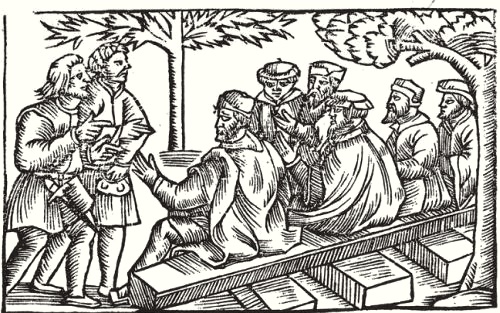
A ting assembly in Olaus Magnus from his "History of the People of the North" from 1555. Tings were usually held outdoor.
If someone lies with a woman secretly, then her family can raise a case against this man and get him fined or to lose his "manhelg" - which is his peace - and they can then kill him without legal consequences. Paragraph 18 says: "If a virgin - or another woman - allow someone in secret to lie with her with her will, and it becomes known, then her kinsmen, even though she is silent and does not accuse anyone, can bring a case against the one whom they will accuse this act, and get him either to swear kinship, if he refuses, or nine marks' fine if he confesses, or convict him by oath or sue him for losing his manhelg, if he will not stand trial."
If a man is convicted outlaw, he must flee the country. Paragraph 22 states:"If a man becomes sworn outlaw, and if his counterpart does not want to receive fines, then he must flee the country by day and month. If he does not flee, the king may seize his goods, and the king may not receive payment for his peace before he has been reconciled with the deceased's family." - It is not allowed to provide shelter to outlaws. Paragraph 26 says: "He who knowingly houses an outlaw man after day and month, shall pay three marks to the king.".
Jutland Law generally rejects vigilante justice. Paragraph 72 says: "But he who replows the seed of another man has thereby always to pay three mark to the peasant and three mark to the king, even though the land is his, for one must obtain ones right by trial on ting and not take the law in own hands."
Third Book deals with rules of leding, rules of "taking men", killing and fines, killing of a man having sexual intercourse with ones wife, wizardry and so on.
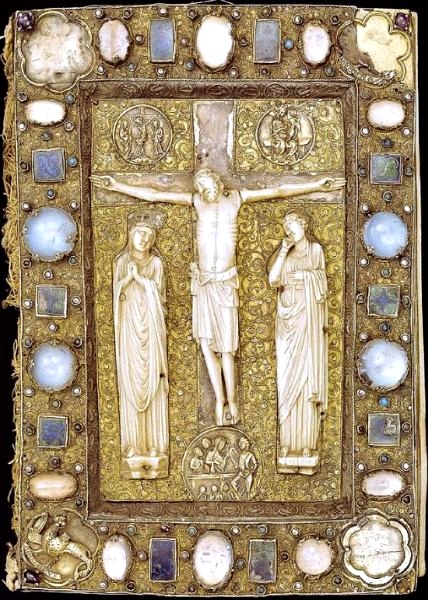
The Horne book is a Latin gospel manuscript from the time of Valdemar the Victorious. The book was given to Horne Church on Fyn in 1656 by Jørgen Brahe and Anne Gyldenstierne from the manor Hvedholm, located in Horne parish. The frontpage is adorned with carved whalrus-tooth - probably from Greenland - and rock crystals. Photo Elin Lindhardt Pedersen Wikipedia.
Everyone had the duty to go on leding, when it was their turn. Paragraph 1 says: "When leding is ordered, anyone - as many as they are in a havne - must go out their year without being selected, unless they are so old or young that they are unable to go out or are women or learned men."
They must provide for their weapons themselves. Paragraph 4 states: "Each styrismand must have full weaponry, and also a crosbow and three dozen arrows and a man who can shoot, if he cannot shoot himself. And every havne-peasant on the ship must have shield and the three weapons: sword, kettle-hat, and spear."
Kings, dukes and bishops are allowed to "take men" - who then becomes free of taxes to the king. Paragraph 8 siger: "The king may take men everywhere in his kingdom, in whatever skipæn he wants, and the duke in his duchy, but others of the king's children or kinsmen or counts may not take men except in their own jurisdiction."
In one circumstance, vigilante justice is legal. Paragraph 37 says: "If a man is wounded in whore-bed with another man's wife, and he escapes alive, but dies of the wounds, then he must lie on his own deeds, and the peasant must be blameless." - "But if he is killed in whore-bed, then shall the one, who killed him, take the duvet and sheet in which he was killed, bloody, to the ting with the testimony of two men that he was killed in whore-bed and not elsewhere." - "But wherever a man is killed outside whore-bed, even if he is charged with whore-case, or whatever else he is charged for, then truth-men must always step in to decide the case."
Theft was distinguished from robbery. A thief takes another man's property in a hidden and cunning way, at night or in unnoticed moments. A robber, on the other hand, takes another man's property in public so that the owner has opportunity to take his weapons and defend his property. Theft was despicable and thieves were often hanged, while robbers could get away with paying fines. Paragraph 47 says: "If a man goes to another man's field at night and cuts his grain or takes his harvested grain, then he is a thief. But if he is a travelling man and gives his horse a sheaf or let it grass on the harvested field, then he is neither a robber nor a thief, but if he takes something away from the field, then the owner of the field can sue him, who took it, whether he wants to do it for robbery or for theft."
Valdemar the Victorious was one of Valdemar the Great and Queen Sophie's eight children.
He was still unmarried, when at the age of 32 he succeeded his childless brother, Canute the Sixth, on the throne in 1202. However, he already had several children out of wedlock, namely Knud Valdemarsen with Esbern Snare's widow, Helena, and Niels Valdemarsen with an unknown mistress.
Esbern Snare died in 1204, so Knud Valdemarsen must have been born in 1205-06, one should think. He was appointed Duke of Estonia in 1219, further it is said that Valdemar gave him several estates in Sweden, which belonged to the Danish royal family. However, Estonia was briefly lost in 1223 at the same time as the tragic events of the hunt on the island of Lyø, but Knud retained his Duke title. Later he got Blekinge as a fief. Knud later participated in Abel's and Kristoffer's rebellion against their brother, King Erik Plowpenning. He is buried in St. Bendt's Church in Ringsted.
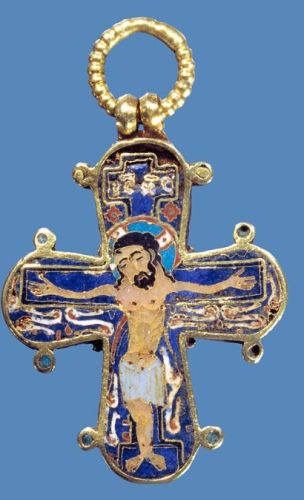
The Dagmar Cross is a Byzantine relic cross of gold with enamel found in a tomb in Ringsted's Sct. Bendt's Church in the 1600's and delivered to the Royal Chamber of Art, where it was believed that it had belonged to Queen Dagmar and it is therefore called the Dagmar cross. The dating ranges from 1000's to around 1200. A copy of the cross was in 1863 given by King Frederick 7. as a wedding gift to the Danish princess Alexandra's wedding to the English throne-prince Edward 7. Since then, copies of the cross in silver and gold have become popular in Denmark as gifts for baptism and confirmation. Photo Lennart Larsen Nationalmuseet Wikipedia.
He gave his second son out of wedlock, Niels Valdemarsen, Halland as a fief. Niels, as a minor in 1214, married Oda of Schwerin, a sister of the herostratically famous Henry of Schwerin, who later abducted king Valdemar on the island of Lyø in 1223. By the marriage, Niels got half the county of Schwerin as mortgage in pledge for the dowry. However, the young Niels died as early as 1221, but not before Oda had given birth to a son, Niels of Halland-Schwerin. Valdemar the Victorious took charge of being guardian for his infant grandson and ordered Albert of Orlamunde to redeem the mortgage on his behalf, while Count Henry was on a crusade. When Count Henry returned to Schwerin the following year, in 1222, he thus found his county reduced to half.
We can believe that Valdemar's first wife, Dagmar, was quite young, when she got engaged to him in 1205, at very most 19 years old - probably younger. Valdemar was then 35 years old. She was baptized Dragomir or similar, but the Danes chose to call her Dagmar.
The following year, the wedding took place. An edition of Ryd Monestary Yearbook writes for the year 1206: "King Valdemar married Dragomir - The King of Bohemia's daughter."
Queen Dagmar quickly won the hearts of the Danes by her youth, beauty and mercy. Ryd Monastery Yearbook continues: "And Queen Dragomir asked for Bishop Valdemar to be released from prison on the condition that he should never come to Denmark again."
With Denmark's position in European politics, Valdemar could have got a princess from a European superpower that would have brought great political benefits to Denmark. We may think that he had fairly free choice between unmarried Northern European princesses, yet he chose a daughter of the rather insignificant King Ottokar I of Bohemia. And not only that - Dagmar was a child of divorce. King Ottokar had divorced Dagmar's mother, Adele of Meissen, on the pretext of too close kinship. Normally, a divorced queen would not be allowed to leave the country with the royal children, but in this case Dagmar, her mother and siblings, had all been thrown out the gate and had sought refuge in Meissen north of Dresden with Adele's brother. The divorced queen complained to the pope, but without success.
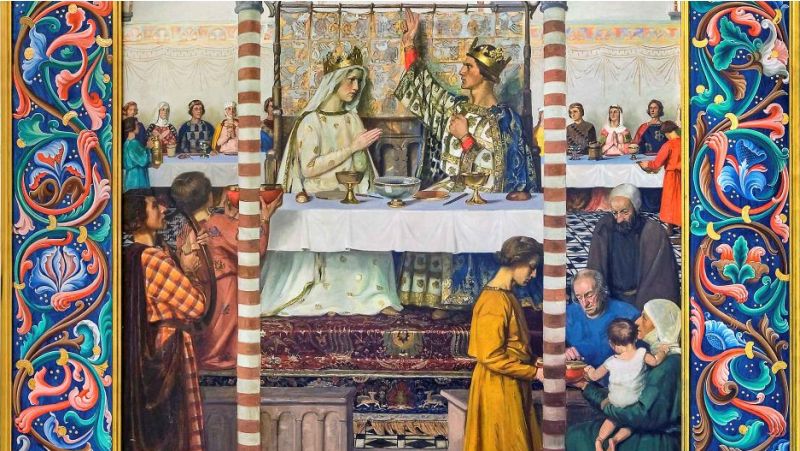
|
King Valdemar's wedding with Queen Dagmar. Painting by Agnes Slott-Møller 1932. Foto Tutt art pitturas cultura poesia musica.
But then suddenly happiness smiled to the detronized queen. A king of one of the richest and most powerful countries in the North proposed to her daughter. Valdemar can hardly have met Dagmar in person, he must have heard of her, indicating that she had a big reputation for her beauty in Europe and that she was really something special. Probably Valdemar had sent trusted men to Meissen to meet her and see her in live.
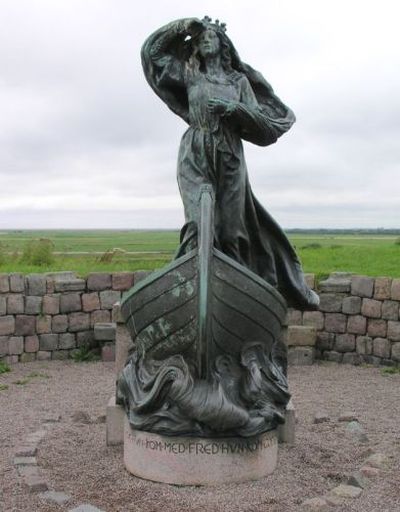
Anne Marie Carl-Nielsens statue of Queen Dagmar from 1913 placed in the remains of the castle of Ribe, where where she is supposed to have gone ashore. Photo Bonio Wikipedia.
Historians write that we know nothing about Dagmar - other than the folk songs, and they are the pure fiction. But precisely this rumor of her beauty and personality that had spread in Europe is indicating that she was something special. Folk songs must also have had a core of truth. When Dagmar could win the hearts of the Danes so quickly - and to a degree that she is still remembered after 800 years - it must be because she has been something very special. Maybe a Princess Diana type or similar.
In one of five folk songs about Queen Dagmar, Junker Strange goes and gets her in Valdemar's name. He plays chess with her and they discuss the marriage. She asks about Valdemar's financial situation. Junker Strange tells that his master "owns a fishing water more rich than all the Bayer King's land".
It is said that Queen Dagmar and Junker Strange went ashore in Ribe. A folk song says:
Dagmar she came there sailing off land,
- so many golden flew.
King Valdemar gallops his horse on the sand
- there he sails, Junker Strange with Virgin Dagmar.
"My gracious Miss! be glad and happy!
You will never regret, You gave him your trust."
The Dane King took her in his arms,
gave Dagmar the gold crown and name of queen.
Dagmar she threw her glove to the ground:
"All of Denmark I now want to be good".
But should I become Queen of Denmark,
then all prisoners should be given free from their irons.
"Danmarks Folkeviser i Udvalg" by Svend Grundtvig.
Dagmar was the Queen of Denmark for seven years. In 2009 she gave birth to a son named Valdemar. One folk song tells that she died in a maternity bed in 1212, the other merely say that she fell ill and died.
The folk song says that he stayed at Riberhus and suddenly became ill. The song says:
Queen Dagmar lies in Ribe ill,
to Ringsted they may wait for her.
All the ladies, living in Denmark,
them, she lets fetch to her.
- In Ringsted Queen Dagmar rests.
Valdemar was at that time in "Gurreborg", but Dagmar's "little boy" rode "nights and days" to fetch him. "Queen Dagmar has sent me to you, in Ribe she is ill" - "she is very frightened for her life", he said to the king - "Forbid God, Father in heaven, that Dagmar had to die so young," the king replied. "When the King rode out of Gurreborg, he was followed by well over a hundred men; but before he rode over Riberbro, he was a man alone." - "Queen Dagmar died in little Kirstin's arm as the King rode up the alley."
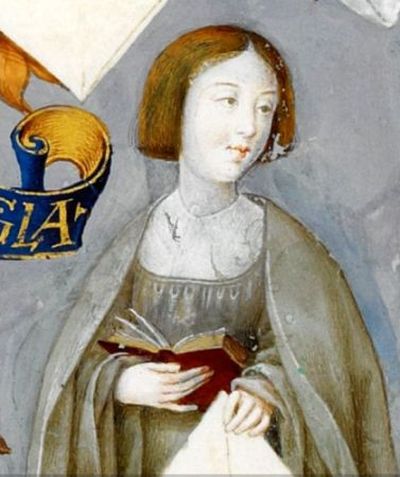
Berengaria in The Portuguese Generalogy. Photo Antonio de Holanda Wikipedia.
Ryd Monastery Yearbook for 1212 says: "Queen Dagmar died. Her real name was Margrete - she was called Dagmar because of her beauty."
Two years after Dagmar's death, Valdemar married Berengaria, daughter of King Sancho of Portugal. Ryd Monastery Yearbook writes: "King Valdemar married Bengerd - a sister of Count Ferdinand of Flanders. Otherwise, her real name was Bringenilæ." She was the daughter of King Sancho of Portugal and the tenth of seventeen siblings.
The folk song about Queen Bengerd describes her as the incarnate evil:
"Early in the morning, long before day,
- God delight your soul, Queen Dagmar!
Bengerd she demanded her morning gift.
- Woe to her Bengerd! and Lord God be with the King!"
"Lord! You give me Samsø!
and a gold crown of each lady!"
"My Lord! You let it so be:
You do not allow wives to wear scarlet!"
"My dear sir! You let it be:
never let peasant's son ride a good horse!"
And so on in 31 verses.
But Berengaria and Valdemar had four children together, so she must have had her attractive sides.
At the opening of the royal tombs in Ringsted in 1858, Berengaria's tomb was found undisturbed, in which the remains of a ca. 160 cm tall woman was found. Dagmar's grave, on the other hand, was empty except for some random bone remnants.
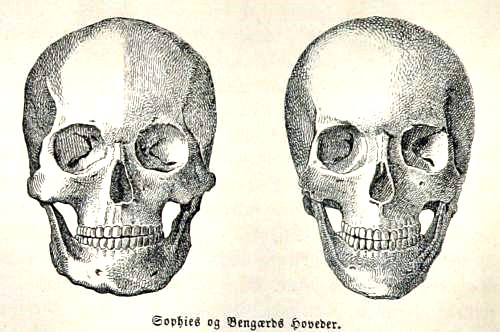
Sofie's and Berengaria's skulls drawn in connection with the opening of the tombs in Sct. Bendt's Church in Ringsted in 1858. Note their perfect teeth. Drawing in "Danmarks, Norges og Sveriges Historie" af N Bache Wikipedia.
Berengaria's three sons, Erik, Abel and Kristoffer, all became kings, but their mutual wars brought Denmark into misfortune and eventually led to the unlucky kingless time when Denmark was almost disintegrated. It may be those, who gave their mother her bad reputation.
As the oldest, Erik became king after his father - posterity has given him the byname Plowpenning. However, he was killed by his brother, Abel, and his body submerged in the fjord, Slien. A few years later, however, Abel himself was killed during a campaign in Ditmarsken and Kristoffer became king after him.
Their sister, Sofie, married Mark Count Johan of Brandenburg, the founder of Berlin. In 1247 she undertook the task of mediating between her brothers and therefore in the winter of 1247 traveled from Brandenburg to Denmark despite the fact that she was pregnant at this time. The journey was the cause of premature birth, which caused her death. She and the newborn child are buried in Flensburg.
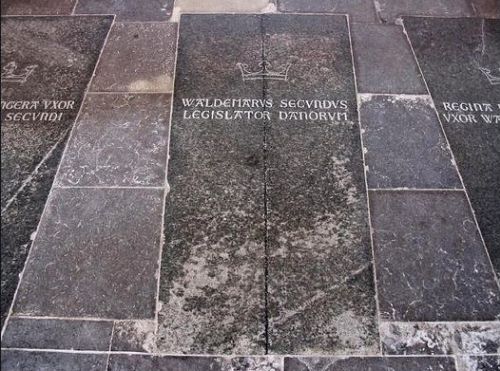
Valdemar the Victorious' grave in Sct. Bendt's Church in Ringsted.
Valdemar the Victorious died on Thursday, March 28, 1241 in Vordingborg. The king's sons, the country's bishops and many great men were present.
The cause of death is unknown, but bishops and great men from all over the country had had time to gather and therefore we can rule out sudden causes of death, such as hereditary heart disease, heart attack and the like. It must have been a disease from which he had suffered for quite some time and which was worsening.
He was then 71 years old and had ruled the country for 39 years.
|
Fuld tekst af Jyske Lov - Codex Holmiensis Det Kongelige Bibliotek Folkeviser Kalliope Ryd Klosters Krønike Heimskringla Dronning Dagmar Wikipedia Middelalderdragter Salmonsens Konversationsleksikon Otto Barnet af Braunschweig-Lüneburg Wikipedia Frederik 2. (Tysk-romerske rige) Wikipedia. Henrik af Schwerin Wikipedia. Kalkmalerier.dk Kalkmalerier.dk Arnold af Lybeks Slavekrønike Per Benny Paulsen Valdemar Salomonsens Konservationsleksikon Valdemar Sejr Wikipedia Valdemar 2. Sejr (1202 - 1241) Nationalmuseet Valdemar Den Store Danske Berengaria Den Store Danske Valdemar den Unge Den Store Danske Jyske Lov Det Kgl. Bibliotek Hertugdømmet Estland Wikiwand Kong Valdemars Jordebog Wikiwand Valdemar den Unge Sognets Historie Om Dronning Bengerd Sorø Amt 1931 Fortale til Jyske Lov, 1241 Overblik Sammenhæng Danmarks Stednavne Nordisk Forskningsinstitut Snorre Sturlasson Kongesagaer - Nationaludgaven 1930. Danmarks Historie 4 Kirker Rejses alle Vegne af Ole Fenger - Gyldendal 1989. Valdemarerne af Palle Lauring - Gyldendals Bogklub 1973. Danmarks Historie bind 3 Kongemagt og Kirke af Hal Koch - Politikens Forlag 1963. |
| To top |
