7. Similarities in heraldry and construction style
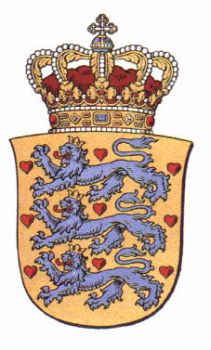
Lions have not lived in Western Europe since before the last ice age, yet royal coats of arms have shown a real passion for lions since coats of arms were introduced in the early Middle Ages at the same time as the Crusades. Both the famous Duke Henry the Lion of Saxony, King John of England, Richard the Lionheart of England, Canute 6. of Denmark, Count Baldwin of Flanders and King Ferdinand 3. of Castile - just to name a few - had quite similar lions in their coats of arms, all of which were kept in the lively and nervous style that we also know from the Scythian art of the the steppe and decorations in Qin and Han dynasty tombs in China.
This may indicate that this was precisely the artistic style of the Indo-European tribes, who in the past populated the steppe from Hungary to Inner Mongolia.
1. Artistic style
There are a number of striking similarities in the historical architectural style, shipbuilding and heraldry between China and Scandinavia.
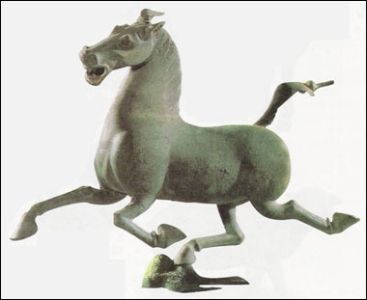
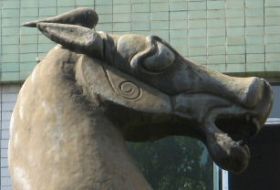
Left: Han Dynasty Bronze Horse from Gansu.
Right: The head of the horse from Gansu.
Note the curl it has under the ear. It resembles the one that the Cherchen man had painted on his temple. I understand that other mummies from the Tarim Basin also have such a figure painted on their temples. It also resembles the basic figure in the pattern on Qin Shi Huang's clothes. The image of the horse's head is from an enlarged copy. The curl can also be seen on the original horse.
Here is the famous Han dynasty horse, cast in bronze. The legs are raised high, the tail is in the air and the head is up, the nostrils are flared - elegant, nervous and lively.
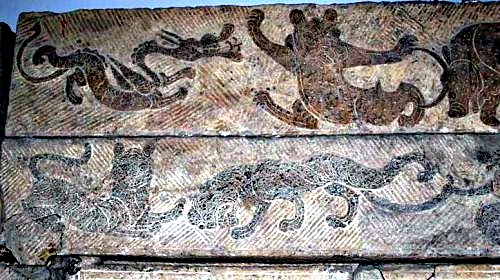
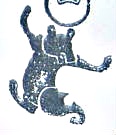
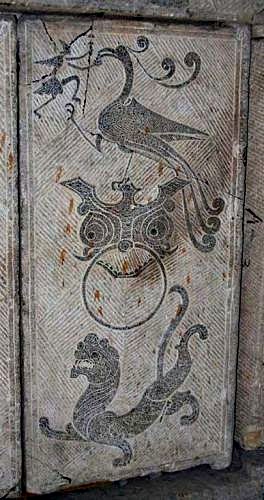
Panel from excavated Chinese house from Han Dynasty, which lasted about 400 years, namely 206 BC - 220 AD. It shows a small dancing man, a peacock, an eagle or bat with a ring and a potent lion. We must believe that the figures illustrate well-known tales, which are now long forgotten.
The three crowned lions in the Danish coat of arms, and in many other European heraldic animals, have the same nervous, elegant and lively style as the horse from Gansu. The heads high, their mouth open, the legs raised high and the tail raised high. Most European royal coats of arms contain something with lions. But there have been no lions in Western Europe since before the last ice age. Where did they get the idea?
Both Herodotus and Aristotle describe lions as common in Greece around 480 BC. They appear in Greek legends and myths, but became extinct around 100 BC.
Lions are said to have lived in Syria and Asia Minor until as late as the mid-19th century, and the Crusaders may have become acquainted with them there.
Motifs from a magnificent gold necklace found in a royal kurgan in Tovsta Mohyla, Pokrov, Ukraine, dated to the second half of the 4th century BC.
On the left are two griffins attacking a horse, and on the right are two lions, a female and a male, attacking a wild boar. This last is one of the few motifs with lions in Scythian art known in present day. But it is on the other hand very lifelike and anatomically quite correct.
We know Scythian art from the splendid finds of gold jewelry in the Ukraine, and we can believe that it was the general artistic style of all the Indo-European tribes across the steppe right to the area north of China, and that it is because of Indo-European influence that the decorations in a Han dynasty tomb are made in the same spirited and lively style.
During the 12th century, European kings and noble families created coat of arme, which often contain lions and eagles in lifelike positions, which style we recognize as characteristic of the Scythian tribes on the steppe of present-day Ukraine and probably the rest of the Indo-European peoples, who then populated the plain from the Hungarian Pusta to the plain of the Yalo River near Korea.
The horse from Gansu may represent one of the "horses that sweat blood", the "Heavenly Horses" of Fergana, which the Han emperor received from the Yuezhi people. They were the key to the victory over the Xiong-Nu.
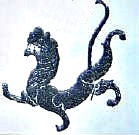
Decorations in an excavated Han dynasty house are kept in exactly the same elegant artistic style as the horse, a dancing bear, a leaping dragon and a potent lion. The Qin and Han dynasties seem to have been a time when anything was possible.
Panel from excavated Chinese house from Han Dynasty. It shows a leaping dragon, a dancing bear pursued by an attacking bull, a panther or lion, and a wolf. The figures must have illustrated well-known tales that have long been forgotten.
The Qin Dynasty only lasted a short time, namely 15 years, but it is nevertheless fundamental in Chinese history, because it united China in a lasting and ultimate way.
The Zhou Dynasty was China's longest-lasting dynasty, but after 789 years it had completely dissolved into seven states, which waged intense wars against each other.
The state of Qin was originally a barbarian duchy on the outskirts of the Zhou emperor's territory. But over the course of about 200 years, the king of Qin conquered the other states one by one and finally declared himself emperor of all China.
But upon the death of the first Qin emperor, rebellion broke out, and Qin men were persecuted and killed everywhere, the royal palace was burned down and the complex with terra cotta soldiers destroyed, but however not completely, as we know.
The subsequent Han dynasty was culturally very close to Qin, and they built on the imperial foundation of laws and regulations that the Qin dynasty had created. The Han dynasty subsequently lasted for 400 years.
2. Dragons on the roof
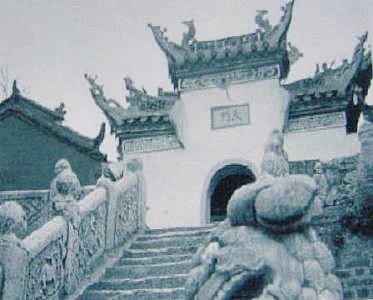
The tips of the gables of ancient Chinese buildings are often adorned with animal heads, dragon heads, or decorations resembling these.
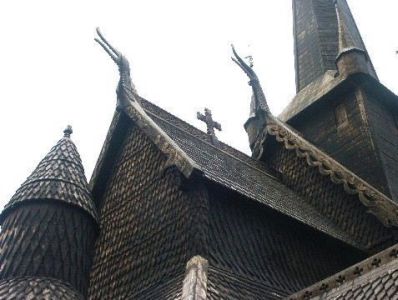
The Norwegian Borgund stave church with dragon heads on the roof.
Scandinavian buildings from the Viking Age, such as Norwegian stave churches, are also adorned with animal heads - which may be dragons - on the tips of the gables.
In almost all civilizations, the divine powers and their antagonists are believed to reside in the sky, or at least nearby, on high mountain, like the Greek gods, who lived on Mount Olympus.
The Chinese emperor went to a special Temple of Heaven every year and made offerings with prayers to the Heaven for a good harvest.
A dragon on the roof must have been thought of as a protection against evil forces, lightning strikes and hurricanes,
Left: Chinese Temple with dragons on the roof. Photo Chinese internet.
In the middle: Dragon head on the roof of Chinese temple. Photo Facebook.
Right: Dragon head on the roof of Chinese building. Photo Facebook.
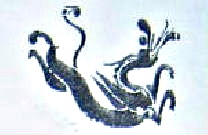
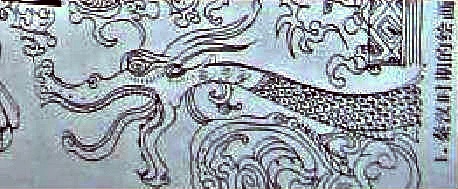
Left: Chinese Dragon from Qin-Han dynasty on silk painting from Ma Wang Dui in Hunan Province.
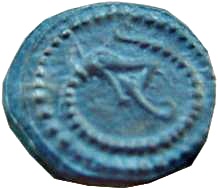
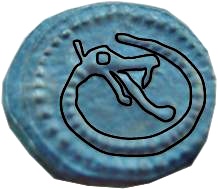
To the right: Coin from Dorestad, a so-called sceat, found in the Viking Age trading towns, Dorestad in Frisia and Ribe in Southern Jutland with a very similar dragon.
It is exactly the same crocodile-like type as on the silk painting from China, with its tongue sticking far out, or perhaps it is spitting fire. Even the neck tassel is pictured in the Dorestad coin. Photo Flemming Rickfors.
3. Dragon heads on ships
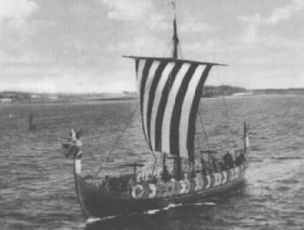
Every year, dragon boat races are held all over China. A dragon boat is a lighter version of a Viking ship, adorned with a dragon head on the bow.
Left: Scandinavian Viking ship with a dragon head on the bow.
Right: Traditional Chinese dragon boat. In the old days, they were used to wage war on the rivers. They are paddled like the Hjortespringboat. Can it really be a complete coincidence that both the Viking ships and the ancient Chinese warships look the same, with a dragon head on the bow?
In fact, it was common practice in ancient times to carry carved animal heads in the bows of ships. Rock carvings from the Scandinavian Bronze Age indicate that at least some of the ships carried a carved animal head fore or aft. A relief from the palace of Sargon II at Dur-Sharrukin, exhibited in the Louvre Museum, shows Phoenician ships with what looks like horse heads in the bows.
The Aesirs were originally a horse-riding people from the steppe. The skjalds always refer to ships as "horses of the sea", although no Viking ship is known to have carried a horse head in the bow.
A dragon-headed excursion boat on the Yalu River near Dandong with North Korea in the background. It looks like a Viking ship with a dragon's head on the bow. Those who built this excursion boat have probably never heard of the Vikings. They have simply followed tradition, so that's how it should look.
Also, the ancient Greek poem "Odysseus" compares a ship to a span of horses: "Like a team of stallions, a pack of four in hand, who together leap forward across the plain at a blow of the whip with their heads held high in their path, thus the ship's dust leaped into the water, and the glittering wave of the plowed sea foamed violently in her wake.
But already in the Viking Age people began to use something else than dragon heads, perhaps they were connected with the old religion. Encomium Emmae describes that Sweyn Forkbeard held a show of honor for the fleet prior to sailing for England: "For here one could see lions cast in gold on the prows," - "One could also see dolphins cast in bronze, and centaurs of the same metal, which made one remember the fabulous tales of the ancients."
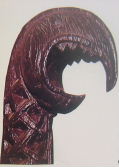
Left: A dragon head for a Viking ship found in the Schelde river. Photo Flemming Rickfors.
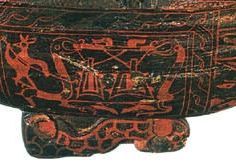
Right: A painted wooden duck from Han Dynasty China. A creature stands on a ship with something resembling a weapon in its hand. The ship has a dragon head, which is very similar to the one found in the Schelde River. Photo Flemming Rickfors
Later, figureheads were used, and with the advent of steamships, the idea of a ship having a soul was abandoned altogether.
4. Building structure
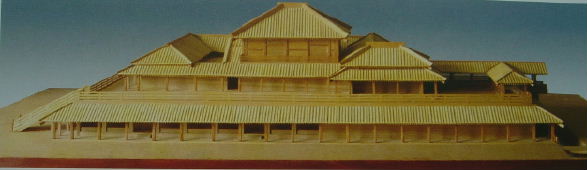
Pillar corridors and vaulted halls have a long tradition in ancient Chinese architecture, as can be clearly seen in the architecture of the Forbidden City in Beijing, the wide wooden verandas that actors move around on in the many historical series on Chinese TV, and the reconstruction of the Qin Imperial Palace in Xianyang's Municipal Museum.
Model of the Qin Imperial Palace - reconstruction in Xianyang's Municipal Museum. The palace was burned down by rebels in 202 BC almost before it was completed. It was probably reconstructed on foundation of postholes and the like.
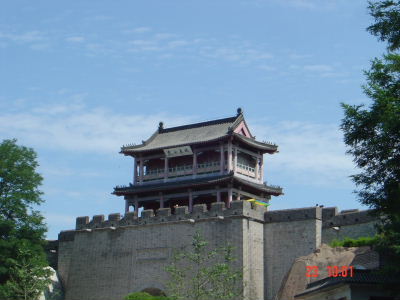
Old Chinese temples typically have a covered, shady entrance behind some pillars, and if they have several floors they are often equipped with a veranda all the way around. A bit like old American wooden houses in the prairie states, which in the front of the gable have a covered, shady terrace supported by some pillars, with room for a rocking chair.
Pillar galleries and verandas are an ancient Chinese style that can be traced back at least to the Qin dynasty, as can be seen in the reconstruction of the imperial palace in Xianyang's Municipal Museum.
the veranda is probably called a swallow's passage because it is a place where you can "cool off" (svale in danish) in the scorching heat of summer, and the bird that likes to build nests in such places came to be called a "swallow" quite naturally.
Chinese temple with swallow's passages both in the ground floor and the next floor. Photo Tripadvisor.
The Aesirs brought this style of building to Scandinavia, despite the fact that the need to cool off in the summer is not particularly great in these regions.
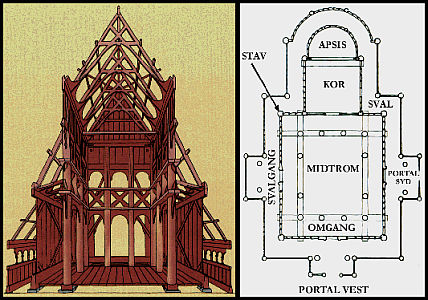
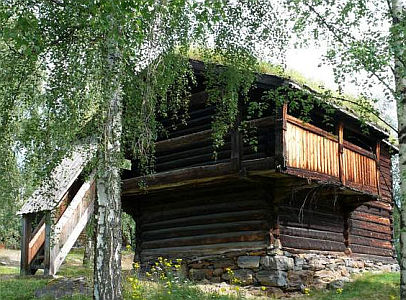
The Borgund Stave Church in Norway had thus originally a corridor all the way around. Many old buildings from the Scandinavian Middle Ages are constructed with a ground floor, which contains storage space, and rooms for practical purposes, an outdoor staircase leads up to a corridor on the first floor, and from this there is access to bedrooms.
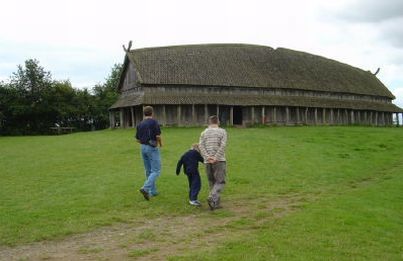
This type of building was probably introduced already in the Germanic Iron Age, not long after the arrival of the Aesirs. This is confirmed by the fact that the postholes from the Germanic Iron Age, which have been found in the Gudme area on Funen and in Gammel Lejre on Sjaelland, where the Aesirs and the Danes settled, have a very large diameter, indicating buildings with several floors.
Which is also confirmed by Ynglinge Saga's account of the Swedish king Fjoldne, who during a visit to King Frode in Lejre at night wanted to step down from his bedroom on the first floor in the name of nature, but subsequently went in through the wrong door, slipped and fell through a hole into a large vat og beer on the ground floor.
A swallow's passage is mentioned in the folk song "Roselil and her mother":
Sir Peder stood on the "swallow" and listened with cunning,
Sir Peder stood on the "swallow" and listened with cunning:
He laughs best, who laughs last!
Ha, ha, ha! Så, så, så, så!
He laughs best, who laughs last!
The original construction of the Norwegian Borgund Stave Church with swallow passage. Most of this was removed in the 18th century. Today, only the swallow passage in the entrance facade is preserved.
Borgund Stave Church was built around 1180, and it is the least changed of the Norwegian stave churche. The church is a so-called long church and has dragon heads on the the gables, carved portal and originally a narrow passage all the way around.
Helge Gjessing describes the building style in Tunsberg of Norway in the early Middle Ages. A gaard consisted of two halves, which had "verandas" that faced each other, so to speak mirrored each other, with a narrow courtyard in between.
"According to the city law, the so-called "gaard" was divided lengthwise into two parts, which created two buildings, each with its own gable; these buildings were separated from each other by a narrow courtyard." - "which was closed at each end by a courtyard gate. The two parts where the farm was divided in the yard probably originally had the same owner; however, over time they often came into different hands and were sold separately. A remnant of the old relationship can be seen in the fact that following the king, the gaard should be offered to the person with whom the owner has courtyard gates together. The courtyard gate is first mentioned in Tunsberg in 1015 during the Icelander Grette's stay in the town."
A Swedish sheriff's farm from the 17th century with a veranda, a "swallow".
In terms of interior design, the two parts of the farm were the same and both contained storage rooms and sales stalls as well as living rooms." - "On the second and third floors, if the houses were very hard, there was a storage room, a living room, the common place to hang out in the summer, and in addition the various bedrooms or lofts. These rooms were accessed by a staircase in the courtyard, which led up to a verandah that was built on the outside of the house. From there, doors led to the various rooms."
In the many Chinese historical TV series, the action often takes place in similar houses, with wide verandahs facing each other across a narrow courtyard. The author has not been able to find the historical source for such houses, but I am convinced that it exists.
5. Burial mounds
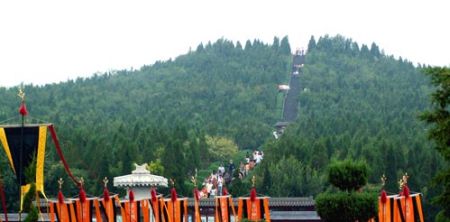
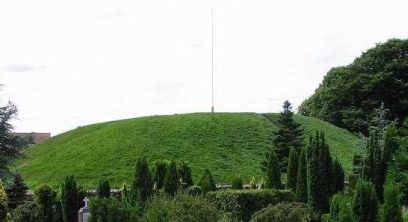
Among the Indo-European peoples of the steppe, the dead were buried. There are thousands of ancient burial mounds all over the Eurasian steppe. The first Qin ruler was also buried near Xian in an impressive burial mound. It resembles the Jelling Mound, but is of course many times larger.
Left: Qin Shi Huang's tomb at Xian.
Right: The Jelling Mound, which is very similar to the tomb of the first Qin emperor, only somewhat smaller, which cannot be explained away. The mound contained a square burial chamber.
6. Long defensive ramparts
Long defensive walls were quite popular a few thousand years ago. They were found in England, Scandinavia and of course in China. In England there was Hadrian's Wall, built by the Romans, and Offa's Dyke, which protected the English kingdom of Mercia from the native tribes of Wales. In Denmark we have Dannevirke near Slesvig as well as many smaller ramparts from the Roman Iron Age.
Left: Hadrian's Wall in Northern England near Scotland. Photo quisnovus from Gloucester Wikipedia.
Right: Offas Dyke between Wales and the English kingdom of Mercia. Photo Chris Heaton Wikipedia.
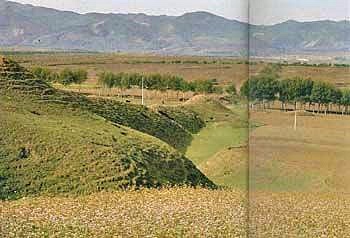
In ancient China, many of the original states had border defence ramparts to the north for protection against the so-called "Rong" tribes on the steppe. When the Qin conquered all of China around 200 BC, they connected these original ramparts, thereby The Great Wall of China was created.
The impressive wall that we know today was built by the Ming and Qing dynasties some hundred years ago. The original ancient ramparts, which were built two thousand years ago, were undoubtedly more "rampart"-like.
Left: The Great Wall in North China at Badaling. Photo Wikipedia.
In the middle: Qin dynasty part of the Great Wall of China in Ning Xia north of Guyuan. Photo Chinese internet.
Right: Dannevirke. Photo Paal Sørensen Wikipedia.