Snorre explicitly state that the Aesir came from Asia, which is also reflected in their name. We know from history that many of the ancient horsemen of the eastern steppe used Chinese as craftsmen and administrators. It is known that the Xinbei tribes on the plains of what is now Inner Mongolia did so, and even Genghis Khan had a Chinese administrator. It is very likely that the Aesir also had Chinese specialists attached.
Therefore, when it is said in the Younger Edda that "Vodin set out from Tyrkland and with him he had a great host, old and young people, men and women, and they had many precious things with them," then they must have included their Chinese experts in metalworking and other crafts.
The dwarves must have been a big hit in Scandinavia. Everyone must have heard of them. Snorri begins rather directly - without long explanations - to list their names, which suggests that they really existed.
1. The creation of the dwarves
The Edda poems are populated by many different races, including aesirs, vanirs, elves, jaets and dwarves. We can believe that it is not pure poetry - that these designations denote real races or people groups that have existed in a - possibly distant - past, and have made their contribution to the genes of modern danes.
The dwarves were created from the blood and bones of the primeval giant Ymer, it is said. That is, water and mountains. The Völvens Spådom tells of the origin of the dwarves:
All the Creators went
to the Chair of Fate,
each most holy God,
and then held counsel,
about the hosts of the Dwarves
who were created to life
from Brimer's blood,
from Blain's bones.
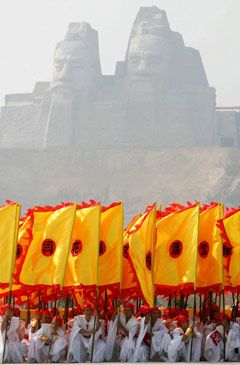
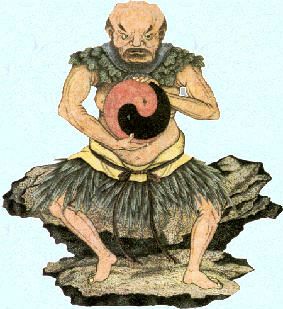
The Chinese Primordial Giant Pan Ku.
Brimer and Blain are pseudonyms for the primordial giant Ymer, and his body was, as is well known, used to create the Earth.
The Scandinavian creation myth tells that in the beginning there was an enormous nothing, "Ginnungagap". But when the ice and cold from the northern Niflheim met their opposites, the heat and fire from the southern Muspelheim, dew fell in the middle of Ginnungagap, and in this mild climate the primeval giant Ymer arose.
The Aesirs, who were Odin, Vile and Ve, killed Ymer, and from his body they created the World.
The Chinese have a somewhat similar creation myth. They say that in the beginning everything was chaos. But when the two opposite forces, ying and yang, met each other, they created the primeval giant Pan Ku.
From his own body, Pan Ku created the earth. His head became a mountain, his breath became clouds, and his voice became thunder. His skin became plains, his hair became trees, his bones became metals, and his veins became rivers. From the insects that crawled on Pan Ku's body, humans, that is the chinese, were created.
The Chinese description of how the humans, that is the Chinese, were created, is thus very similar to the creation story in the Edda, which goes:
"From Ymer's giant flesh the earth was created
and from wound-sweat the sea;
Mountains from his bones, bushes from his hair.
The sky from his skull."
Ymer's blood became the rivers and the sea, his flesh became the solid land, his bones became rocks and mountains. From the maggots that crawled in his flesh, the dwarves were created. The latter was obvious, since the chinese themselves had said that they were created by some kind of creepers that crawled around on the primeval giant.
2. The dwarves
The Vølven's Prophecy is the first poem in the Elder Edda, which was written down around 1200 AD in Iceland, but the stories themselves are much older. A völve was a sorceress, who could see into both the past and the future. The poem is shaped like a monologue, and it tells of the creation, destruction and resurrection of the world.
At the end of The Vølven's Prophecy, a very serious situation is implied:
What do the Aesir do?
What do the Elves do?
All Jotunheim is shaking,
Gods are holding ting.
Dwarves groan
at stone doors
All the Creators went
to the Chairs of Fate,
each most holy God,
and then held council,
about the flocks of the Dwarves
The Aesir had decided to leave the eastern steppe and go west, to find greener and more fertile lands, where they could live in peace. But they had among them many Chinese craftsmen and other experts, with whom they had probably lived for generations. They "held counsel about the flocks of the Dwarves", and decided that they should join them on the journey west.
The Vølven's Prophecy mentions the individual dwarves by name, so one must believe that they were people who really existed and not just a literary invention.
There seem to have been various groups of dwarves such as Durin's and Dvalin's flocks and Lofar's offspring:
Greatest among them
Modsogner was,
but Durin became
the next of the Dwarves.
Many they formed
with human features
in the Land of the Dwarves,
as Durin said.
Nye, Nide,
Nordre, Sudre,
Austre, Vestre,
Altjof, Dvalin,
Nar og Nain,
Niping, Dain,
Bivar, Bavar,
Bambor, Nore,
An og Anar,
Ae, Modvitner.
Veig og Gandalf,
Vindalf, Torin,
Tekk og Train
Tror, Vit, Lit,
Nar og Regin,
Nyrad, Radvid -
there are all
the Dwarves mentioned.
File, Kile,
Funden, Nåle,
Hepte, Vile,
Hannar, Svior,
Billing, Brune,
Bild og Bure,
Frar, Hornbore,
Fræg og Lone,
Aurvang, Jare,
Eikenskjalde.
Now all the Dwarves
in Dvalin's flock
until Lofar
are to be enumerated - listen -
Those who searched
from the stones of the lake bottom
over the Dyndvangsseat
to the sandy ground.
There were Draupner
and Dolgtraser,
Har, Haugspore,
Hlevang, Gloin,
Skirfer, Virfer,
Skafid, Ae.
Alf and lngve,
Eikensjalde,
Fjalar, Froste,
Fid and Ginnar.
Until the end of the world
one must always remember
the offspring of Lofar,
I listed here.
From "The Vølvens's Prophecy" translated by Olaf Hansen 1911
At the end of the prophecy, Vølven suggests that at least some of the dwarves came from a kingdom to the north that no longer existed:
To the north
on the Nidesletten
a Hall of Gold stood -
it was Sindre's lineage.
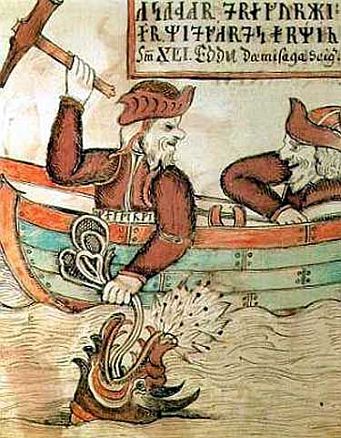
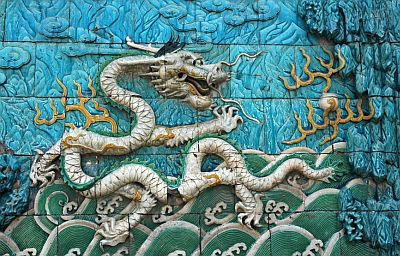
Scandinavian and Chinese dragons are very similar to each other.
On the left: Thor is fishing with the jaet Hrymer and gets the Midgard Dragon on the hook. - Icelandic drawing from the seventeenth century.
On the right: Dragon from the Nine Dragon Wall in the Forbidden City.
The chinese dragons lived at the bottom of the lakes. The first and largest dragon lived in the World Ocean.
The dwarves were very similar to other people, as it says:
"Next the Dwarves.
Many they formed
with human features"
But since they were called dwarves, one must believe that they were shorter in stature than the Aesir.
3. Dwarves and aesirs
For thousands of years, the Chinese have called their Japanese neighbors "dwarves" because they were somewhat shorter in stature than themselves. That's just how it is done in those parts of the world.
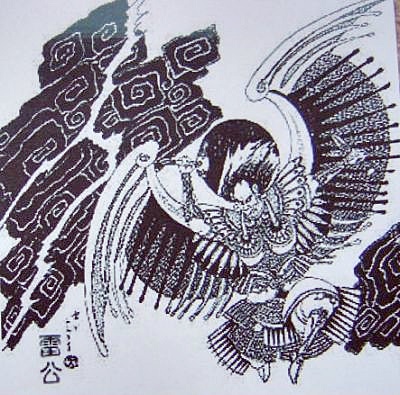
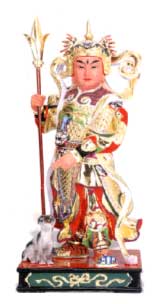
Left: Chinese thunder god with a short-handled hammer, with which he produces thunder. Found on the Chinese internet in 2011.
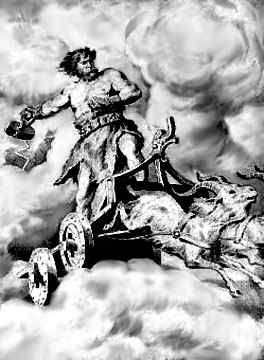
Right: the thunder god Thor with Mjølner - a short-handled hammer. Photo of unknown origin.
Overall, the relationship between the Aesir and the dwarves seems to have been quite friendly. In Scandinavian myths, Thor was often away from Asgard to battle against the jaets. We never hear of him being away to fight the dwarves.
Once, when Thor had been away for years on a war campaign against the jaets, a marriage was arranged between the learned dwarf Alvis and Thor's daughter. However, he managed to get home in time to have it thwarted. This is told in the poem "Alvismal".
In the old days, the Chinese emperor was greeted by shouting three times: "Long live the emperor". The Danes have the same custom, but over time rationalized to: "Long live -," and then three times hurrah.
Left: Chinese dragon on silk painting found in Ma Wang Dui in the province of Hunan. Photo Flemming Rickfors.
Right: Coin from Dorestad and Ribe, a "sceat" from around 700 AD with a similar dragon. Note the crocodile-like mouth, the long tongue and the characteristic neck tuft. Photo Flemming Rickfors.
The largest of the aesirs' dragons, the Midgard Serpent, lived at the bottom of the sea. In Asgard, in the heart of Asia, it must have lived at the bottom of one of the great lakes there. Later it moved with the aesir to the World Ocean.
The emperor's byname was The Great Dragon or The Great Serpent. The emperor's throne is the Dragon Throne. The Chinese were the children of the Great Serpent, that is, they obeyed the Great Serpent in the same way that children obey their father.
In Zhaoqing in southern China, halfway between Guangzhou and at the border with the neighboring province of Guangxi, there is a park called "Seven Star Lake". Here is a cave with 108 mythological figures from ancient China. These are small statues, all erected by local people for the purpose of entertainment and information.
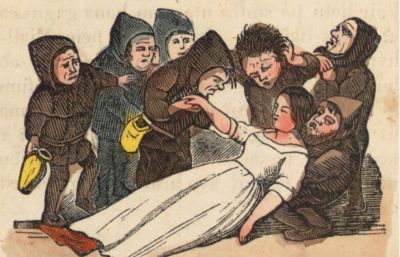
The seven mountain men, who are Erlang's companions, also appear in the western folk tale "Snow White and the Seven Dwarfs", which was collected and written down by the Brothers Grimm in the 19th century in Germany. Photo Landsbokasafn Iceland Wikipedia.
Among these is a thunder god, "Da-lai Gong Gong", which means "Grandfather Thunder". He is depicted with a hammer with a short handle, which he uses to evoke thunder. We recognize him as the thunder god Thor or at least one of his close colleagues. Thor's hammer "Mjølner" also had a short handle, as is well known.
The myth of the god "Erlang" comes from Sichuan. The stories about Erlang have some themes in common with Beowulf's journey to the Danish court and his killing of the monster Grendel at the bottom of the lake, as well as with the fairy tale about the seven dwarfs.
The king of Qin appointed Li Bing as governor of Sichuan. The new governor arranged for the construction of an extensive system of dams and canals. The intention was to improve irrigation and prevent flooding.
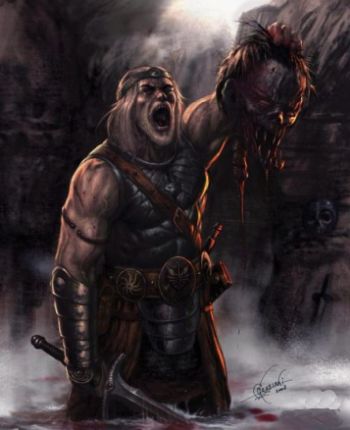
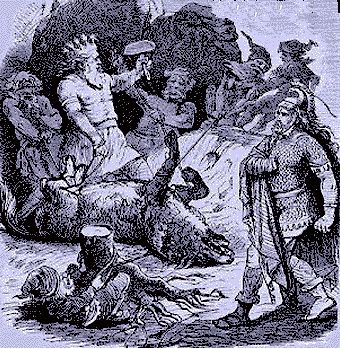
Beowulf returns triumphantly to the surface with Grendel's head in his hand.
In the Old English poem Beowulf, the hero dives to the bottom of the lake and kills a monster.
The poem Beowulf tells the story of the gothic prince Beowulf traveling to the court of the Danish king to free him from the terrible monster, Grendel, who was ravaging his halls at night and killing and devouring his men. Beowulf managed to mortally wound Grendel when the monster sought a meal in a hall, where Beowulf and his men were waiting. Grendel retreated to his lake and sought refuge in the deep water. But the king's halls were now attacked by Grendel's mother, who wanted to avenge her son. Beowulf got dressed in magical armor and dived into the depths of the lake to kill the monster. He came to an underwater cave, where he fought with Grendel's mother and defeated her with the help of a magical sword. He found Grendel's body in the cave and cut off its head. With this in his hand, he triumphantly rose to the surface of the lake. Digital drawing by Kristin Ishaya - Pinterest.
The king's second son, Erlang, helped him build the advanced irrigation system that still exists and is in use today.
However, before the facility was built, the area was frequently hit by floods.
Erlang was ordered to find the cause of the disasters and prevent them. From spring to winter, he made many difficult journeys, but he did not succeed in finding, what he was looking for. One day, while traveling deep in the mountains, he met a tiger. Erlang immediately killed it and cut off its head. At that moment, seven hunters arrived, amazed at the sight of Erlang's bravery. Knowing Erlang's difficult task, they asked him to become his companions. Erlang accepted their friendship.
Modern Chinese representation of God Erlang with his trident and the third eye in his forehead.
Once, when Erlang and his seven friends and companions approached a thatched hut by the river, they heard someone crying. It turned out to be an old woman crying because her youngest grandson had been taken away to be sacrificed to the river god, an evil dragon.
Erlang and his friends sneaked into the river god's temple and hid behind a statue. When the dragon entered, they charged forward with their weapons. The dragon turned and jumped into the river. Erlang and his friends pursued it to the bottom of the river. There they caught the evil dragon and chained it to a rock. Then the floods stopped.
Another story about Erlang tells that a man named Zhao Yu was given the task by the emperor to fight an evil river dragon. With his double-edged sword in hand, he jumped into the river. There he killed the dragon. The river water turned red with its blood. When he climbed out of the river, he held his double-edged sword in his right hand and the dragon's severed head in his left. All the people knelt in reverence.
They erected a temple in his honor called "God Erlang of Guankou". During floods, the god can still be seen riding a white horse in the mist across the streams.
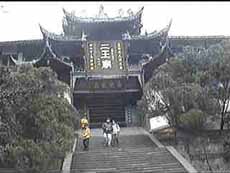
Erwang Temple in Guanxian, Sichuan.
A third story about Erlang and his seven friends and companions tells that they were seven holy men from the mines of the coal mountain. Because they helped a tyrant with his evil deeds, they were all killed by Nezha and Yang Jian. According to "The Chronicle of Chengdu Prefecture", they were all seven hunters and friends of Erlang. It is said that they had a very distinctive appearance, and they were also called "The Seven Monsters". All this gives associations in the direction of the story of "Snow White and the Seven Dwarfs".
The name Erlang means the second son. He is armed with a double-edged weapon, like the Roman god Neptune. He has a third eye in his forehead, which is an Indo-European feature.
In ancient times, the statues of Erlang's seven friends and companions stood in the Erwang Temple in Guanxian in Sichuan. However, this temple has been destroyed and rebuilt many times throughout history, and their statues can no longer be found.
Erwang means "Two Kings". It is so called because both Erlang and his father were later given the status of kings. However, many call it the Erlang Temple.
4. The dwarfs' products
The dwarves of Norse mythology were known as skilled craftsmen. But they were often subjected to the envy and greed of the aesirs.
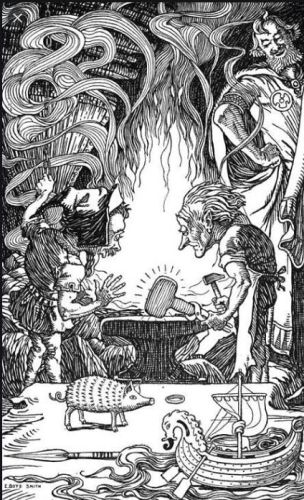
The dwarves Sindre and Brok forge the hammer Mjølner. In the foreground are other of their products, namely the boar Gyldenbørset and the ring Draupner. However, the spear Gungner, Sif's golden hair and the ship Skidbladner were made by their competitors, the sons of Ivalde. Drawing: Elmer Boyd Smith (1860 - 1943) - page 88 in Brown, Abbie Farwell (1902). "In the Days of Giants: A Book of Norse Tales" Illustrations by E. Boyd Smith. Houghton, Mifflin & Co. - Wikipedia.
Once Loki cut the hair of Thor's wife, Sif, while she was sleeping. She was unhappy, and Thor became furious with Loki and threatened to break every bone in his body if he did not provide Sif with new hair. But it had to be not just ordinary hair - no, it had to be made of gold, and it had to be able to grow on the scalp like normal hair.
In his distress, Loki sought out the dwarves of Ivalde's sons and asked them for help in creating such hair. They took on the task and promised to produce two more wonders, namely the ship Skidbladner and the spear Gungner.
Convinced that the three objects were second to none, he boasted to the dwarves Brok and Sindre that no one could produce things as magnificent as Ivalde's sons could. "I dare put my head on that," said Loki.
It ended with Brok and Sindre making the boar Golden Brush, the ring Draupner and not least the hammer Mjølner.
Odin, Thor and Frey were the judges in the competition between Ivalde's sons and the brothers Brok and Sindre. They thought that all the things were unique, but thought that Brok and Sindre had made the most beautiful and unique things, and named them the winners.
Now Brok and Sindre demanded Loki's head, which was the promised prize. Loki instead offered Brok a sum of money, but the dwarf said no. He then tried to run away, but was brought back by Thor. But Loki tricked them by saying: "Just take my head, it's yours, but don't touch my neck, because it's mine". Therefore, the brothers could not cut off his head. Furious at having been deceived by Loki's eloquence, the brothers instead took an awl and sewed his mouth together with a leather strap.
The chain Gleipner, which the Aesir used to bind the Fenris wolf, was created by the dwarves in the land of the black elves.
The broken sword Gram was reforged by the dwarf Regin.
Freja's necklace, Brisingegammen, was created by the four dwarves Alfrigg, Berling, Dvalin and Grerr, who were called "the Brisingers"
5. Sif's golden hair
It is told in Skjaldskabermal in the Younger Edda that Loki cut the hair of Thor's wife, Sif, while she was sleeping. She became unhappy, and Thor became furious with Loki and threatened to break every bone in his body, if he did not make new hair for Sif. It had to be not just ordinary hair - it had to be made of gold, and it had to stick to the scalp and grow like normal hair.
The episode with Sif's golden hair was the occasion for the dwarves to forge many unique and wonderful objects for the aesirs. Ivalde's sons, created Sif's golden hair along with the spear Gungner and the ship Skidbladner.
But perhaps Thor was a little naive.
Sif sleeping in the forest as Loki approaches to cut her hair. Drawing by A. Chase 1894 in "Legends of Norseland" - Wikipedia.
In some historical cultures, women's hair was considered a symbol of their femininity and their place in society. Adultery meant that a woman lost her position in society, and therefore her hair was cut off. This punishment has regularly been repeated in the form of punishment against women, who have had intercourse with the enemy. This happened among others in Denmark in 1945 with the "field mattresses".
Thor was often away for very long periods to fight against the jaets. There are accounts of Sif being visited by other men. In the Song of Harbard in the Elder Edda, Odin has taken the shape of a ferryman and addresses Thor as follows:
"Sif has a whore at home;
you must go and seek him.
You must practice that work;
I consider that better."
During Ægir's feast, Loki claims to Sif that he himself had had intercourse with her, and he should know:
If it were you,
you alone were
shy and stingy towards men.
One I know,
as far as I believe
who broke Hlorride's marriage;
and that was the treacherous Loki.
6. The hammer Mjølner
The hammer Mjølner was Thor's most important weapon in his eternal battle against the jaets. Mjølner means "the crusher". It had the property that it always hit its target when thrown, and it always returned of its own accord to the thrower's hand. When Thor swings the hammer, it creates thunder and lightning, which is why Thor is called the thunder god.
The poem Skaldskaparmal in the Younger Edda tells how Mjølner was created.
Loki was an inventive prankster among the gods. He had the idea to cut the golden hair of Thor's wife, Sif, while she was sleeping. Thor became furious and threatened to break every bone in his body if he did not repair the damage. So Loki went to the sons of Ivalde, the dwarves, and asked them to take on the difficult task of making new golden hair for Sif.
Ivalde's sons accepted the challenge to show their professional skills, and in addition to the beautiful golden hair that grew like normal hair, they forged the spear Gungner and the ship Skidbladnir.
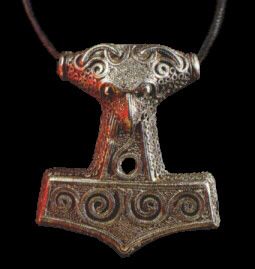
A silver-plated Thor's hammer amulet found in Scania, which once belonged to Baron Claes Kurck's collection.
Around 1,000 Thor's hammer amulets from the Viking Age have been found scattered across Scandinavia, Great Britain, Russia and the Baltic countries. They were the aesir faith's answer to the Christian cross. Ola Myrin, Statens historiska museum/SHM - The Viking World Wikipedia.
Then Loki went to Ivalde's sons' competitors, the dwarves Brok and Sindre, who were brothers, betting his own head that they could not make something equally wonderful.
Brok and Sindre took up the challenge and forged the boar Gullinbursti and the ring Draupner.
But when they then began to forge the hammer Mjølner, Loki became afraid that he would lose the bet and with it his head. He transformed himself into a fly and bit Brok in the eyelid, just as the work on Mjølner was at its most critical stage. The result was that Mjølner got a slightly shorter handle than most hammers, but this did not diminish its magical properties in battle and war.
7. The chain Gleipner
In the Prose Edda it is said that Loki fathered the Fenris wolf with the jaet women Angerboda. The wolf grew up with the aesirs in Asgard, when it was a puppy. It grew so large and terrifying that only Tyr dared to feed it.
The aesirs decided that for safety's sake the wolf should be bound before it became too strong. They forged a very strong chain, called Løding, and lured the Fenris wolf into allowing itself to be bound with it, telling it that it was a kind of friendly test of strength. But the wolf easily broke it.
Then they tied the wolf with the chain Drome, which was twice as strong, but the wolf also broke this chain, so that the pieces flew in all directions.
The Aesir bind the Fenris wolf with the dwarves' thin chain. Gold Bracteate from the Germanic Iron Age around 600 AD found at Troldhättan in Vester Gotland in Sweden, which shows how Tyr lost his hand when the aesirs bound the Fenris wolf at Ulveled. Tyr holds his left hand in the wolf's mouth, and he has no sword. He has quite long hair - Photo Reddit.
Now the Aesirs were in serious trouble. They sent the messenger Skirner to the dwarves in the land of the black elves and asked them to forge a chain that would be strong enough. They took on the task and forged the chain Gleipner.
The dwarves knew that to forge a chain that no one could break, they had to use what no one could find. And in the deep halls underground in the land of the black elves they set about forging a chain made of fish breath, bird spittle, bear sinews, mountain roots, women's beards and the sound of cat paws.
They called it Gleipner because it resembled an insignificance. It was smooth and soft like a silk ribbon, yet stronger than any chain of iron. When the Aesir saw it, they immediately knew that this was their chance to bind the Fenris wolf.
Gleipner appeared like othing, but the wolf sensed that there was deceit and treachery behind it, and it would only let itself be bound if one of the Aesir would put his hand in its mouth as security. Tyr stepped forward and put his hand in its mouth. As expected, it turned out that Fenris could not break Gleipner. Snorri says: "Then everyone laughed. Except Tyr. He lost his hand".
The Aesir bound the Fenris wolf with the dwarves' thin chain and placed it deep underground far out in Udgaard with a sword in its jaws. "Here it shall lie until Ragnarok" ends the story. Icelandic drawing from the seventeenth century.
The Aesir used the chain Gleipner to bind the Fenris wolf to a stone deep underground far out in Udgaard, where it stands and howls. To prevent it from snapping at the aesirs, they placed a sword at an angle in its mouth, and the foam from its mouth creates the river that runs through Udgaard.
8. The ring Draupner
The dwarves Sindre and Brok forged the ring Draupner, which they gave to Odin. Draupner means "the dripper", because every ninth night eight new rings "drip" down from "Draupner" - all as heavy and solid as the original ring.
Upper part of the hilt of the magnificent sword from Kyndby near Frederikssund in Denmark. It is a so-called ring sword from the Germanic Iron Age around 600 AD. This means that an eyelet and a ring, sometimes in gold, have been added to its hilt as decoration, initially in two separate parts but over time worked together into one massive piece. It is believed that the ring is meant to symbolize the owner's loyalty to the prince, the ring giver, probably the king.
Odin placed the ring Draupner with his dead son, Balder, at his funeral pyre. When Hermod rode down to the realm of the dead with a vain prayer to have him returned to the living, Balder gave him Draupner back.
The Danish Iron Age king, Rolf Krake, gave the young man, Vøgg, not just one, but two, gold rings, thereby binding him to him in fidelity until death.
Still in modern times, a golden ring on the ring finger of the left hand symbolizes loyalty and fidelity.
9. The sword Gram
The Vølsunga Saga tells that in a European kingdom, perhaps on the Rhine, Sigmund celebrated the wedding of his sister, Signy, to King Siggeir. In the middle of the hall grew the tree Barnstok.
Suddenly a tall stranger with only one eye arrived. He brought a magnificent sword, which he stuck into the tree right up to the hilt, and said "The man who pulls this sword out of the trunk shall receive it from me as a gift, and he will find that he has never carried a better sword than this." The stranger was Odin. He left again immediately after the wedding feast.
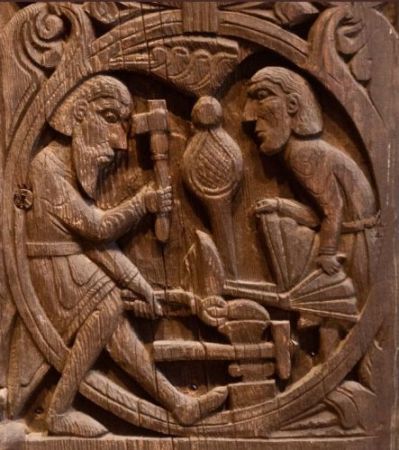
The dwarf Regin reforges the broken sword, Gram, with Sigurd at the bellows. Detail from the Sigurd portal in Hylestad Stave Church from 1175. Photo Twitter.
Everyone tried in vain to pull the sword out of the tree, but Sigmund pulled it out easily. The sword was named Gram, which means "angry".
But it was a magnificent sword, which aroused King Siggeir's desire. He offered three times the sword's weight in gold, but Sigmund refused. Then he captured Sigurd and all his brothers and threw them into an underground hole. But thanks be his sister Signy and the sword Sigmund won his freedom.
With the sword Gram in hand, Sigmund won victory in many battles, but in his last fight against King Lyngvi he met Odin, and the sword broke in two against Odin's spear, Gungner.
Sigmund's wife and now widow, Hjørdis, hid the two halves of the sword.
Sigmund and Hjørdis' son, Sigurd, was apprenticed to a master blacksmith, the dwarf Regin, to learn the noble blacksmithing craft.
After some time, Regin told the young Sigurd about the dragon Fafner, who was brooding over a mighty treasure of gold and silver, and asked Sigurd to kill it for him. Sigurd accepted on condition that Regin made him a sword that was capable of killing such a monster.
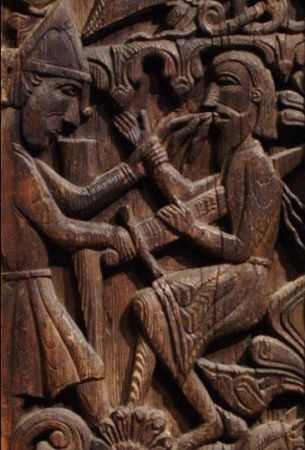
Sigurd kills his foster father, the dwarf Regin. Detail from the Sigurd portal in Hylestad Stave Church from 1175. Photo Jeblad Wikipedia.
Regin forged an admirable sword for Sigurd, but when Sigurd tried it, it broke at the first blow. On his second attempt, Regin forged him a sword that was better than the first, but it also broke.
Next, Sigurd retrieved the broken sword, Gram, from his mother and asked Regin to reforge it, and when he tried it, he split an iron anvil completely through and the sword did not break.
Sigurd hid in a ditch, and when the dragon Fafner crawled over it, Sigurd stabbed it in the stomach with the sword Gram so deeply that his right arm became bloody all the way up to the shoulder.
Regin drank Fafner's blood and asked Sigurd to roast the dragon's heart for him. But in doing so, Sigurd became able to understand the birds' chirping, and they said that Sigurd should eat the heart himself, and that Regin would kill him and keep all the treasure for himself.
Sigurd then killed Regin and took as much of the treasure as he could carry, and rode away on his horse, Grani.
10. The ring Andvaranaut
The ring Andvaranaut is so named because it originally belonged to a rich dwarf named Andvari. Andvaranaut means "Gift from Andvari".
Both the Elder and Younger Eddas tell that the Aesirs, Odin, Loki and Høner, wandered through the world. When they became hungry, Loki killed an otter. They sought shelter with a dwarf named Hreidmar for lodging for the night and to prepare the otter.
But Hreidmar recognized in the killed otter his son, Otr, which means "otter", who not only bore this name, but also had the magical ability to transform himself into an otter and in this form catch fish in a waterfall.
Hreidmar and his two other sons, Fafnir and Regin, demanded that the aesirs be punished for the killing of Otr, but the Aesir had no gold to pay the penalty.
On the Drävle runestone from the early 11th century, on the left is the dwarf Andvari with the ring Andvaranaut, at the top of the picture is Sigurd, who kills Fafner by stabbing the sword Gram into its belly, and on the right is Brynhilde or Gudrun, who offers him a drinking horn.
But Odin knew that not far away lived a dwarf named Andvari, who owned a great treasure. Andvari lived in the water like a fish.
He sent Loki out to obtain gold by taking it from Andvari.
Loki captured Andvari and forced him to hand over all his gold down to the very last piece, which was the ring Andvaranaut.
This ring had the same property as Draupner, namely that it dripped or created gold, and Andvari wanted to keep it so that he could rebuild his fortune. But Loki showed no mercy and took this last piece of gold as well, much to Andvari's regret.
Then Andvari cursed his ring: "It will bring death to two brothers and feud to eight princes, and it will be of no use." Then Andvari disappeared into a stone. Loki gave the treasure and the ring to Odin, and Odin put the ring aside for himself.
Hreidmar demanded that the penalty should be so big that the entire body of the otter should be covered with gold. But when the aesirs had used all of Andvari's treasure to cover the otter, Hreidmar pointed out that a hair was still sticking out. Reluctantly, Odin found the ring Andvaranaut and covered the hair, and then he cursed the ring.
Now the ring Andvaranaut was cursed by both the dwarf Andvari and Odin.
But Hreidmar refused to share the gold with his sons, Fafner and Regin, and therefore Fafner was so angry that he killed his father and took all the gold, including Andvaranaut, for himself.
But the curse of the ring rested on him, and because of his greed he was transformed into a dragon, who brooded over the treasure alone on Gnitahede.
Hreidmar's second son, Regin, became a master blacksmith in a kingdom on the Rhine River. Here he took the young king's son, Sigurd, as an apprentice and foster son, so that he could be trained in the noble blacksmith's craft.
Sigurd kills the dragon Fafner by sticking the sword Gram into its soft belly from below, so that he becomes bloody all the way to the shoulder. Carving on Hylested Stave Church in Norway from the twelfth century. Photo Jeblad Wikipedia.
Vølsunge Saga tells that Regin knew, where Fafner was brooding over the treasure, and he persuaded the young Sigurd to kill the dragon with the sword Gram, which happened. But Regin wanted all the treasure for himself and planned to kill the king's son, which the birds' chirping revealed to Sigurd, who therefore killed Regin.
For his feat, Sigurd was bynamed Fafnersbane. He took as much gold as his horse, Grani, could carry, including the ring Andvaranaut, and rode away.
But the curse of the ring followed him and led to lies, hatred, death and overwhelming tragedy.
Sigurd freed a shieldmaiden, Brynhilde, who was sleeping in a castle surrounded by flames. He fell in love with her, but did not want to marry until he had his own kingdom. He got that, but in the meantime he had fallen in love with the beautiful Gudrun, and the scorned Brynhilde was lured to marry Gudrun's brother, Gunnar.
Gudrun's mother made a magic potion that made Sigurd forget Brynhilde and love Gudrun. Brynhilde was tricked into marrying Gudrun's brother. But when Brynhilde heard of the deception, she demanded that Sigurd be killed. When that was done, she lay down on his funeral pyre by his side.
11. The spear Gungner
Loki had the dwarves Ivalde's Sons make new golden hair for Thor's wife Sif, to replace what he had cut off, while she was sleeping. But at the same time they wanted to demonstrate their technological skills by producing two more unique things, namely the ship Skidbladner, which could sail in both tailwind and headwind, and the spear Gungner, which always hit the target at which it was thrown, piercing it.
The dwarves gave the spear Gungner to Odin.
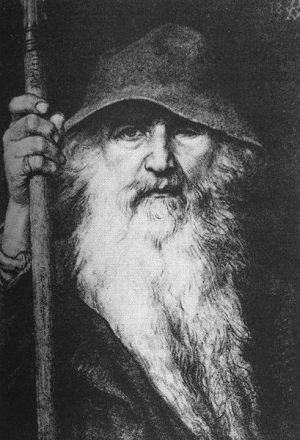
Odin with the spear Gungner - painting by Georg von Rosen 1886.
The name Gungner comes from the Old Norse Gungnir "the shaker".
After killing the dragon Fafner, Sigurd rode south and found a shield castle that shone as if it were on fire. Inside the castle he found a sleeping warrior clad in chain mail. The mail was stuck as if it had grown into the flesh. With his sword Gram he painstakingly cut away the armour and found that the warrior was a woman, a shieldmaiden named Brynhild.
In Sigrdrifumal she tells Sigurd about the magical uses of runes. Among other things, she reveals that runes were carved into the blade of the spear Gungner.
"on Gungnes Odd
and on Granes chest,
on Nornens Nail
and on Owls beak."
As we can deduce from history, the gothic people of the Migration Period came mainly from Scandinavia. When they came into contact with the Roman Empire, almost all of them were converted to the Arian version of Christianity.
Catholic popes and bishops have since had all Arian writings burned, and all Arian Christians have been converted to Catholicism. The last ones - as far as is known - were the Goths in Spain around 600 AD. We know very little about what was special about the Arian version of Christianity.
It can be deduced from the large amount of gold found in Scandinavia from the Germanic Iron Age around 550-750 AD that many goths returned home with all their gold when the dust of the migration period had settled. But where did their Christianity go?
Widukind writes in the Saxon Chronicle from around 967 AD - Third book, verse 65: "The Danes were Christians from ancient times, but nevertheless served the idols according to pagan customs."
Odin hangs in the tree marked by a spear.
In Havamal it is told:
I know that I hung
in a wind-blown tree
for nine nights:
marked with a spear and given
on a spear to Odin -
myself to myself.
Nothing living
knows about the tree,
where its roots come from.
Drawing by Lorenz Frølich 1820 - 1908. The Elder Edda's Songs of the Gods. Wikimedia Commons
We can think that Odin's spear was very important to the people of Scandinavia, because Jesus was marked with a spear, when he hung on the cross, and then he went to Heaven to his Father, "who was greater than he".
Many ancient kings let themselves be marked with a spear when they were at their last, because only men, who had died by weapons came to Odin.
Before a battle, the king, according to ancient custom, threw a spear at the enemy army, thereby dedicating all fallen warriors to Odin.
One can think that the features of the Ase belief, that most resemble Christianity - which are Odin, who hangs in the tree for nine nights marked by a spear and sacrifices himself to himself, like Jesus, and Balder's death despite his exceptionally good personality - were due to the influence of Arian Christianity.
According to Gylfaginning, Odin will ride at the head of the Einherjar army on their way to the battlefield of Ragnarok wearing a helmet of gold, chain mail and armed with the spear Gungner. He will then attack the Fenris Wolf, and that will be his fate.
12. The boar Gyldenbørste
Frey riding Gyldenbørste. Drawing from Greek and Roman, Norse, and Old German, Hindoo and Egyptian Mythology. London, Asher and Co 1874 and Die nordischen Göttersagen 1865. Wikipedia.
Loki challenged the dwarves Sindre and Brok to surpass their competitors, Ivalde's sons, by saying that no one could possibly create things as magnificent as Ivalde's sons, who were busy making Sif's golden hair, the spear Gungner, and the ship Skidbladner. "I dare put my head on that," said Loki.
Eager to win the promised prize, Sindre and Brok produced three even more magnificent things, namely Thor's hammer, the ship Skidbladner and the boar Gyldenbørste.
The boar Gyldenbørste was given to Frey, who was the god of peace, joy and fertility. It is also called Slidrugtanne.
Gyldenbørste is beautiful and well-fed and has golden manes. It can run over water and through the air and is used as a riding animal just like Odin's horse Sleipnir. It has the unique property that its golden manes shine like the brightest sunshine, and the shine from them can illuminate the world as if it were day and even the blackest darkness of the underworld.
13. The ship Skidbladner
In addition to Sif's golden hair, which started the whole ordeal, the dwarves, the sons of Ivalde, made two more wonders, namely the spear Gungner and the ship Skidbladner.
The dwarves gave the ship to the god Frey.
Skidbladner sails equally well in a tailwind as well as a headwind, and equally well through air and over water. When not in use, it can be folded up so that it takes up very little space.
The ship is mentioned in both the Elder Edda, the Younger Edda and the Heimskringla. The name Skidbladner can be understood as "assembled from planks as thin as knife blades", which describes the ship's very light weight.
14. The necklace Brisingegammen
The four dwarves, Alfrigg, Berling, Dvalin and Grerr forged a precious and unique necklace - the most beautiful in the world - called the Brisingegammen.
"Brising" is said to be an old word for fire, "gamen" is similar to the English "gem" for example in gemstone.
Freja coveted the jewelry and wanted to buy it, but the dwarves refused to accept money, instead Freja had to sleep with each of them for a night. Which she did.
But somehow Loki got wind of her immoral behavior and told her missing husband, Odd, who asked Loki to somehow get hold of the jewelry. Loki transformed himself into a fly to enter Freya's room and into a flea to bite her, so that she would turn over in her sleep, allowing him to remove the jewelry.
Loki gave the necklace to Odd, who gave it back to Freya on the condition that she should provoke an eternal war between two earthly kings. These battle during the day, and at night the dead warriors are turned into stone to be resurrected in the morning to fight on. These battles would not end until the end of the world at Ragnarok.
A piece of jewelry with a similar name, "Brosinga mene", is mentioned in the Old English poem Beowulf:
Armor and rings, among necklaces the most beautiful
I have ever heard mentioned on earth.
Never under heaven have I heard of a better
heroic jewel since Hama carried off
Brosinga mene to the mighty castle.