Humans are not perfect social beings. We are driven by powerful emotions that trace their roots all the way back to early humans, millions of years in the past. While these emotions can serve as creative and motivating forces, they can also act to destabilize any human community.
Men's rivalry for status and power, women's urge to manipulate men's emotions, and the rebellion of sons against the fathers, which all of these fuel and empower the "politically correct" narratives of our time: the impending global-warming apocalypse, the "free choice" among 72 genders, the happiness of diversity, the ideal of perfect equality, liberation from traditional norms, the inherent historical evil of white men, and so on.
These natural impulses have always existed. What is unique about the modern era is that we have given them completely free rein. We have granted a moral green light—along with the right to vote and a share of power—to inexperienced, rebellious youth and manipulative women. We did this because we love them. Yet, they are being exploited by dangerous international manipulators whose goal is the downfall of Western civilization. .
Humans are social beings - much like ants and bees. But while these insects are a kind of genetic robots - dutifully performing their tasks without complaint, only to lie down and die, when they are no longer needed, then every individual human is filled with emotions and passions that drive their actions.
There are three ancient volcanoes of intense emotion smoldering beneath human societies that constantly threaten to erupt and shatter those societies into pieces. These are the rivalry among males - that is men - the urge in women to challenge men's emotions, and the rebellion of young men against their fathers.
We love to imagine that our advanced mass democracy represents the pinnacle of historical development. Yet, fundamentally, any form of society must be capable of controlling human passions and exploit them for the greater good, and this is something with which mass democracy struggles.
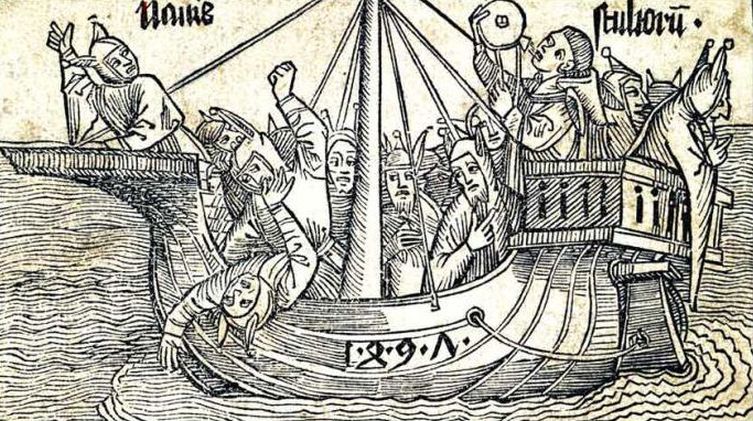
The state is often compared to a ship. One might speak of a particular prime minister standing at the helm, or of him or her relieving someone else on the bridge. In China, Mao was flattered with the title "the Great Helmsman."
Plato was the first to liken the state to a ship. In the dialogue "The Republic", he wrote: "The crew are quarreling among themselves as to who should take command. Each one believes he has the right to steer the ship, even though he has never learned the art of navigation and cannot say, who taught him, or when he learned it. Furthermore, he claims that the art cannot be taught, and they are ready to cut anyone to pieces who suggests otherwise."
Illustration in "Ship of Fools" by Sebastian Brant, illustrated by Albrecht Dürer, from 1494. Foto Literary Kicks.
We must face the fact that a nation with modern mass democracy is like an unstable ship—incapable of righting itself after heeling over..
A crazy idea, that finds only a modest resonance, can cause a ship to heel. Take, for instance, the notion of the "evil" CO2, the concept of 72 genders, or the mass immigration of complete strangers, framed as objects of pity. Such ideas may be seized by sons in their rebellion against their fathers, used by women to challenge or play with men's emotions, or exploited by rival politicians seeking to win votes by riding the wave. It is rarely the case that the ship of society rights itself through the triumph of reason and objective debate. Instead, everything is swept overboard by a surge of intense emotion, causing the vessel to heel even further, drifting helplessly and aimlessly, at the mercy of random winds.
Faced with such chaos, a society must either collapse or alter its organization, and this was presumably what Plato meant by his thesis that a democracy would inevitably have to be replaced by a tyranny.
Rivalry among men, women's desire to challenge and manipulate men's emotions, and the rebellion of young men against their fathers have always existed. These are not only negative impulses. They have driven society's technical and commercial development to new heights, served as inspiration for art and literature, and made life exciting, interesting, and romantic.
In modern times, however, these natural emotions are manipulated and exploited by dark forces working to dissolve nations, families, and all other close-knit organizations and relationships. Their goal is for there to be nothing but millions of detached and lonely individuals within vast state structures, such as the European Union, where ethnically based nations are reduced to mere administrative units.