The Art of Passing a Personality Test
11. Political Correctness Originates from the Unconscious Mind
1. Nature and Civilisation
It is the feminist claim that women and men are alike or almost alike - physically and mentally - but nevertheless, men discriminate and oppress women and exploit them as sex objects, birth machines and stroller pushers. Which is possible because society is dominated by men and women are oppressed and without real power.
But Schwarz argues - along with Freud - that it is women, who have the greatest power. These are the ones it is all about. It is basically the rivalry over women's love that motivates men to work and achievement, and the very existence of women has thus been the crucial and most fundamental precondition for the creation of Western civilization including all its technology and administrative systems.

Capricorn males fight over the favor of females. From youtube Godavari Sarcasm.
In the animal world, males rival fiercely for the favor of females and they fight among themselves so that the blood flows. Among many higher-ranking social animals, such as red deer and great apes, the dominant male does not tolerate any other adult males in the herd. When male pups are old enough, they are relentlessly chased away.
Among human males, however, rivalry is muted, which has made possible cooperation between men and thus the development of actual societies, civilization and culture. But men still rival intensely over women's love, which is the meaning of life for normal men.
Some would argue that men also rival about rank and status. But in reality it is almost the same, for high status and fame will give access to women's love.
It is natural for men - and for women - to bully a colleague who is too successful if the opportunity arises. It is natural for dominant men, when they see a young man more beautiful than themselves, to brand him as a gay man, bully him or chase him away. But if men had only followed their nature, their biology, the Western world would never have reached as far as it has.

The dominant baboon male chases away a younger male. Photo Peter M. Kappeler - Male Reproductive Strategies.
Nature is one thing and civilization something else. Civilization works by supporting and reinforcing some natural inclinations and inhibiting others. In Western civilization, boys are - or were - encouraged to compete with each other, but in a fair way - as in sports. Western values impose on us that we must be gentlemen and give others a chance.
Mature Danish men very often react markedly emotionally to US President Trump, and afterwards they search for arguments. It's because not only is he a man, but he is also a masculine type, simply a rival. An androgynous type like Obama did not trigger those kinds of reactions.
Female politicians attract many votes, and it is not only because they appeal to female voters. Many men feel an unconscious reluctance to vote for a man in his prime - because he is a rival. A female candidate, on the other hand, may be more acceptable because he feels that she is outside the rivalry.
2. The Holy War Against Men
If the West has ever been dominated by men, it is certainly not any more. What were previously men's disciplines have now been taken over by gender integration. In many areas, male dominance has been almost completely replaced by female dominance. Doctors, dentists and lawyers were former men, but are now about being replaced by women.
In 2020, 71% of those admitted to the subject medicine at the University of Copenhagen were women. In the subject of odontology, the admitted women accounted for 75%. In the prestigious law study, 67% of the admitted were women..
All the classical psychologists - Freud and Jung, etc. - were men, but the subject is now becoming a female subject with 78% admitted women. We imagine polar researchers as men like Knud Rasmussen, Peter Freuchen and Lauge Kock, but in the subject "Greenlandic and Arctic studies" 70% of the admitted students are women. Only in distinct technical and mathematical subjects do men hold the fort fairly good - but only fairly.
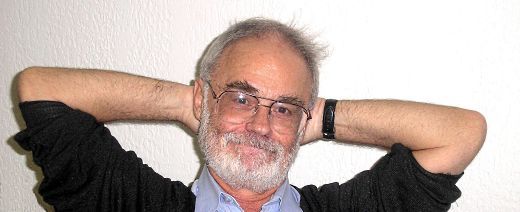
Howard S. Schwartz, professor i Organizational Behavior - Department of Management and Marketing - School of Business Administration - Oakland University i US. Most of the considerations below in this article are based on his works. Schwartz has researched the destructive influence of political correctness on organizations and published numerous books and articles on the subject. The books are "Narcissistic Process and Corporate Decay: The Theory of the Organization Ideal", "The Revolt of the Primitive: An Enquiry into the Roots of Political correctness", "Society against Itself: Political Correctness and Organizational Self-Destruction".
Higher education leads to powerful positions in society and here women are steadily and persistently displacing men. Overall, 62% of those recently admitted to the University of Copenhagen were women. With Marlene Dietrich we can ask: "Sag mir wo die Männer sind"?
3. Boys Crisis
There is a boys crisis. Half of the young men who apply for military service are not considered suitable due to health problems - including mental health problems.
Boys do poorly in the education system. 82.4 percent of women obtain a vocational education against 74 percent of men. It is not entirely clear what the young men are doing instead of taking educations. But it is apparently not something that can drown out the media's constant cheers that now the women have once again conquered new areas from the men. New projects are still being launched to motivate young women to win over the boys and take an interest in the typical male subjects, economics, engineering and mathematics. But the crisis that clearly exists among boys does not force the great interest.

Cozy situation between teacher and students. Foto Divulgacao
Boys, in all likelihood, have a hard time coping with the unstructured, cozy, babbling female style that prevails in the feminist-dominated classrooms.
The American author Christina Hoff Sommers writes in her book "The War Against Boys": "We turn against boys and forget a simple truth: that the energy, competitiveness and physical daring of normal, decent men is responsible for much of what is right in the world."
Sommers writes that the modern classroom fails boys by being unstructured, indulgent and hostile to the competitive spirit that otherwise gives boys incentives to learn and excel. The way forward is therefore: 1) More teacher-led teaching, 2) structure, 3) high expectations, 4) checking that homework has been done, 5) immediate sanctions if the work is not done, 6) greater emphasis on "silent "work, 7) frequent examinations and 8) gender segregated education.
Schwarz reports that some schools have already successfully tested gender-segregated teaching - only for boys: "the most vital ingredient in the success of the solution was finding the right teacher for this group," he explains. "So I chose Rob Jeckells - a young teacher involved in sports and one that the boys easily relate to a lot. We very deliberately planned the teaching method. The class is didactic and teacher-fronted. It involves sharp questions and answers and constant checking of understanding. The discipline is clear - if the homework is not presented, it is done afterwards in detention. There is no discussion." That way, the boys were able to learn even classical romantic poetry.

School-tired boy. Photo College Stats Org.
Schwarz believes that an important reason for the boys' crisis is shame over their masculine identity. A half-century of intense feminist campaigns against men - eagerly supported by the mainstream media - has not gone over the boys' heads.
The Me-too stories are part of a feminist agenda that clearly aims to blacken men's sexuality and turn it into a shameful and disgusting propensity. It is inevitable that when a boy stands in the bath, he may look down and thereby spot the peg that is characteristic of his gender, and thereby become aware that he will grow up and become one of the evil horny men who constantly insult the sweet and loving women.
4. Freud
To find the psychological roots of the progressive cultural dissolution of the Western world and the demonization of especially white men, which today unfold before our eyes, it is useful to use some concepts from Freud.
Narcissism means that the individual narcissist feels that he is the center of the world and everyone else is largely there to serve and service him or to stage his life. He is not aware that everyone else has their own ego and their own motivations independent of him.

Mother and child.
Freud calls the unity of the mother and the baby for the primary narcissism . From the beginning, the newborn child is emotionally part of the mother, which it also was biologically. The mother is omnipotent in fulfilling the wishes of the child. It only needs to scream, then comes a big nice breast full of the sweetest milk. It can be said that at this stage the child experiences itself as the center of a warm and loving world, which is structured solely to meet its needs.
But, alas, the time in paradise does not last forever. There is a real world "out there" which is not the mother of the child and which is quite indifferent to a random child. At this realization, it feels vulnerable and defenseless. This feeling of helplessness will make it feel even more dependent on the mother's help against the relentless reality. To alleviate his anxiety, the slightly older child therefore builds up an idealized notion of an almighty mother, "maternal imago", which expression comes from Jung, but Freud has also used it a few times.
Freud has the concept of "ego ideal", which describes an ideal state that a person's ego subconsciously dreams of achieving.
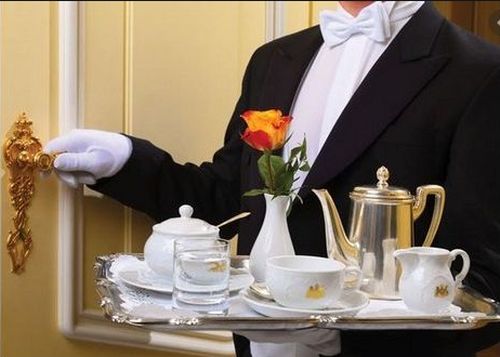
Service in five star hotel. Photo Indiamart
Throughout life, men feel an unconscious longing for a return to the paradisiacal state of primary narcissism. Their "ego ideal" contains this very dream.
It is said that this "ego ideal" lies behind the desire to become rich, because if you get rich, you automatically become a main person and you can arrange with service and servants with yourself as the central person.
One might also think that the exquisite service that the individual guest or passenger receive in five-star hotels or in the airlines' business class appeals to precisely this "ego ideal".
A man may can feel lonely, rootless and aimless in the world. His unconscious dream, "ego ideal", motivates him to seek intimacy with a woman, who for him symbolizes "maternal image", the almighty original mother.
Men dream all their lives about women and sex because sex represents the ultimate union with the woman. Women dream of being loved and admired by high-status men envied by other women.
5. The Male Role
When the boy is around six years old, he will begin to perceive the father as a rival and have fantasies of destroying him to get the mother to himself. But after some time the boy comes to recognize that he has no chance against the adult male.
The boy believes that the father has something that the mother wants and this is the reason why the almighty mother allows this man in her presence. Therefore, he becomes unconsciously convinced that by growing up and by acquiring the father's values and rules as his own, he will be able to merge with one who resembles the mother and thus the "maternal imago". In this process, the part of a man's subconscious that Freud calls "super-ego" - and that is our unconscious moral guardian - is created, a very important part of personality. The super-ego contains the attitudes and feelings of duty that characterize the male role in Western culture.
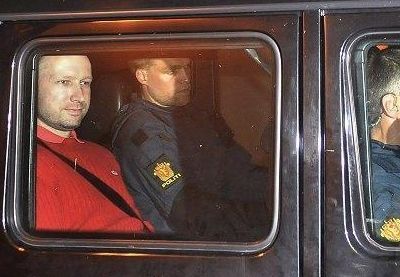
Anders Breivik is driven away in a police car. He smiles because he feels he has done his duty - the worst is over.
Anders Breivik grew up without his father, as so many boys do in these times. But still, he had built a super ego with strict, even downright cruel demands on himself, about what he should do for his country. It suggests that even if boys do not grow up with a father figure, they will still desperately search in their environment for values and rules that can fill this for a man so indispensable super-ego. They can find their values and rules of life in movies, in history, with football coaches or gymnastics teachers.
The role of man involves denying anxiety and keeping reality at a distance from the sphere of warmth and closeness created by the woman's idendification with the almighty mother. If he is to succeed, he must also not allow her to see his own pain and anxiety, and therefore he cannot bring it with him into the family. From this arises the "macho" image that traditional men seek to stand up to.
Emotionally, men need women more than women need men, and that is a source of power. The closer the man gets to the woman emotionally, the more defenseless he becomes in the face of her desires and whims, and the less he is able to defend himself against being completely overwhelmed and eventually abandoned. The closer he gets to her, the weaker he becomes, and the stronger she becomes.
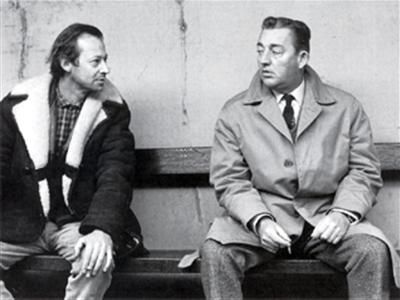
Buster Larsen on the bench in the role of Thomas in Leif Panduro's television play "Goodbye Thomas" from 1968. Thomas' wife wants to divorce because she no longer loves him, "Goodbye Thomas" she says. Thomas then perishes in loneliness and alcohol.
The ideal all-powerful mother, represented by the woman, thus keeps the keys to man's happiness in her palm. But it also gives her an eerie and frightening power. For she is only a woman, and women have their unpredictable moods and whims, she can give him the love he desires so intensely, or she can simply declare that she does not love him anymore, she does not even have to give any reason.
6. The Female Role
Also, the female role is created in the unconscious mind by the "ego ideal", that is a fantasy and longing, again to fusion with the omnipotent mother, the "maternal imago".
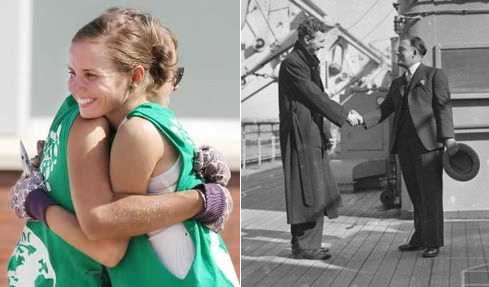
Left: Two women who greet each other with a hug.
Right: Two men greet each other by shaking hands.
Women can love each other, while men respect each other. In modern times, Danish men also have begun to hug, when they meet another man. I do not believe that it feels good for a man to feel another man's unshaven cheek. It's just something men do because they give in to feminist's standing requirement that men must also show emotions.
According to Freud the creation of the female role is conditioned by the fact that girls have no penis. The little girl sees initially also the father as a rival, but she soon realizes that the competition is already over, she has already been castrated. She feels envy toward those, who have this attribute, whose attractiveness Freud never doubted, and she hopes that the father will give her one (she wants to be accepted as a boy). But as time pass by the girl resigns and gives up the idea, and she holds a passive attitude to the father and men in general.
After some time, the girl realizes that she does not have to acquire all the moral rules of the father in a "super-ego" and to perform all sorts of duties, achievements and feats in order to earn a place in the almighty mother's warm and loving sphere - like the boys have to do. She can become a "maternal imago" simply by growing up and thereby creating the sphere of warmth and closeness that men so desperately desire. She can become a mother herself and have a child that she can completely control, possibly a boy with the desired organ.
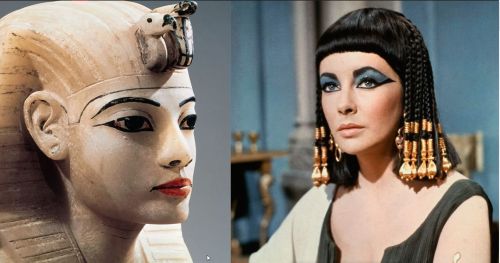
Despite feminists' efforts to make us believe the opposite, it is women's nature to dress up to seduce and manipulate men. It's part of a game that we all love and that makes life interesting. It has taken place, probably since the ice age, yes probably long before.
Ancient Egyptian culture is shrouded in mystery, but their beauty tricks are no secret. From the earliest Egyptian Dynasty, women used saturated blue eye shadow and thick, dark eyeliner. They used advanced necklaces. To the right Elizabeth Taylor in the role of Cleopatra and to the left Nefertiti, as one imagines she applied her make-up. Photo CNN Style.
Teenage girls are deeply fascinated by exploring the power that they have simply because they are women. Just by smiling, bare a bit of the breasts or legs, they can manipulate even adult men.
This is the game between woman and man as we love it. The woman behaves, discreetly and just as casually shows her pleasures, intelligence and charm, but it is the man who must show that he is a man and take the initiative for the decisive approximation and thus expose himself to being rejected.
However, modern feminist women are not always aware that this game is part of the specific Western Culture, where men respect women's responses. Other men - from other cultures - are used to taking what they want as they have the power and physique to do so.

|
A lone and rugged Marlboro cowboy and a cigarette smoking woman - If Freud had lived long enough to see all these self-sufficient cigarette-smoking women, he would have said that their cigarettes are a symbol of the part of the male body, that they want so intense in their unconscious mind.
Women rival and measure themselves against each other on their abilities to attract and manipulate men of high status. They dream all their lives of a life of wealth and status loved by a man who is either rich or famous or both. Poor artists and hard-boiled drug dealers can also have a status that makes women feel that they are something special with them and that they live an interesting and exciting life that other women envy them.
7. The Oedipal Psychology
Freud introduced the Oedipus complex, which is used in his psychoanalysis as a term for an unconscious, sexual love for the mother as well as a similar hatred for the father, arising in a very early childhood and usually quickly repressed into the subconscious.
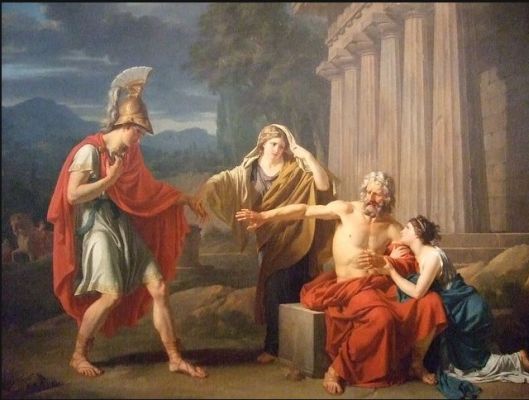
Oedipus at the colonnade - oilpainting by Jean-Antoine-Theodore Giroust.
Oedipus is a Greek tragedy of Sophocles: the oracle at Delhi told King Laius of Thebes that his son would kill him and marry his mother. Therefore the king left his newborn son on a mountainside, so that he might die there. The boy, however, was found by a shepherd, who brought him to the king and queen of Corinth, who were childless. Here he grew up, and as a young man he set out on a journey, where on the way he met an old man in a carriage with five servants. The man refused to go aside for him, and a quarrel ensued, which ended with Oedipus killing him and four of the servants. The old man was Oedipus' biological father, Laius, but he did not know. Oedipus came to Thebes, where the king had just mysteriously disappeared on a journey. Here he married the widowed queen Jocasta, and together they had four children. Many years later, Thebes was hit by a plague, and the oracle in Delhi said the disease would not go away until the mystery of the former king's death had been solved. King Oedipus began energetically to unravel the matter, and eventually found out that the missing king was the old man in the carriage, whom he once met on the road, whom he himself had killed, and who was also his biological father, and Jocasta, with whom he had four children was his biological mother. Thus the original prophecy became true. Jocasta committed suicide and Oedipus blinded himself.
The Oedipal Psychology - suggested by Schwarz - is part of the original Western civilization. It describes that the boy - or girl - who was originally biologically part of the mother, feels a close connection to her in the first years. The mother is omnipotent in fulfilling the wishes of the child. It only needs to crave food, then comes a big lovely breast full of the sweetest milk. It can be said that the child at this stage experiences itself as the center of a loving world, which is solely designed to meet its needs.
The child's experience of the father is characterized by remoteness, because he is basically absent - out in the world - where he works and serves to enable the children to grow up and mature under the mother's supervision, largely without worries.
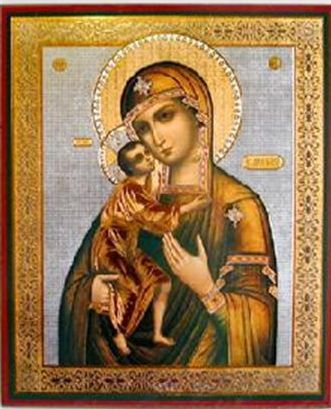
Virgin Mary, the Mother of God - The ancient Russian icon Feodorovskaya Virgin Mary was very important for the Romanov family. The icon can be traced back to the Apostle Lucas.
This is where Freud's Oedipus complex comes in. Schwartz's says that the son "wants to kill the father so that his intimate and exclusive bond with the mother can be re-established." Many do not remember from their childhood that they had any desire to kill their father, but they have no doubt wanted him to disappear, to stay away so they could have the mother for themselves.
But after some time, the boy comes to the realization that it is not so easy to get rid of the father. He comes to believe that the father has something that the mother like, and this is why the almighty mother allows this man in her presence. Therefore, the boy becomes unconsciously convinced that by growing up and becoming like the father, he will be able to achieve the intimacy of a woman who resembles the mother.
In traditional Western Civilization, this successful dissolution of the infantile Oedipus complex represents a socialization that creates competent adult members of society, who, through many compromises, are able to integrate with all the other egos that make up social reality.
But the father has - along with all the other fathers - triumphed into hell, as it is said. During the 1950s and 60s, Western men created the greatest material prosperity and security that ever existed on the surface of the Earth. Life has never been easier. The idea that there is an independent grim reality out there, outside the family, that sooner or later will have to be confronted, lost its probability.

Feminist liberation. Photo Youtube Howard S. Schwartz: Oedipal Psychology & Political Correctness.
This, the ease of life, has led to the original Oedipal Psychology being replaced by the Anti-Oedipal Psychology which is characterized by the family becoming a matriarchal base group, and the father redundant and run out on a siding.
It was originally the father's job - with his rules and admonitions - to gradually prepare the children for their adult lives out among thousands of other agents who do not necessarily love them. But the children are now allowed to live in their dreams closely connected to the mother and are no longer prepared for the real world outside the loving framework of the family.
Since the father's presence in the family no longer seems strictly necessary, he comes to appear as a stranger who takes something that rightfully belongs to the children, namely the mother's love. Schwarz writes: "The importance of the father's role has been lost and he has come to be seen, not as a model for their ambitions, but as an uninvited guest"
At the same time, modern feminist politicians distribute ample funds to single mothers, enabling them to get the father's money anyway.

Black Pigeon speaks' caricature of the new male type. From "The Rise of Modern Emasculated Man".
In some relationships, however, biological fathers are still tolerated as a kind of assisting mothers, who "help with the children," in which role, however, he will always be a second-rate agent, who cannot offer the same warm intimacy as the real mother.
Because of the absent or devalued father, the sons have trouble forming their super-ego, their personality. It is easy to see that it is a precise characteristic of modern young people that they feel that they lack personality. They try to compensate with T-shirt with messages, tattoos, steel on the face, smoking and absurd and provocative attitudes and so on.
It is not impossible that Western civilization will change character, so that the oepdipal psychology will be completely replaced by an anti-oepidipal psychology. Perhaps men will be reduced to a kind of drones - as at ants and bees - which only have the duty of fertilizing the almighty females at special romantic weekend events. Incidentally, they will have no access to the children, who will enjoy complete protection against their harmful influence. It would be a pure cultural change, there are no biological conditions that stand in the way of such a civilization. But one might think that it will have a hard time surviving in the struggle against other civilizations, such as the Muslim one, and the almighty females will eventually find themselves in a harem.
8. Masculinity and Work
As said, The boy notices that the mother allows such a man, the father, in her intimacy, and he can be with her without being cowed and engulfed by the almighty "maternal image". He therefore assumes that the father is doing something that the mother admires; and that this is why she allows him in her presence. Therefore, the boy believes that by growing up and becoming like him, he will be able to merge with someone who is similar to the mother.
Men feel they need to create or accomplish something that enable them to present themselves to the woman as worthy of being with her. But it has to be something that she wants, something that she strives for in her unconscious "ego ideal".
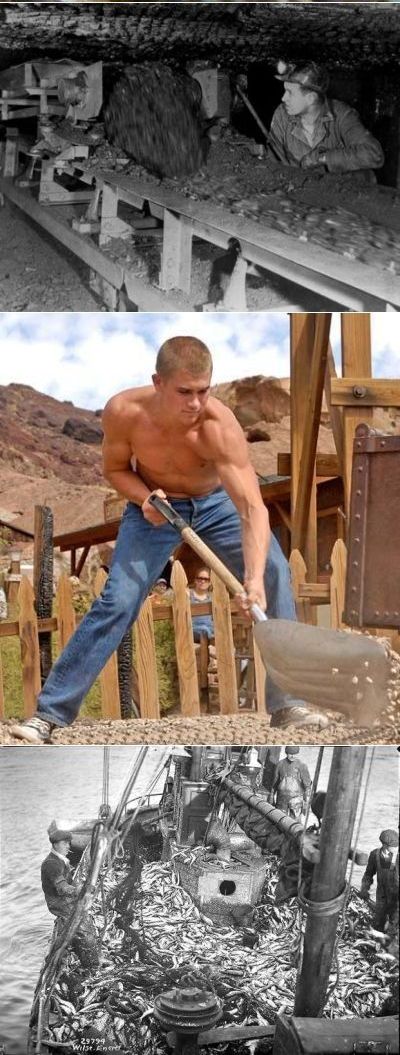
Men's achievements and work was more visible earlier. In times gone by, the necessity of man's achievements was visible. He came home to the cave with prey, wounded and exhausted, or he came home tired from the field after working all daylight hours to provide food for the family's survival.
It is easy to see how work, understood as economic activity, fits into this psychological schema. If the man performs work that creates wealth and thus status and also improved material circumstances for the woman and their children, then he can keep her love.
The traditional division of labor between the sexes rests on the woman's understanding that the role of men is hard, that men, who take on this responsibilty, sacrifice themselves, that it is full of anxiety, and that the only reason, why men do it, is love. This convinces her that the dependence of the man, that she feels, is part of a mutual dependence.
If the understanding of work as waivering and pain is lost, the whole notion of the role and activity of men will change dramatically, including the traditional division of labor between the two sexes.
If the father simply does what he wants because that is what he desire, if his activities are pleasure, then there obviously is something that women have been deprived of and excluded from. The traditional gender roles will then be associated with aggression, submission and oppression, as feminists like to portray them.
Western men yearn for accomplishments - fundamentally and unconsciously, to appear worthy of winning the love of women. As Mick Jagger from the Rolling Stones said: "Why do you think we work so hard to write songs, rehearse and travel the world and give concerts?"
But I think Western men crave more than other men, and this has been the main reason why the industrial revolution first broke through in Europe..
As I said above. the goal of a man's accomplishments, including work, is to make himself worthy of being loved and admired by women. But the realization of the strength of this need creates in him a great fear of being rejected and destroyed, he fears that the project of his life may not succeed, that he will not meet the expectations. You could call it a kind of exam nervousness. Realizing that success is ultimately important to him, and at the same time that women's favor is erratic and unpredictable, he is gripped by fear of failing.
Such a deep and fundamental fear cannot be consciously recognized, and therefore it shows up as an autonomous, unexplained, unquestioned drive to achieve something, to create something, to make a difference, a restlessness and a curiosity that only can be explained with reference to the unconscious mind, to where it has been displaced.
It is this compulsive character of men's work that is the reason why cultural creation has been largely a male activity. Women will most often feel that they are already a representation of "maternal imago" and resting in themselves, and therefore they have no need for such a restless quest for fame and glory.
Schwarz believes that men's restless longing and striving represent a characteristic feature of the psychodynamics of Western civilization that is not biologically conditioned. It is part of the "white men's culture" that has created our wealth, and which powerful forces are now in the process of discarding.
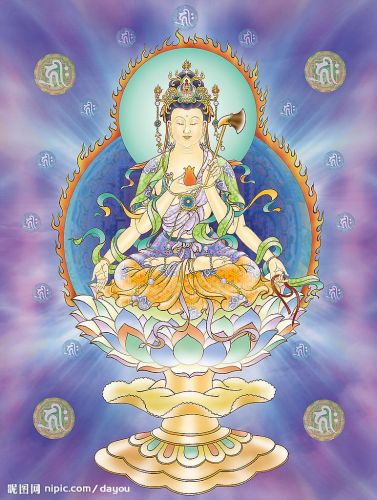
Guan Yin, the Buddhist Virgin Mary, seated on a lotus flower. Many men prefer to pray to Guan Yin instead of Buddha. At that time Buddhism came to China for more than a thousand years ago, Guan Yin was a more sexless intellectual identity, but over time she had assumed the guise of a woman because men need women.
A characteristic side of men's work is his dependence on rules and a degree of impersonality. Communication in connection with men's Work activity is guided by rules rather than by emotions. The reason for this is that men's feelings are elsewhere, they are with the women. They can not attach themselves to each other based solely on emotions, simply because they do not have so many feelings for each other.
Sure, one can easily lament this lack of feelings, but it is worthwhile to note that it is this insensitivity, which makes possible the logic and rationality that has been the reason that men's labor organizations throughout history have been so targeted and effective, as it has.
This is a point that feminists completely ignore, because they contrast rationality with feelings, and they identify feelings with warmth and love. But rationality must be contrasted, not with feelings, but with irrationality. And feelings must be seen to encompass not only warmth and love but also coldness, hatred, envy, jealousy, rage and resentment; that are after all also feelings. And that is when we allow the complex game of conflicting emotions to displace reason, that irrationality will come to dominate our decisions.

|
The container ship Edith Maersk and her sister ship Emma Maersk are the world's largest container ships, specialists estimate that they each can carry 15,200 TEU. The ship is 397 meters long and 56 meters wide. Built in Odense Steel Shipyard and delivered to the owner A. P. Moller in 2007. The construction of Edith Maersk is just one of countless feats accomplished by white men.
Achievement-oriented, controlling, compulsive, displaced, competitive, rule-bound, unemotional, logical, rational, hierarchical - these are the characteristics of work done on the basis of Western men's psychology.
Throughout history, such organizations made up by white men, with great creativity created the Western civilization, the industrial revolution and the whole of modern society and thus all the comforts, that feminists take for granted.
Consciously and unconsciously, men's achievements are directed towards women and their children, their whole endeavor is fundamentally motivated by love for them. It is difficult to see how men, as defined through this work, can be such oppressive monsters as feminists describe them..
9. The problem with the Real World
Freud and Professor Schwartz define "ego-ideal" as a fantasy of a wishful thinking that we all carry within us and which often contains the dream of merging with an idealized almighty mother, thus as the child was once part of the mother, a dream of returning to the original "primary narcissism", in which the whole world seems structured with the one purpose serving oneself.
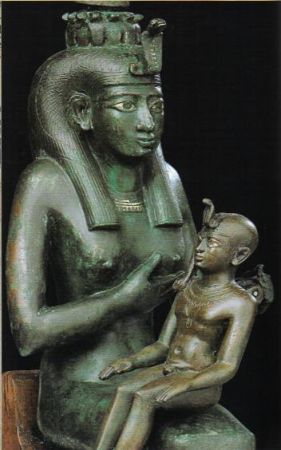
The Mother Goddess Isis with the Horus child. Bronze statue from the Egyptian Karnak period - 664-332 BC - can be found at the Egyptian Museum in Cairo.
The father first turns up to the child as the parent, who is not the mother. He is an uninvited guest, who disturbs the perfect narcissistic idyll between mother and child. For the child, he is a threat, a blocking and an unwelcome presence. It seems for the child that if it could just get rid of the father, it could achieve complete and perfect happiness. In this way, the father becomes the personification of pure evil.
The latter is the psychological core of feminist theory of oppressive men. The problem is simply that the objectionable aspects of this ghost do not come from the father as such, but from the fact that he represents the real objective world as it exists outside the narcissistic nexus of mother and child, a grim world that is not particularly interested in a random mother and her child. Thus, the rejection of the father and his rules and admonitions is basically a denial of reality itself.
Therefore, if the father is compromised, if his power over the mother can be portrayed as aggression, which only serves his own interest, if the liberation from the father can be perceived as the path to true happiness, then it will mean a denial of it real world, which will be replaced with beautiful dreams and imaginations.
Within the framework of the traditional family, the man and the woman's role represent different orientations to reality because of the two sexes' different relation to "ego-ideal" and its "maternal imago".
As I said, a man feels he must earn his right stay in "maternal imago's" warm intimacy. "Maternal imago" represents his longing for love. He has an unconscious, fundamental fear that his life's project can fail, and therefore he must constantly direct his attention to the real world, which is populated by other agents, who do not automatically love him and his loved ones.
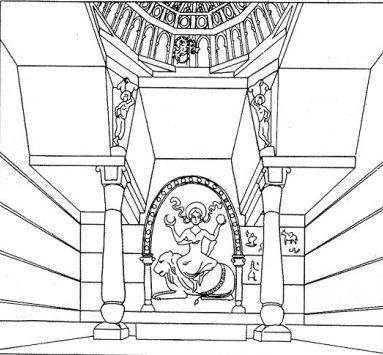
|
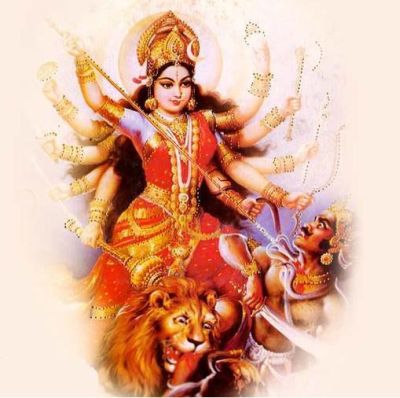
Left: The Hindu Goddess Mahishasuramardini riding on a lion - the almighty mother of all things - both god and mortal.
Right: The four-armed Sogdian goddess Nana with the sun in one hand and the moon in another - seated on a lion - surely also a mother goddess. Sketched after a mural found in an excavated house in Uzbekistan. In the Scandinavian mythology, Nana had a more withdrawn role as Balder's wife.
A woman, on the other hand, can become a representation of "maternal imago" simply by growing up. Also for her, "ego-ideal" represents longing for love. But she can herself create the warm sphere of "maternal imago" without having to perform achievements and feats. She rests in herself, and her orientation is against the mother-child relationship, and therefore she will increasingly perceive the cold indifferent real world as something abnormal and unfair.
This empathy, which characterizes the traditional female role, must be understood in relation to the logic of motherhood, and especially in the light of the immediacy and warmth that she brings to the child. Later, as Freud noted, this warmth and empathy will also intensify the relationship between man and woman, but only to the extent that the woman identifies the man with a child. In fact, we can see that what can be called the female style, which is kind, conciliatory, warm and caring, is in itself a consequence of the identification with the "maternal image".
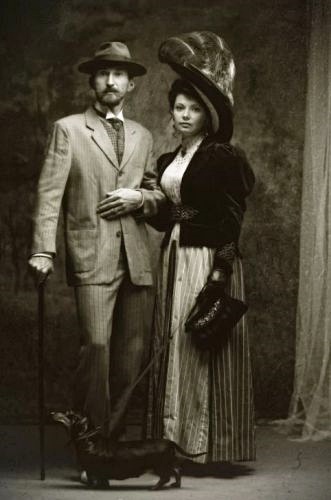
Man and woman from around 1900. Fotocex.ru.
In the original psychodynamics of Western civilization, the woman is still aware that she needs a man to confront the real world and keep it at a distance, so to speak, at arm's length, so that her own immersion in feelings can be maintained without leading to a catastrophe for herself and the children. Therefore, she will value the man's achievements and accomplishments, allow him to stay with her in the sphere of warmth and intimacy and offer to heal the wounds that his duties and work with the real world entails. In this way, it makes sense for a man to perform deeds, achievements and work that are dangerous, strenuous or painful.
But the triumph of feminism has disrupted this psychological "division of labor" in the family.
The modern production and distribution systems and the welfare system are ingeniously designed by men for the purpose of making life completely safe by taking into account all conceivable dangers that could threaten the lives of women and families. It is easy to see that modern society with welfare and abundance has created an idea that there is no cold and indifferent real world outside the family and the mother's love at all.
The liberated feminist woman will therefore no longer have any idea that she needs a man to protect her and her children from a grim reality. She can imagine that she can make life perfect alone through her love and kindness, just by being herself. Her belief that the man has a function may disappear.

Loving mother with children. Photo Youtube.
Thus the feminist monster very well can have been aroused by the men themselves, because they have been so successful in their efforts to make life so safe and predictable for their loved ones creating the modern technology and the nationwide welfare-systems.
If the rejection of the real world happens - and our imagined world instead will be dominated by beautiful dreams - then the man's work, achievements and feats will be reduced to some meaningless selfish activities - a kind of self-realization similar to mountaineering - and the woman can feel that his presence in her sphere is an unwanted intrusion that he insists on only for his own sake. If the father simply does what he likes because he wants to - if his work and other activities are pleasure, then the traditional gender roles will be associated with aggression and oppression, as the feminists depict them.
10. The Housewifes of the Suburbs
We remember that the traditional sexual division of labor in marriage gave the man a duty to engage the external reality, thereby giving the woman the opportunity to care for the home and give her love to the children, while they were growing up in a protected environment.
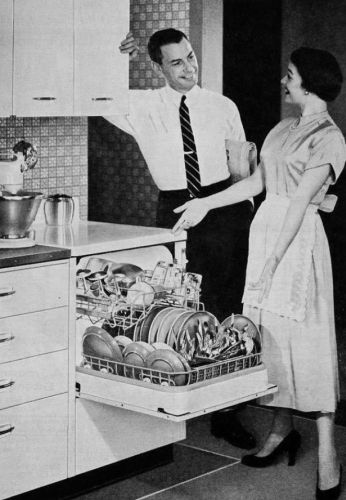
Dishwasher around 1950-60. Photo Pinterest.
The historic housewife was a key figure in the family, without whom it could not function. Only hundred years before our time, she had to get up early - before the rest of the family - and light the stove in the kitchen and the oven in the living room. Her efforts were crucial to the family's wellbeing and health, making clothes and cooking from raw materials. Some families were lucky to have skilled housewives, while others had to settle with less skilled ones. Being a housewife represented a great responsibility for the family, which could give both recognition and status.
However, in the fifties, the material conditions for housewives were already very significantly improved compared to earlier times. The mothers could benefit from running water and electricity, vacuum cleaners, mixers, electric stoves, refrigerators, central heating, electric irons, washing machines - some even had dishwashers. They could take the car to a supermarket or other stores where they could buy ready-made clothes, ready-baked bread, food in cans ready to heat up and much more. It was no longer necessary to be a skilled housewife, you just had to be a housewife, and the necessary qualifications were roughly limited to setting a thermostat and turning on and off the electricity contacts.
The new housewife role offered very little opportunity to excel and enforce the environment's respect for skills, ingenuity and energy. It was, in fact, an intolerable existence that could make anyone deeply depressed.
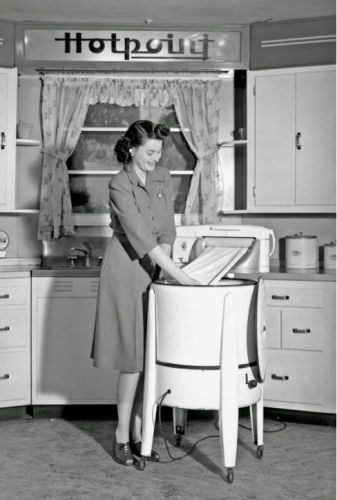
American washing machine 1949. Photo Pinterest.
Real challenges are such in which it is possible to fail. When you stand with sweat on your forehead and think "What now?" you feel that you exist in close contact with the emotionally cold reality, and when and if you are lucky enough to solve the problem, you gain self-confidence and increased respect from the outside world. It is called personal development.
The housewives in the suburbs were angry, and - somewhat unfairly - they blamed the husbands for their unsatisfactory lives. They did not admire their men, who thus kept them in golden cages, they felt.
But, as we remember, the son's psychological development is based on the fact that he sees that the almighty mother allows the father in her vicinity, that he believes that the father has something or can do something that the mother admires and wants, and therefore he wants to grow up and become like the father so that he can merge with someone who is similar to the mother.
But the mothers in the suburbs did not admire their husbands, whom they somewhat unjustly blamed their situation, as women do. This disturbed the mental development of the sons, because why should they want to be like the father, when he did not have something that the mother wanted and admired?
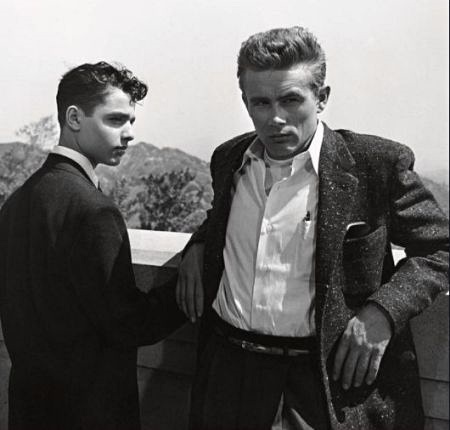
James Dean in Rebel without a Course with his characteristic white T-shirt with round neckline under the shirt as a kind underwear. The film came to Denmark in the early 1960's. Photo Youtube.
Here the mother stepped in, she expected and demanded of the son that he should support her in the struggle against the father, and he should admire her perception of herself as a person with many talents and a strong personality, but who, however, was prevented from unfolding these by the father. The son, who was now emotionally cut off from the father, could not help but follow her, because it was now his only identity in this World that he was the son of this woman.
The sons of the frustrated suburban women then became the angry young men, who were so brilliantly portrayed in the movie "Rebel without a Course" starring James Dean. Its English title is very descriptive. It was as if their personality - their superego, Freud would say - had not been completed, that something was missing. They were angry, but did not really know what they were angry about.
11. The Alienated Students
Schwarz believes that he can trace the first tendencies towards the "critical" modern philosophical direction, called post-modernism, in the attitudes - or lack thereof - of a group of students at Harvard University, which the psychologist Keniston studied around 1960.

Kenneth Keniston American social psychologist 1930-2020. Photo Hail Science.
Post-modernism is a broad term that encompasses both feminism and the rest of political correctness. Postmodernist philosophy is primarily aimed at modernism, which is the rationality of the Enlightenment. It is "critical" of ideas of objective reality and objective morality. They deny the existence of objective universal truths, human nature and objective reason.
In 1960, Keniston found a group of students at Harvard University, who were different from the others. He called them "alienated" because they rejected roles and values that were typical of adult American men. The young men underwent a TAT test based on which Keniston concluded that they all had a history of dominant mothers and rejected fathers.
Schwarz has selected passages from Keniston's report on the students' attitudes, which he associates with postmodernist themes, thereby making it probable that political correctness stems from the suburban housewifes's rejection of the father in the 1950-60's.
Sections with italic are Schwarz's excerpts from Keniston's report. Attached in bold are the corresponding post-modernist themes, also selected by Schwarz:
"The universe is basically empty and meaningless" (p 61)
Denial of objective reality
"In such a pessimistic, anxiety-provoking and dead universe, truth necessarily becomes subjective and even solipsistic. The alinated are true to the logic of their position and almost to a man accept the suvjectivity and even arbitrariness of their own points of view." (p 62)
Subjectivism, relativism.
"Whatever sense of meaning a man may have must inevitably be his own creation." (p 62)
Social constructionism.
"Above all, they have contempt for those who "blind themselves" to the "realities" of existence of "pious optimism." Shallow consolations and the easy acceptance of the traditional verities of our society. Part of the difficulty of communication come from the unreliability of appearances. Not only do the alinated agree with a statement like "Beneath the smiling face of man lies a bottomless pit of evil," but they affirm that all apperances are suspect, whether of men or institutions. thus nothing can be accepted at face value, every apperance conseals opposite potentials beneath it." (p 67)
Deconstruction
"The ethical corollary of anger, scorn and contempt is self-interest, and in the alienated we find a special form of egocentricity (p 66) which involves the need to use others for one's purpose - and the converse conviction that the same principle governs the actions of one's fellows, even these are disguised under some other other principles. (p 67)
Reduction of social process to self-interest politics
"All place primary emphasis on experience and feeling, on the search for awareness and the cultivation of sentience and perceptiness - and they further emphasize the importance of expression of this experience.
Almost to a man they emphasize what I will call goals and values - those goals and values whose primary source is the self and whose chief aim is the development of sentience, awareness and feeling." (p 71)
Authenticity
"In such an outlook, reason must play a secondary role to feeling (p 71)
Resistance to reason and logo"centrism"
"In the struggle for emotion, passion and feeling the enemies are two: first excessive rationality and self-control, and second, social pressures which limits independence" (p 72)
Resistance to external and internalized social control.
"The individualism of the alienated is - a solitary and lonely individualism of the outsider, the man who lives physically within his society but remains psychologically divorced from it." (p 73)
Marginality
"The enemy is the entire status quo - not merely pernicious aspects of the social order which must be changed to permit improvement, but the entire social and cultural ethos" (p 78)
Generalized rage against society
"The result of diffussion and fragmentation of the sense of identity, an experience of themselves as amorphous, indistinct amd disorganized - insofar as they have any clear sense of self it is almost entirely defined by what they are against, what they despise, by groups they do not want to belong to and values they consider tawdry" (p 186)
Fragmentation of identity, negative self-definition
"Fear and dislike of competition - leading to an almost complete repudiation of the compeditive business ethic of American society, to a dislike of and an avoidance of social situations with a competitive quality, and to the continuing view that competition and rivalry, though ubiquitous, are destructive to all concerned." (p 176)
Abhorrence of agressiveness, competition.
"A central legacy of childhood for most of the alinated young men was the deep conviction that adult men - as epitomized by their own father - were not to be emulated, and the further belief that adulthood in general was disasttrous insofar as it meant becoming like their fathers. (p 178)
Repudiation of the father.
In their fantasies - we find an exaggerated dream of the blissfulnes of early mother-son relationships, of the capacity of truly maternal women to provide totally for men, of the complete absence of distinctions between self and object. (p 189)
Appeal of fusion, apothesis of the maternal, rejection of distinction between subject and object.
"For many alinated student, the refusal of adulthood extends to rejection of adult sexuality - these youths find what our society defines as a "normal" sexual relationship between man and woman frightening and difficult. Some of these diffuculties are common to late to late adolescents - but they are heightened by their fundamental aversion for "initiative", for "activity" - all qualities culturally defined as part of the male sex role. (p 199)
Difficulty in developing male heterosexual orientation.
"An especially crucical aspect of the failure of acculturation among the alinated is - their systematic undermining of repression and denial, two of the most common adaptive techniques in our society (and probably in all societies). (p 197)
Facination with the "dark side" of life and society.
Keniston says that in his TAT analysis of the alienated students, he repeatedly encountered a characteristic theme. It was a remarkable family constellation, in which the father was seen as weak and emotionally distant, and the mother was seen as energetic, powerful and full of vitality.
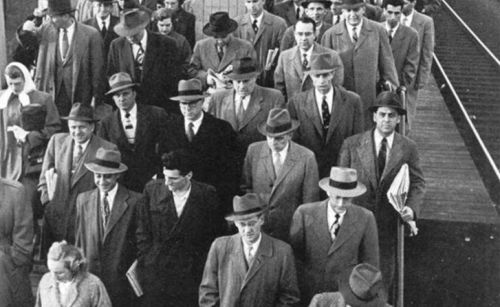
Men in gray suits on their way to work in the US in the sixties. Photo Foundation for Economic Education.
In the typical family history, the parents came from traditional families, characterized by strong fathers, whom they idealized. But as products of their time, they sought to find new ways in the sense that they sought to create new gender roles that would enable them to realize themselves more fully. They began their marriage with these lofty ideals, including the belief in the possibility of new roles for women. But they did not succeed. The father gave up his early ideas and devoted himself to a career that enabled him to make as much money as possible. He became, in a word, "corporation man." The mother gave up hope of a career that allowed her to exploit her talents, and became a housewife.
As time passed by, the father became more and more involved in his career, which removed him more and more - physically and mentally - from the family. The mother thought less and less of him. He did not support her sufficiently in her hopes of realizing herself, she thought. He was not much of a real man either. He was certainly not the man her father was, for sure. She took the son as an emotional replacement for her husband, drew him very close to her, shared her disappointment with her marriage and husband with him, and gave him the responsibility to fulfill the hopes, which she still had in her life.
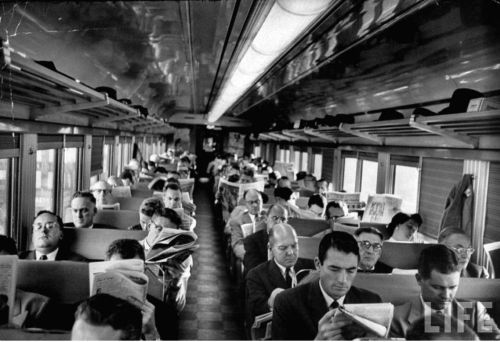
The father and other men in gray suits on their way from the suburbs to their work in the United States in the sixties. Photo Life.
It was thus completely underlined for the son that the father certainly had nothing that the mother admired and wanted. She neither respected nor admired him. Therefore, the son realized that there was not much point in growing up and becoming like him. But for biological reasons he also could not grow and become like his mother, and therefore he was trapped in no man's land and the development of his super ego - which is his personality - therefore stalled, and he became one of Keniston's alienated students.
12. Corporation Man
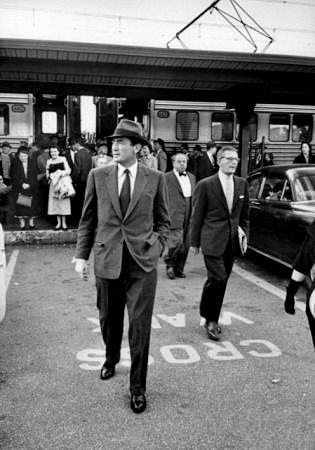
Gregory Peck in the role of The Man in the Gray Flannel Suit. Photo A Continuous Lean.
One of the suburban housewifes' accusations against their husbands - which is repeated by the sons - was that they had sold their souls, as anonymous employees of the new large corporations their attitudes were for sale for the highest bidder. The men's dilemma is described in Sloan Wilson's 1955 novel "The Man in the Gray Flannel Suit", which quickly came as a film.
The main character, Tom Rath, wants to make more money to support his family and he gets a job in one of the new television channels. He is given the task of writing a speech for the top manager, Hopkins. Tom Rath is invited to Hopkins' private home to discuss the speech. He is received with the most exquisite courtesy of Hopkins himself, who offers him a drink. Schwarz quotes how Hopkins expresses his admiration for Tom's manuscript:
"Wonderfull!" Hopkins suddenly boomed.
Tom turned around.
"Marvelous," Hopkins said, even louder. His whole face was beaming with satisfaction. "You really got the feel for it!"
"I am glad you like it," Tom said modestly.
"This really sings" Hopkins said enthusiastically. "It is remarkable that you can do so well the first time around!"
"It is the second draft, actually," Tom said. "Mr. Ogden gave me some suggestions"
"The heart of this thing is just right!" Hopkins said. "Now let us just go over it together. Did you bring a copy?"
Sentence by sentence Hopkins took the whole speach apart. When he finished he had asked for shanges in almost every paragraph. "Well" he concluded, "You certainly did a grand job! Just fix up the details we have worked out and let us see it again in a few days. Would Wednesday be too early?"
Tom gulped his drink and excused himself - He was halfway to Grand Central Station befor he fully realized that Ogden and Hopkins had simply told him the same thing in two different ways: to rewrite the speech. In spite of this, Hopkins had somehow left him eager to try. Well, he thought admiringly, I allways heard he could drive men and made them like it.
Tom Rath continued thinking: The thing to remember is this, he thought: Hopkins want me to be honest. But when you come right down to it, why does he hire me? To help him to do what he wants to do - obviously that is why any man hires another. And if he finds that I disagree with everything he wants to do, what good am I to him? I should quit if I do not like what he does, but I want to eat, and so, like a half million other guys in gray flannel suits, I will allways pretend to agree, until I get big enough to be honest without being hurt. This is not being crooked, it is just bing smart.

The Man in the Gray Flannels Suit. Photo Promotional Film Poster Wikipedia.
These quotes from Sloan Wilson's novel illustrate that the suburban wives and their sons were right. Their husbands and fathers, who worked in the new big companies, had to sell themselves to some degree. They could not just do things their own way because the new corporations were very different from their fathers farms and small shops. They really had to adapt. Probably the men had improvidently shared their experience of adversity at work with their wives, but instead of solidarity, they were given contempt that the wives passed on to the sons.
Some believe that there really is something feminine about the new large corporations. Schwarz quotes General Electric's training program: "If the task of the manager is not so much work as the managing of other people's work, it follows that getting along with people is far and away the most important skill of all." And to please and adapt is part of the female style.
It requires a high degree of adaptation and mutual acceptance to develop and produce complex machines and plants, such as electricity supply, televisions, vacuum cleaners, mixers, electric stoves, refrigerators, central heating, electric irons and washing machines. A scramble of alpha males would never have been able to accomplish this.
The many "corporation men" from the suburbs were simply real men, who were determined to make some money to support their families, "whatever it takes", as the saying goes. And what is really wrong with that? They did their utmost for the family and could not be made sole responsible for that their wives had difficulty finding meaning in life.
13. The Daughters
The sons of the liberated suburban wives were weak because they could not develop strong personality through identification with a valued father. The son's identification with his powerful mother had to become partial and incomplete for obvious reasons.
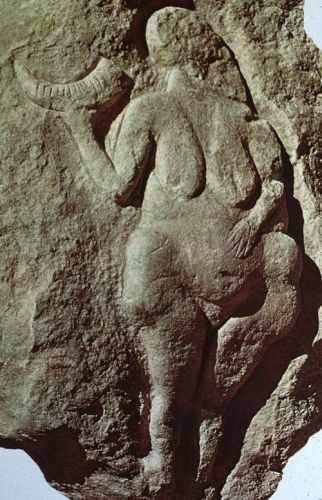
Venus from Laussel is found under a rock overhang at Laussel in the Dordogne not far from Lascaux in France. The place is today believed to have been a place of worship for a mother goddess. It dates from the ice age and it cannot be determined whether it was created by Cro Magnon or Neanderthal humans.
But no such restrictions applied to the daughter. She did not have to admire her father to gain strength. She could identify directly with the amazing power of the original mother. She easily adopted the mothers' degradation of the father.
The mother drew her close to her as her close friend in the condemnation of her husband.
The father represented everything that was bad. His achievements were bad and his failures were even more bad, his presence was bad and his absence was intolerable. What he did was bad and whar he did not do just proved his failure.
The daughters have in this dysfunctional menagerie become the hard core of political correctness and postmodernism.
14. The deep Current Against White Men

Black Lives Matter unrest in US. Photo prruk.org
A retired officer from the merchant fleet once told me that many years ago, when his ship were at Saigon for an extended period of time, he was chatting with a young female student about this and that.
She introduced the topic, what type of man Vietnamese women deep in their mind would prefer if they had the choice, a Vietnamese man or a man of European type? Of course, there are bad types everywhere, some are alcoholics, some are well educated, others are not, and so on - but everything else being equal? She had no doubt that a Vietnamese woman would typically prefer a European type. They gave a better sense of security, she thought.
Winning women's love is the deepest motivation for everything men do, including work, discoveries and achievements. Not only for Western men, but all men - but often unconsciously. It probably fills far, far more in men's thoughts, mind and especially feelings than - for example - resentment and indignation at the slavery of the past, the brutality of white police officers against other men or the supposed exploitation of developing countries by the industrialized countries.

Statue of Christopher Columbus toppled from its plinth in the Minnesota State Capitol. It is quite certain that the perpetrators did not carry out this destruction because they have followed the history lessons in school particularly well. It is an expression of hatred against the white men and the whole of Western civilization. Photo Darran Thompson Native News Online.org
The officer had since chatted with many friends and colleagues from all over the world about this topic and the general impression was that almost everywhere in the world, women would prefer a white man - all other things being equal - if they had the choice.
The Vietnamese, South American, Asian and African men - and all other ethnic men - know it, and - most likely unconsciously - deep in their hearts they typically nurture a deep aversion to white men and everything they stand for, inclusive all of Western civilization and history. They will never forgive us, no matter how many apologies, freedoms and rights they are bestowed.
The ongoing massacres against christians all over the world are not only motivated by the words of the Koran but also by that Christianity is perceived as part of the detested white men's culture.
It is likely that the real driving force in the global campaign against white men, as we see unfolding today, is the desperate unconscious feeling of other ethnic men of being forever handicapped in their endeavors to win the love of attractive women - even though they have been promised that everyone should be equal.
15. Link and Literature
20201025
